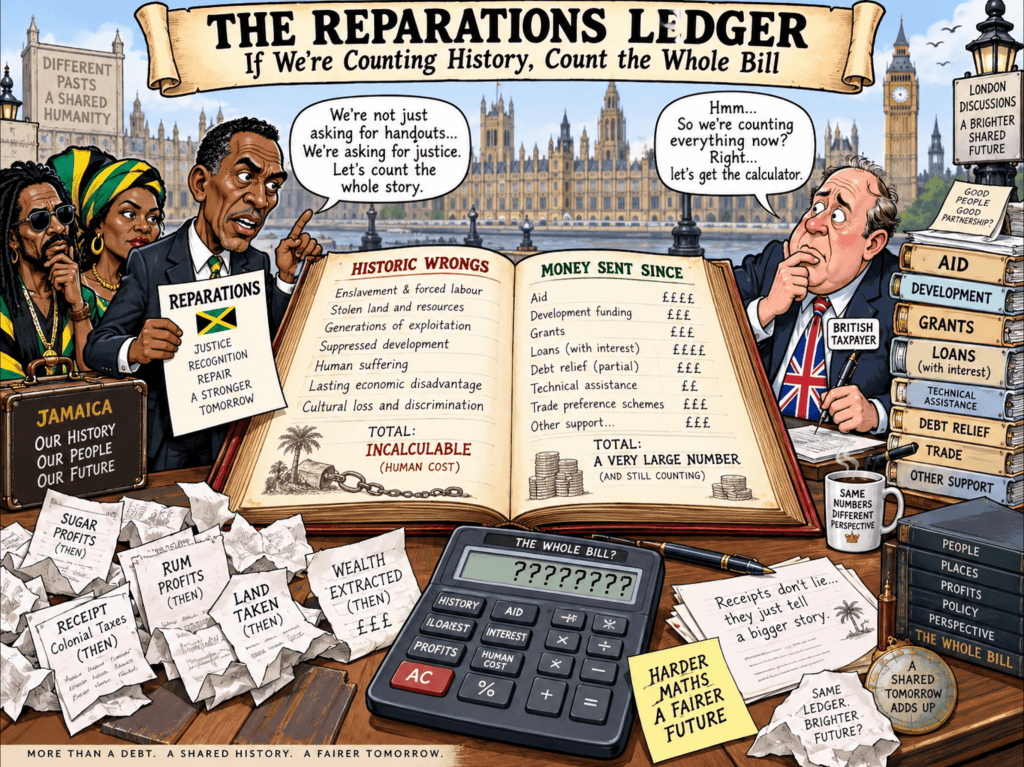
📚💷Jamaica has renewed its campaign for slavery reparations, once again placing Britain’s historic responsibility for slavery and colonial exploitation firmly in the spotlight. There is no sensible case for pretending slavery was anything other than brutal, dehumanising and profoundly damaging. Britain was deeply involved in the slave trade and plantation economy, and Jamaica lived for generations under a colonial system that overwhelmingly served imperial interests.
But if the discussion is going to become a financial reckoning between nations across centuries, then the history after slavery and after independence also deserves to be included. The modern relationship between Britain and Jamaica did not consist of Britain simply packing up, sailing home and never contributing another penny. British public money continued to support Jamaica through development programmes, technical assistance, grants, debt relief, disaster support and investment in economic and social development.
🧾 The Ledger Did Not Close When Empire Ended
One of the most easily forgotten parts of this debate is infrastructure. Britain was involved in financing and developing infrastructure in Jamaica during the colonial period, including transport, public works and wider economic development. That investment should not be romanticised as an act of pure generosity, because colonial infrastructure often served imperial trade, administration and commercial interests as well as local needs. Even official British historical research acknowledges both sides of that story: Britain invested substantially in Caribbean infrastructure and technology while colonial societies remained deeply unequal and many people continued to live in poverty. (GOV.UK)
That distinction matters because history is more complicated than either side sometimes wishes to admit. Britain benefited from colonial Jamaica, but Britain also spent public resources maintaining and developing the island. Roads, transport links, public works, agricultural development and other forms of infrastructure did not materialise from thin air. Some served British interests, some served Jamaica’s economic development, and often the two purposes overlapped.
After independence, that financial relationship did not disappear. British taxpayers continued supporting Jamaica through development assistance and regional programmes. Modern British-backed infrastructure funding has supported climate resilience, agriculture, water, transport and other projects across the Caribbean, with Jamaica among the beneficiary countries. The United Kingdom Caribbean Infrastructure Fund, for example, has provided grant funding for climate-resilient economic infrastructure, including projects in Jamaica, and remains active through the end of 2026. (Caribbean Development Bank)
That means Britain has contributed to infrastructure in Jamaica both historically and in the modern era. The circumstances and motives have changed enormously, and it would be misleading to pretend colonial expenditure and modern development aid are morally identical, but it would be equally misleading to pretend that Britain simply extracted wealth for centuries and then vanished without putting resources back into the country.
Modern British support has also extended beyond bricks, roads and concrete. Britain has helped fund technical expertise, disaster resilience, financial protection against hurricanes and programmes intended to strengthen critical infrastructure against climate change. The UK’s current Small Island Developing States strategy specifically refers to infrastructure support involving bridges, renewable energy, ports, water systems and sea defences across the Caribbean, while also highlighting work with Jamaica on protecting critical infrastructure from climate risks. (GOV.UK)
This matters because reparations arguments often reduce the relationship to a single historical transaction in which Britain took and Jamaica lost. The reality is considerably more complicated. Britain unquestionably benefited from slavery and colonialism, but subsequent generations of British taxpayers have also financed assistance, reconstruction, infrastructure and development in Jamaica and throughout the Caribbean.
Those taxpayers were not plantation owners. They were nurses, builders, shopkeepers, factory workers, pensioners and millions of ordinary people whose taxes helped finance international development long after slavery had disappeared and Jamaica had become an independent state.
That does not mean development aid somehow cancels slavery. It does not. Nor should a road, bridge or agricultural programme be treated as a retrospective payment for human bondage. Modern aid was generally provided for development, diplomacy, economic cooperation, disaster resilience and other contemporary policy objectives rather than as formal reparations.
But that does not make those contributions irrelevant either.
If modern Britons are expected to inherit a financial liability arising from the actions of people who lived centuries before them, it is reasonable to ask whether the contributions made by later generations should form part of the same historical discussion. A ledger cannot credibly preserve every debit for centuries while pretending every subsequent credit belongs in a completely different book.
This is where the reparations argument becomes uncomfortable. Britain’s historic wrongdoing is rightly remembered in extraordinary detail, while decades of later British assistance can disappear from the narrative almost completely. The result can sound as though Britain exploited Jamaica, left with the proceeds and never looked back.
That simply is not the full story.
Britain has continued to put money and expertise into Jamaica’s development, including infrastructure that supports agriculture, resilience and economic activity today. British-backed regional funding has supported roads, bridges, ports, water systems, renewable energy and climate protection across the Caribbean, while Jamaica itself has received infrastructure-related support through those wider programmes. (GOV.UK)
The sensible position is not that Britain can produce a stack of aid receipts and declare slavery settled. That would be historically and morally absurd. The sensible position is that anyone demanding a centuries-long financial accounting should acknowledge the whole relationship rather than selecting only the transactions that produce the desired answer.
Count the plantation profits and the exploitation. Count the wealth generated through slavery. Examine the economic consequences of colonial rule and the inequalities it helped create. Those belong in the history.
But continue reading.
Account for the infrastructure Britain financed during the colonial period, while acknowledging the imperial interests behind much of it. Account for the assistance supplied after independence. Account for grants, technical support, debt relief, disaster assistance and the modern infrastructure and resilience programmes financed by British taxpayers.
That is not an attempt to erase the past. It is an attempt to prevent the past from being edited.
The difference between colonial Britain and modern Britain also matters. Britain today is not governed by plantation owners dispatching ships across the Atlantic to extract sugar wealth. It is a democratic country whose taxpayers have repeatedly financed overseas development, humanitarian relief and infrastructure in former colonies, including Jamaica.
Modern Britain has therefore not simply inherited the liabilities of the old relationship. It has spent generations contributing to a new one.
Perhaps the fairest way to describe it is this: Britain of the colonial age undoubtedly took from Jamaica while also spending on infrastructure that often served imperial purposes. Britain of the modern age has continued contributing resources without possessing or governing Jamaica, supporting development, resilience and infrastructure after the country became independent.
Those are different historical relationships, and both deserve to be acknowledged.
A serious reparations debate can therefore recognise slavery as an immense injustice while also recognising that Britain has not spent the intervening generations sitting on its hands. Modern Britain has paid into the relationship repeatedly, including through the physical infrastructure and development support that continues today.
Once those facts are admitted, the argument becomes far more complicated than simply declaring that one country owes another an unspecified historic bill.
History is not a restaurant receipt preserved from the eighteenth century while everything ordered afterwards is conveniently torn off the bottom. 🍽️📜
If we are opening the ledger, open the whole ledger.
🔥 Challenges: Are We Counting Everything, or Only What Suits the Argument?
The real question is not whether slavery was wrong; that argument was settled long ago. The question is whether a modern financial reckoning should consider everything that happened afterwards as well, including generations of British development assistance and infrastructure support.
Should modern British taxpayers inherit historic liabilities while the contributions of previous modern British taxpayers are excluded from consideration? Or should a serious discussion about financial responsibility examine the complete relationship between the two countries?
That is the debate worth having.
👇 Drop your view in the blog comments. Should Britain’s past and present infrastructure contributions form part of the reparations debate, or should reparations be treated as completely separate from everything Britain has contributed since? Like and share the post and get the argument moving. 💬🔥
The sharpest arguments, funniest observations and best comments may be included in the magazine. 🎯📰


Leave a Reply