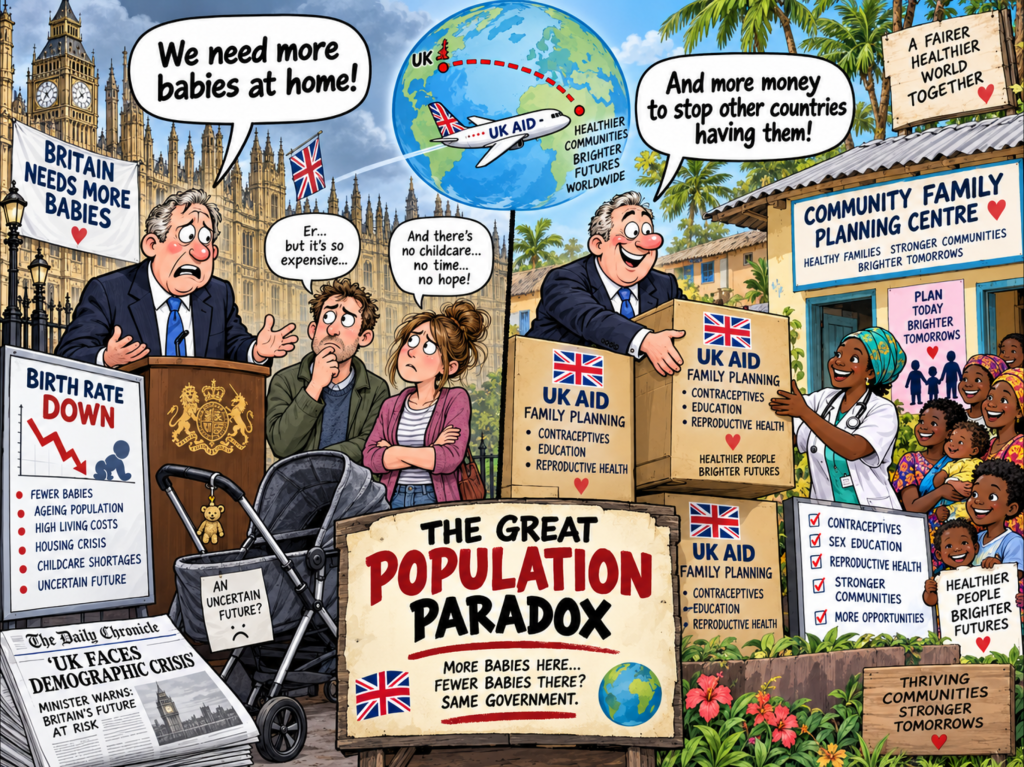
👶💷🌍Britain has a birth-rate problem. The UK fertility rate fell to 1.39 children per woman in 2025, far below the roughly 2.1 replacement level, and Parliament is openly discussing what fewer babies could mean for the workforce, public services and economic growth. (Hansard)
Education Secretary Bridget Phillipson has also spoken publicly about wanting more young people in Britain to feel able to have children, amid concerns that housing costs, childcare and financial insecurity are putting family life out of reach. (The Guardian)
Meanwhile, British taxpayers are committing roughly £254 million to a major overseas reproductive-health programme that includes contraception and family planning.
🍼Please Have More Babies, Britain — The Demographic Spreadsheet Is Looking Nervous
You really have to admire the choreography.
At home, the alarm bells are ringing:
“The birth rate is falling!” 🚨
“The population is ageing!” 👴
“Who will support the workforce and public services?” 📉
“Young people need to feel able to start families!” 👶
Then the international-development department wanders in carrying a cheque book the size of a paving slab.
💷 £254 million for overseas reproductive-health programmes including contraception and family planning.
Now, before somebody deliberately misunderstands the point, contraception and reproductive healthcare can bring major health benefits, particularly where women lack access to basic medical services.
But politically, the contrast is spectacular.
Britain is simultaneously having a national conversation about not producing enough children while spending hundreds of millions of pounds on programmes abroad that include helping people control whether and when they become pregnant.
It creates the sort of government messaging normally produced after three departments accidentally hold meetings in different buildings.
Britain: “Please have children.”
Also Britain: “We appreciate children are extremely expensive.”
Young couple: “Can we afford a house?”
Britain: “Steady on.”
Young couple: “Affordable childcare?”
Britain: “We’re looking into it.”
Young couple: “So how exactly are we supposed to have these babies?”
Britain: “Have you considered personal responsibility?” 🤡
And that is where the real argument sits.
If policymakers genuinely believe Britain needs more children, perhaps the first question shouldn’t simply be “Why aren’t people reproducing?”
Perhaps it should be:
“What have we done to make having children financially terrifying?” 💸🏠🍼
Because apparently Britain needs babies badly enough to hold parliamentary debates about demographic decline — but not badly enough to make housing, childcare and raising a family feel remotely affordable.
🔥Challenges🔥
So which is it?
If Britain desperately needs more babies to support an ageing population, should taxpayers be questioning hundreds of millions in overseas family-planning expenditure?
Or is the real hypocrisy closer to home — politicians worrying about falling birth rates while young British adults look at rent, mortgages, nursery bills and grocery prices and conclude that baby number one already requires the financial planning of a minor sovereign state? 🇬🇧💷
Tell us what you think in the blog comments. 👇💬
🔥 Should Britain concentrate more aid spending at home?
👶 Should government do far more to make having children affordable?
🌍 Or are overseas reproductive-health programmes perfectly compatible with encouraging wanted births in Britain?
Comment, like and share — and send this to someone who has noticed that Britain apparently wants more babies but hasn’t quite worked out how ordinary people are supposed to afford them.
The best comments, arguments and beautifully sharpened verbal missiles will be featured in the magazine. 🎯📰


Leave a Reply