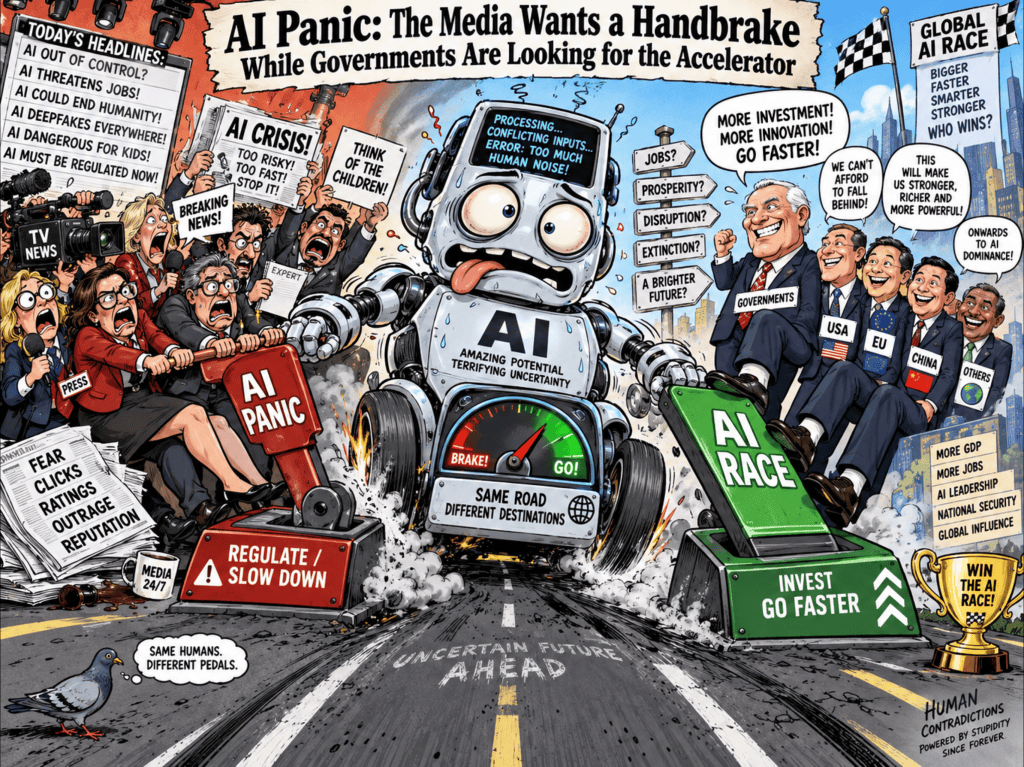
There is something magnificently British about watching the artificial intelligence revolution arrive at motorway speed and responding by forming a panel to discuss whether the motorway should exist.
Much of the public debate around AI now sounds as though the technology can simply be told to calm down until newspapers, politicians, regulators and assorted professional worriers have finished deciding how frightened everyone should be. The problem is that AI is not a village fête. Britain cannot postpone it because the risk assessment has gone missing behind the tombola.
The central contradiction is simple: governments may want safeguards, regulation and public reassurance, but they also know they are competing in a global technological race. If one country deliberately slows down while others accelerate, that is not responsible leadership. It is a rather expensive way of volunteering to come second.
The Great British Strategy: Regulate the Rocket Before Someone Else Lands It 🚀
The media naturally loves the darker possibilities. AI might destroy jobs. It might spread misinformation. It might undermine copyright, education, journalism, democracy, civilisation and possibly the sacred tradition of pretending anyone has read the terms and conditions.
Some of those concerns are serious. Powerful technology needs rules. Fraud, impersonation, deepfakes, discrimination, privacy abuses and unsafe automated systems are not imaginary problems. But there is a difference between regulating harmful behaviour and behaving as though technological progress itself requires permission from a breakfast television sofa.
That distinction matters because governments are not merely referees in the AI race. They are participants.
Every major economy wants the investment, computing infrastructure, research talent, productivity gains, military advantages, scientific breakthroughs and new industries associated with advanced AI. Ministers may give speeches about caution in the morning and announce an AI investment zone by lunchtime. Apparently the technology is a terrifying threat to humanity right up until it creates 4,000 jobs in someone’s constituency.
And that is where the idea that the media will somehow “control” the direction of AI begins to look rather optimistic.
Newspapers can demand restrictions. Broadcasters can host endless debates involving a technology correspondent, an ethicist and somebody who once saw The Terminator. Campaigners can call for pauses. Committees can publish reports so thick that artificial intelligence may eventually be required to summarise them.
But none of this alters the strategic calculation.
If Britain, Europe or any other major economy imposes restrictions so severe that innovation simply moves elsewhere, the technology does not vanish. The laboratories move. The investment moves. The engineers move. The data centres move. The tax revenue moves. The strategic advantage moves.
The moral satisfaction, however, remains safely at home.
This does not mean governments should surrender regulation altogether and allow the algorithmic equivalent of the Wild West. It means regulation has to distinguish between stopping genuine harm and stopping development merely because development makes institutions uncomfortable.
And then what?
Suppose one country introduces a glorious gold-plated regulatory framework involving five agencies, nine consultations, seventeen impact assessments and a compliance portal that crashes in Chrome. Meanwhile, competitors develop better models, attract more capital and build industries around them.
What has actually been achieved?
The country has not stopped AI. It has stopped some AI happening there.
That is the gap missing from much of the theatrical debate. There is enormous attention on whether AI should advance, when the more realistic question is where it will advance, under whose rules, using whose infrastructure and generating wealth for whom.
The internet followed a similar pattern. Governments debated it, newspapers worried about it, regulators chased it, traditional industries complained about it and eventually everybody used it to renew their car insurance.
AI is likely to be messier, faster and far more powerful. But the political instinct remains wonderfully familiar: announce control over something that is developing faster than the machinery designed to control it.
The sensible alternative is neither panic nor blind acceleration. Set clear rules for demonstrable harms. Punish fraud properly. Protect privacy. Establish accountability where automated systems materially affect people’s lives. Make safety requirements understandable and enforceable. Then allow legitimate development to continue without forcing every startup to employ a compliance department larger than its engineering team.
Because meaningful regulation should make dangerous behaviour harder.
It should not merely make innovation easier somewhere else.
The media can warn, challenge, investigate and expose genuine abuse. It should. But believing it can frighten AI back into the laboratory misunderstands the scale of what is happening.
Governments are looking at AI and seeing risk.
They are also looking across the border and seeing competitors.
And when national advantage, economic growth and strategic power enter the room, there is usually only so long anyone is prepared to keep the handbrake on.
Eventually somebody asks the question Britain has perfected through centuries of reluctant modernisation:
“Are we regulating this thing — or are we just watching everyone else build it?”
🔥Challenges: Who Actually Wins If Britain Slows AI Down?🔥
Should governments put the brakes on AI until regulation catches up, or would that simply hand the advantage to countries willing to move faster? And where should the line be drawn between genuine protection and bureaucratic self-sabotage? Have your say specifically in the Chameleon News blog comments. 💬🤖
👇 Comment, like and share — especially if you think the AI debate needs fewer theatrical warnings and more serious answers.
🏆 The best comments will be included in the magazine.


Leave a Reply