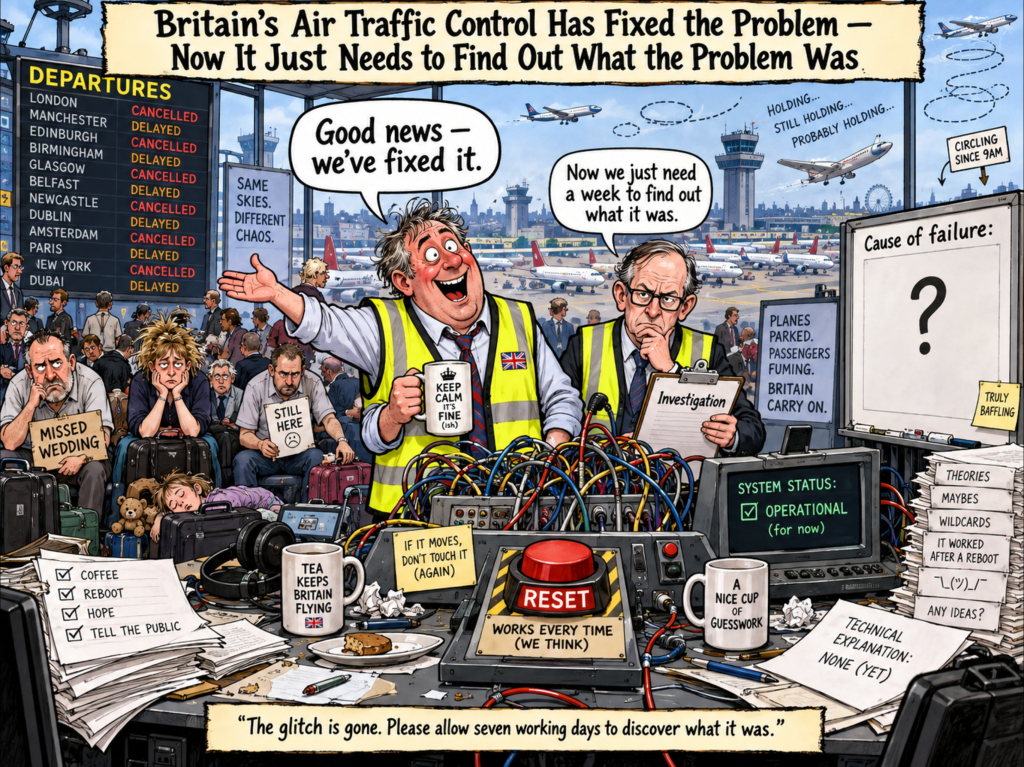
There is something magnificently British about bringing a large chunk of the aviation system to its knees, cancelling more than 2,000 flights, stranding hundreds of thousands of passengers — and then announcing that the problem has been fixed before apparently being able to explain properly what caused it. NATS says the technical failure has been resolved. Excellent. The Government has now given it a week to investigate why the thing it has already fixed needed fixing in the first place.
🔧 The Glitch Is Gone. Please Allow Seven Working Days to Discover What It Was
The failure hit NATS’s flight-processing system on 8 September, triggering cancellations and delays across Britain’s airports. Aircraft ended up in the wrong places, crews were displaced, passengers were stranded and airlines were left trying to reconstruct schedules that had been fed through an industrial shredder. The immediate technical fault was dealt with within hours, but the consequences rolled merrily into the following day.
And now comes the bit Britain does exceptionally well: the investigation into the investigation-worthy event.
Transport Secretary Heidi Alexander summoned NATS chief executive Martin Rolfe, while Downing Street gave the company a week to produce an investigation into the failure. Then, because one investigation might accidentally produce an answer before everybody has forgotten why they were angry, the Civil Aviation Authority is also conducting an independent review expected to report in six months.
Six months.
By then, some passengers may have completed the journey by walking to Tenerife.
This would perhaps feel more reassuring if Britain hadn’t already been through something strikingly familiar. A major NATS failure in August 2023 affected more than 700,000 passengers, according to CAA estimates, and prompted its own independent review, recommendations and assurances about resilience.
So naturally, three years later, here we are again: airport departure boards glowing red while another official review prepares to discover whether lessons learned from the previous lessons learned were sufficiently learned.
The latest outage has already produced the traditional ceremonial stages of British institutional crisis management. There has been an apology. There has been a ministerial summons. There are demands for resignations. There will be reports. Regulators will examine resilience. Executives will explain that safety remains paramount. Somebody will eventually recommend “improved processes”, “greater robustness” and perhaps a thrilling new committee with a quarterly PDF.
Meanwhile Downing Street has said the NATS chief retains the Government’s confidence despite airline bosses calling for him to go.
And then what?
That is the question buried underneath all the furious headlines.
Because investigations sound dramatic. “Chief summoned” sounds dramatic. “Independent review” sounds extremely dramatic. But none of those phrases automatically puts a passenger on the holiday flight they missed, reimburses an airline for every knock-on cost or prevents another computer from deciding, at precisely the wrong moment, that Britain’s skies would benefit from an unscheduled afternoon off.
The CAA has said the disruption is likely to count as an “extraordinary circumstance” under passenger-rights rules, meaning travellers may be entitled to care, refunds or rerouting but are unlikely to receive the normal statutory delay compensation from airlines.
Which gives the whole affair an especially elegant British symmetry: the passenger loses the holiday, the airline loses money, the regulator opens a review, the Government demands answers and the computer presumably receives a stern verbal warning.
Nobody should pretend the cause does not matter. Of course it matters. Air traffic control is critical national infrastructure, and understanding precisely why a system failed is essential before deciding what should change.
But that is precisely why the eventual consequence matters more than the theatre surrounding the inquiry.
If NATS’s systems need greater redundancy, require investment, need different oversight or should face stronger financial consequences when failures are preventable, then say so and do it. Parliament has already debated whether the current system unfairly leaves airlines carrying substantial costs when air traffic control itself is responsible.
What passengers don’t need is another magnificent bureaucratic orbit ending six months from now with forty recommendations, three action plans and the immortal closing sentence of British public administration:
“Lessons will be learned.”
Because after 2,000 cancelled flights, thousands of ruined journeys and another enormous institutional investigation, the important question isn’t whether officials can eventually explain which bit of software had a nervous breakdown.
It’s whether anything happens afterwards that makes it less likely to happen again.
Otherwise Britain’s aviation strategy appears remarkably simple: ground the planes today, investigate tomorrow, publish the lessons next spring — and keep the report somewhere handy for the next outage. ✈️📚
🔥Challenges: When the Reports Land, Will Anything Actually Change?
After thousands of cancelled flights, another investigation and another six-month review, what should the real consequence be if this failure proves preventable — tougher regulation, financial penalties, management changes, greater investment, or yet another promise about “resilience”? Tell us what you think in the comments on the Chameleon News blog. 💬🔥
👇 Comment, like and share — and tell us whether Britain needs another aviation review or an aviation system that actually stays switched on.
🏆 The best comments will be included in the magazine.


Leave a Reply