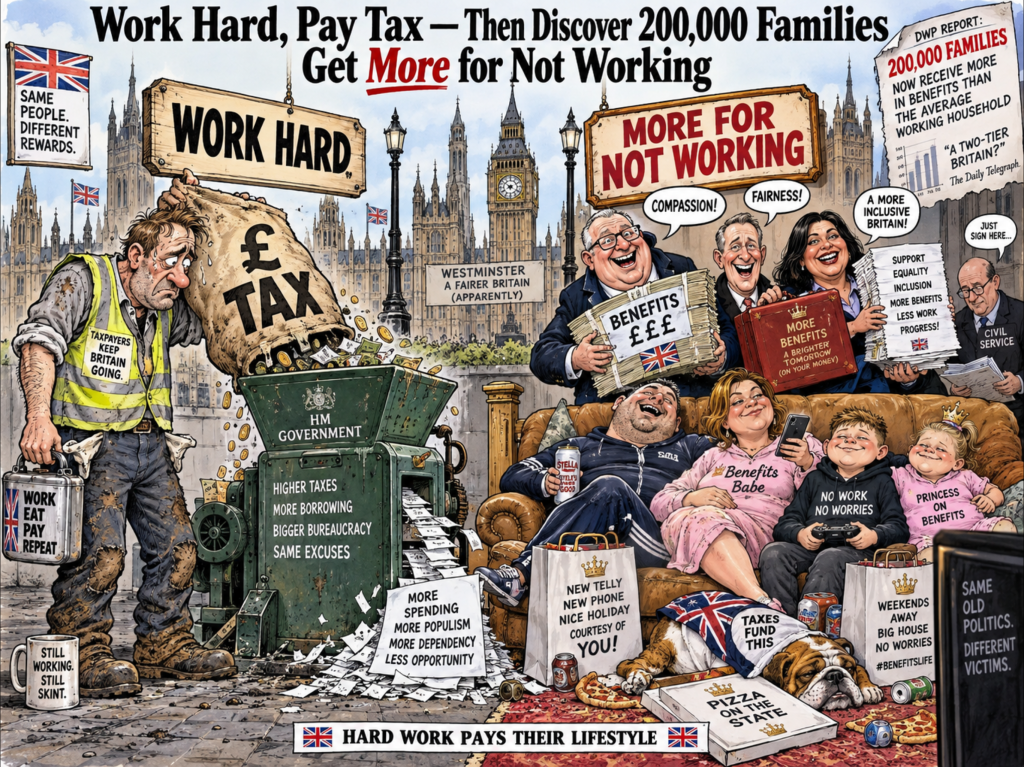
Britain has spent decades teaching people the rules of the game of life: get a job, work hard, pay your taxes, support yourself, save what you can and keep going. Follow that route for forty or fifty years and, in theory, you should come out ahead.
Then the working taxpayer reads that around 200,000 families receive state support worth more than the annual earnings benchmark for a typical full-time worker.
And suddenly the obvious question is: have the people who followed the rules chosen the losing strategy?
🎲 Welcome to Britain’s Game of Life — Where Working Means You Keep Landing on “Pay Again”
That is the real issue. It is not simply about one benefits figure. It is about what that figure represents to millions of people who get up every morning, travel to work, pay tax and then watch a large chunk of their earnings disappear before they have even started living.
The worker earns the money. Then Income Tax arrives. National Insurance follows. Council tax wants a turn. Then come the mortgage or rent, fuel, electricity, food, insurance, petrol and childcare. By the time everybody has taken their share, the person who actually earned the money gets what is left.
And politicians call this “making work pay”.
Of course, not every household receiving state support is in the same position, and not every payment is the same. But that technical explanation does not make the political problem disappear.
The person working full-time is not sitting at the kitchen table studying Treasury classifications. They are looking at their bank account, what they earned, what they kept and whether all this effort is actually moving them forward.
That matters, because a society cannot keep telling people that work is the route to a better life while allowing millions of workers to feel that employment merely earns them the privilege of financing everything.
There was once a simple bargain: you worked hard and, over time, hard work improved your position. That bargain now looks far less certain.
Take extra hours and you may pay more tax. Earn a little more and support can disappear elsewhere. Take a better job and childcare may swallow the difference. Travel further for work and transport costs eat into the gain.
This is not how incentives are supposed to work.
The Government regularly talks about getting people into employment and reducing economic inactivity. Fine. But what incentive is being offered to the people who are already working?
Because there is only so long you can tell people that work is economically superior while their disposable income keeps shrinking.
Eventually somebody notices that the motivational poster does not match the payslip.
That is where the “game of life” comparison matters. People adapt to rules. If one route means effort, stress, commuting, childcare and taxation, while another appears to provide comparable security without the same burden, people will start questioning the rules.
That is not laziness. That is incentives.
The worker is often trapped in the least glamorous position in the system: not wealthy enough to ignore the bills, not poor enough to qualify for extensive help, but earning just enough to be useful.
Politicians call them “hard-working families”.
Usually just before asking them for more money.
And then what?
We will no doubt hear another promise to “make work pay”, another consultation, another programme and perhaps another minister standing in a warehouse wearing a high-visibility jacket.
But the solution is much simpler.
People who work should see a clear financial reward for doing so. If someone works more hours, they should become meaningfully better off. If they support themselves, government should not keep treating their income as an endlessly available source of revenue.
Welfare should remain a safety net for those who need it.
But work must remain the obvious route upward.
Not simply the route that comes with an alarm clock.
Because once ordinary taxpayers begin to believe that playing by the rules leaves them behind, the problem is no longer just the welfare bill.
It is the credibility of the whole system.
For years the message was:
Work hard and you will get ahead.
The modern version increasingly feels like:
Work hard, pay for everything — and try not to notice who is overtaking you.
🔥 Challenges: Has Britain reached the point where people who work, pay tax and follow the traditional route through life are getting the worst deal? If government wants people to believe that work pays, should it first make sure workers can actually see the reward in their bank accounts? Tell us what you think on the Chameleon News blog.


 Chameleon Magazine
Leave a comment