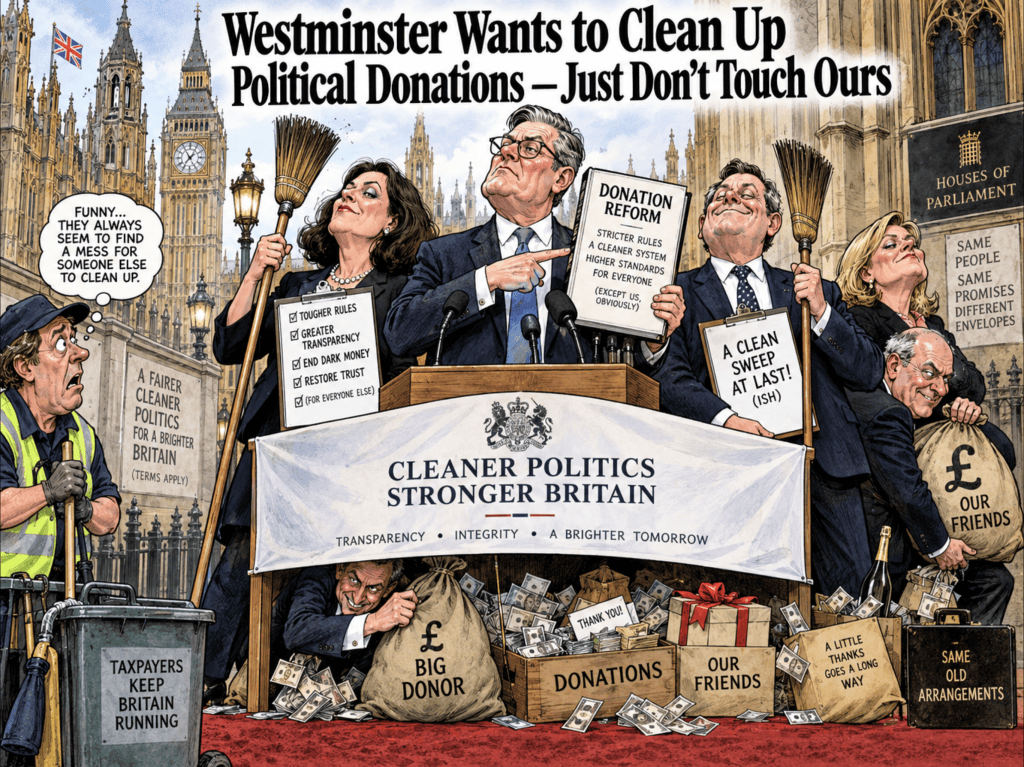
British politics has suddenly discovered that enormous political donations might be a problem.
Reform UK has collected £72 million from Ben Delo and Christopher Harborne, who have each committed £36 million. The donations have revived demands for limits on how much one person should be allowed to give a political party.
The concern may be genuine. But it is difficult to ignore the timing: Westminster has spent years accepting large sums from wealthy individuals, businesses, trade unions and other organisations. Now that Reform has a very large cheque book, politicians are suddenly taking a closer look.
💷 Everyone Supports Donation Reform When It Targets Somebody Else
If one individual can hand a party £36 million, it is reasonable to ask whether elections are drifting away from a contest of ideas and towards something resembling Premier League ownership.
But the same questions must apply to every major donor, party and funding structure. Labour receives significant support associated with trade unions; Conservatives have historically relied heavily on wealthy individuals and businesses; and Reform has now demonstrated that it can play the millionaire-donor game with considerable enthusiasm.
A comprehensive donation cap could affect them all.
If £36 million from one wealthy individual creates an unacceptable risk of influence, politicians must explain why £36 million arriving through another permissible structure would suddenly be harmless.
The answer cannot simply be:
“That money is different because we like where it comes from.”
Nor can Reform become a passionate defender of unlimited generosity merely because it currently possesses the largest collection tin.
A fair rule should annoy everybody equally.
If Westminster is genuinely concerned about political donations, it should introduce rules that would still be considered fair if the money moved in the opposite direction tomorrow. Apply them transparently across individuals, companies, unions and other organisations, close escape routes, require rapid disclosure and impose penalties serious enough to deter violations.
What Britain does not need is a political-finance regime that changes depending on who receives the money, or politicians using the language of democratic protection to weaken their opponents.
The Reform donations have raised a legitimate question about money and political influence. Westminster’s sudden interest raises another: why now?
If large donations threaten democracy, apply the same principle everywhere.
Because if Westminster now decides big donations are dangerous, wonderful.
Just make sure politicians are still enthusiastic when somebody reaches for their cheque book.
Otherwise the great clean-up of British political finance will amount to exactly what we have come to expect:
Everybody else’s money out of politics — and hands off ours.
🔥 Challenges: Is Westminster genuinely concerned about the influence of political donations, or has it only become interested because Reform has received £72 million? Should the same scrutiny apply to billionaires, businesses, trade unions and every major political party? Tell us what you think on the Chameleon News blog.
💬 Comment, like and share — and tell us whether Britain needs one genuinely neutral set of political donation rules, or whether politicians simply want to investigate the money going to their opponents.
🏆 The best comments will be included in the magazine.


 Chameleon Magazine
Leave a comment