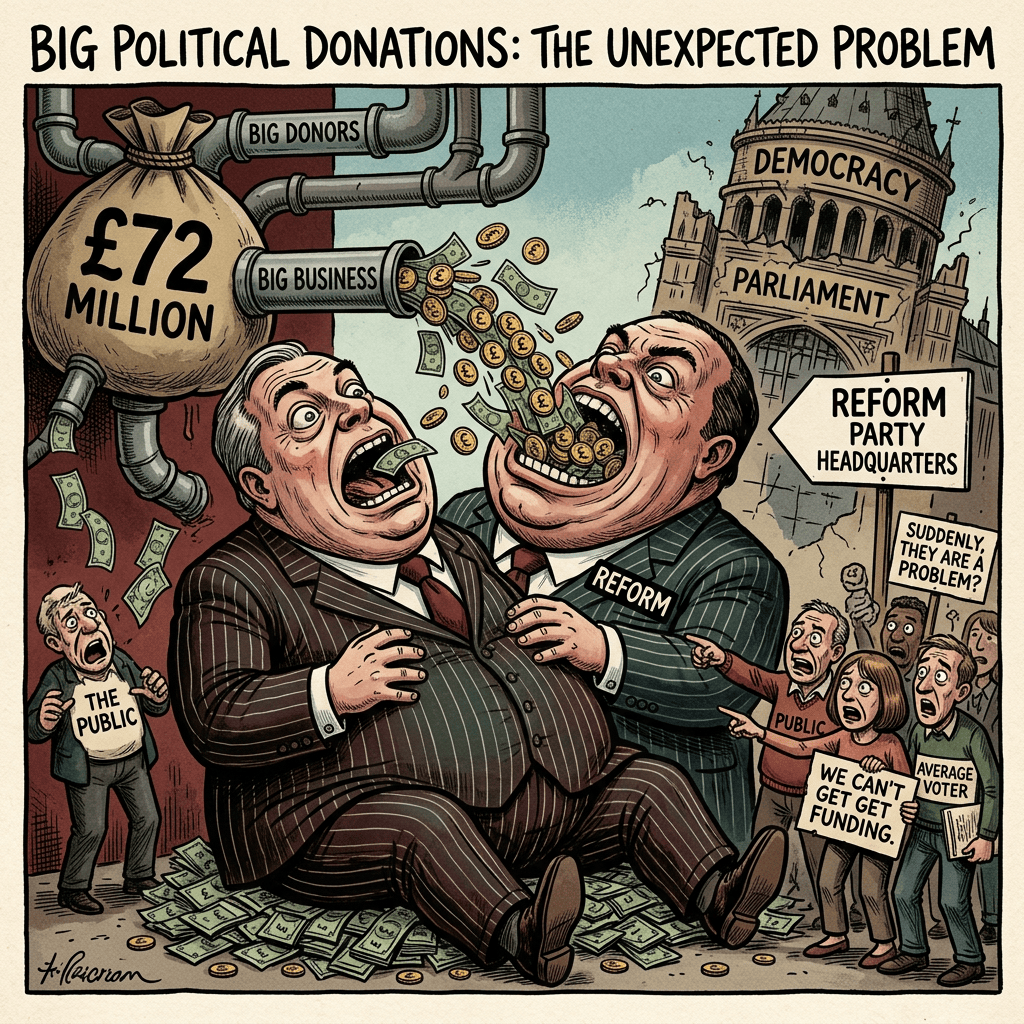
There is nothing quite like watching British politics discover a moral principle immediately after somebody else gets the money.
Reform UK has received £72 million from two wealthy donors, Ben Delo and Christopher Harborne, each contributing £36 million. That is enough to transform a party’s campaigning operation — and enough to make Westminster suddenly wonder whether allowing enormous political donations might be undemocratic after all.
Funny, that.
💷 Big Money in Politics Was Apparently Fine Until It Started Going Somewhere Else
There is a serious question here. Democracy should be a contest of ideas, not an auction conducted by people who discovered cryptocurrency before the rest of us mastered contactless payments.
But the question cannot begin and end with Reform.
The Government is considering tougher political-finance rules, including restrictions on foreign money and possible limits on “mega-donors”. Some Labour MPs have proposed an annual cap on individual donations.
Fine. Write the rule. Apply it to everybody.
Labour has historically received substantial support from trade unions, which can lawfully finance political activity through statutory political funds. Ministers have also been asked whether proposed restrictions would apply equally to unions and other organisations.
This is where Westminster reaches for the emergency box marked “Nuance”.
“We need tougher rules on political donations.”
Excellent. Do they apply to our donors?
“Well, obviously that is a completely different type of money.”
Of course it is.
Apparently £36 million is a threat to democracy when it arrives from a billionaire, while large institutional donations require several committees and an explanatory diagram before anyone decides whether the same principle applies.
The legal structures may differ. The democratic question does not:
How much financial influence should any individual, company, union or organisation be allowed to exercise over a political party?
If £36 million from one donor can buy excessive influence, that concern cannot disappear when the money comes through an organisation aligned with another party.
That should make Reform uncomfortable.
It should make Labour uncomfortable too.
Good. That is usually how you know you have found a fair rule.
Separate allegations concerning political financing should be investigated properly and judged on the evidence. They should not be confused with the broader question of whether extremely large lawful donations should be permitted.
A lawful donation does not become unlawful because its recipient’s opponents find the amount horrifying.
Nor should Parliament introduce rules that restrict one party’s funding model while preserving everybody else’s favourite route to the bank. That would not be cleaning up political finance. It would be moving the goalposts after discovering the other team has bought a better striker.
Suppose Parliament introduces a £100,000 annual limit on individual donors.
Fine.
Does it apply to companies? Trade unions? Other organisations? Affiliated groups?
Could £10 million become acceptable simply because it arrives through an institution rather than an individual?
If some enormous donations are democratically dangerous while others are part of Britain’s rich political tradition, then this is not really a debate about money in politics.
It is a debate about whose money politicians like.
The solution is hardly revolutionary: set sensible limits, make them transparent, close genuine loopholes and apply equivalent principles to individuals, companies, unions and other major funding organisations. Enforce them whether the cheque is heading towards Reform, Labour, the Conservatives, the Liberal Democrats or the Monster Raving Loony Party.
If huge political donations are dangerous, they are dangerous regardless of who receives them.
Otherwise Britain is about to perform one of its finest democratic tricks yet:
Removing big money from politics while ensuring all the correct big money remains exactly where it is.
🔥 Challenges: Has Reform’s £72 million exposed a genuine problem with enormous political donations — or merely shown how quickly politicians object when big money flows to their opponents? Should the same rules apply to wealthy individuals, companies, trade unions and every other major donor? Tell us what you think on the Chameleon News blog.
💬 Comment, like and share — especially if you think political donation rules should apply equally, no matter whose bank account the money comes from.
🏆 The best comments will be included in the magazine.


 Chameleon Magazine
Leave a comment