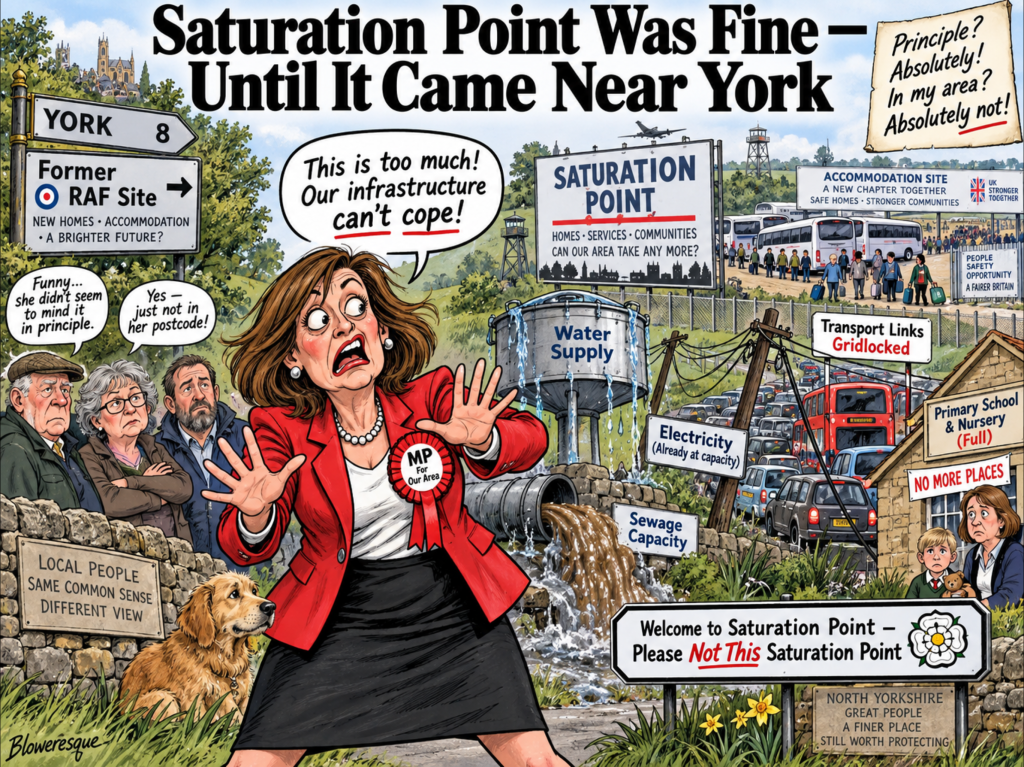
There are few principles in British politics more durable than this one: a policy is much easier to support when somebody else has to live with it.
Labour MP Rachael Maskell has found herself facing accusations of hypocrisy after opposing plans to accommodate around 1,200 asylum seekers at the former RAF Linton-on-Ouse site in North Yorkshire. Her objections include entirely recognisable local concerns: water supply, sewage capacity, electricity, transport links and the proximity of a primary school and nursery.
All perfectly reasonable points.
The difficulty is that Maskell has some rather inconvenient historical footage following her around.
🌍 Welcome to Saturation Point — Please Not This Saturation Point
Back in 2015, during the Syrian refugee crisis, Maskell addressed a pro-refugee rally and argued that Britain should keep accepting people until it reached what she called “saturation point”. She acknowledged that this could mean longer hospital waits, larger school classes, fuller cities and higher costs, but argued that those inconveniences were worth accepting to save lives.
That is a perfectly legitimate political position.
Unfortunately, politicians occasionally suffer from a rare medical condition known as Policy Proximity Syndrome.
Symptoms normally begin when an abstract national principle unexpectedly acquires a postcode.
Suddenly, things like schools, infrastructure, public services and local capacity — previously minor obstacles to be nobly overcome — become extremely serious matters requiring urgent consideration, detailed consultation and possibly several stern letters to the Home Office.
The Government is considering RAF Linton-on-Ouse as part of its wider attempt to move asylum seekers out of hotels and into large accommodation sites. The plan has provoked opposition locally and from politicians of several parties. Ministers have said no final decision has yet been made and that planning and other assessments would have to be completed.
And Maskell is hardly alone in raising concerns. Local objections to placing more than a thousand people in a small rural community deserve to be heard regardless of which party happens to be in government.
But that is precisely what makes the old “saturation point” speech so awkward.
Because the arguments being made today — pressure on infrastructure, services, schools and transport — are remarkably similar to the pressures she previously suggested Britain should be prepared to tolerate.
Apparently saturation is a noble humanitarian concept when viewed from the stage of a rally.
It becomes rather more complicated when somebody starts measuring the sewage capacity.
🚰 It Turns Out Infrastructure Exists After All
This is not really a story about one Labour MP changing her mind. Politicians are allowed to change their minds. In fact, given some of the things politicians believe, we should actively encourage the practice.
The interesting question is whether the principle changed — or merely the geography.
If housing 1,200 asylum seekers in one community would place unreasonable pressure on services, then politicians should acknowledge something rather obvious: migration and asylum policy have practical limits determined by housing, healthcare, schools, transport and infrastructure.
That does not mean refusing refugees.
It means admitting that compassion does not magically construct GP surgeries, widen sewage pipes, create classrooms or summon buses out of the North Yorkshire countryside.
The same test should apply everywhere.
If a proposed asylum centre is unsuitable beside your constituents, it does not become suitable merely by moving it beside somebody else’s.
That is the part British politics repeatedly struggles with. Westminster loves national solutions whose consequences can be distributed locally, preferably somewhere beyond the range of the minister’s kitchen window.
We have seen versions of this routine with housing developments, wind farms, prisons, pylons, airport expansion and asylum accommodation.
Everyone supports the principle.
Then the map comes out.
🏡 National Policy, Local Surprise
The answer is not complicated. Decide how many people the country can realistically accommodate, assess where the necessary infrastructure exists, distribute responsibilities transparently and make local capacity part of the policy from the beginning.
Then apply the same rules whether the affected constituency votes Labour, Conservative, Reform, Liberal Democrat or Monster Raving Loony.
Because if “saturation point” means anything, it presumably means reaching the point where available capacity is actually saturated.
You cannot spend years dismissing concerns about pressure on services and then discover that pressure on services is a very important consideration when the Home Office starts looking at an airbase nearby.
Perhaps Rachael Maskell has genuinely reconsidered her earlier position. If so, fair enough. Politics could use more people willing to say: circumstances changed, I learned something, and my view changed with them.
But if the message is simply that Britain should keep accommodating people until saturation point — except wherever saturation becomes personally inconvenient — then we haven’t discovered an immigration policy.
We’ve discovered Britain’s oldest political philosophy:
Build it somewhere else.
🔥 Challenges: Was Rachael Maskell right in 2015 that Britain should accept the pressures of migration until reaching “saturation point”, or is she right now to argue that local infrastructure can make a proposed asylum site unsuitable? And if local capacity matters in York, shouldn’t exactly the same principle apply everywhere? Have your say on the Chameleon News blog.
🔥 Comment, like and share — especially if you think politicians should have to live with the practical consequences of the policies they champion.
🏆 The best comments will be included in the magazine.


Leave a Reply