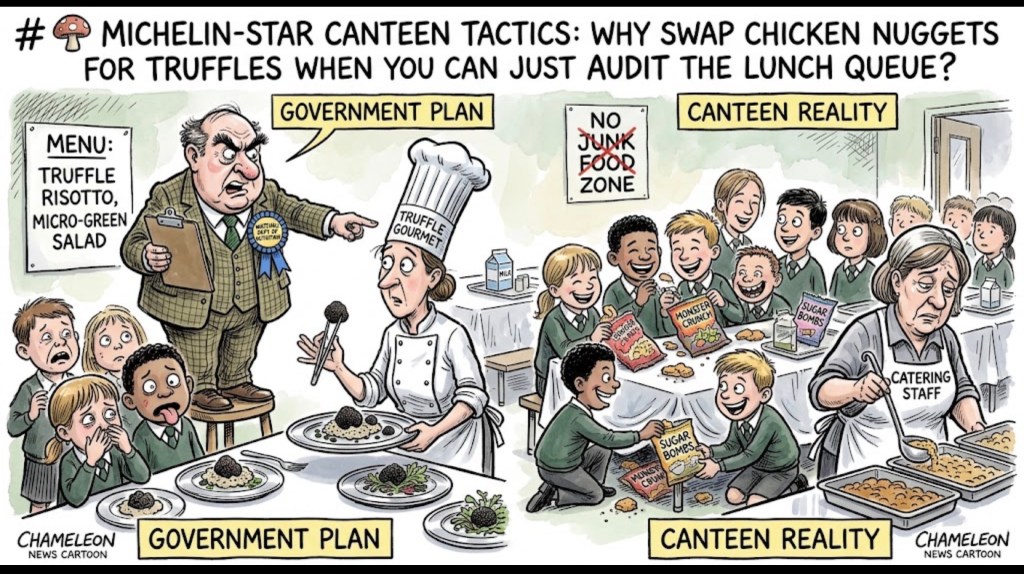
In a bid to turn school dining halls into bastions of culinary refinement, Whitehall mandarins have launched a crusade against the humble chicken nugget. Under the latest grand vision for child health, processed beige delicacies are to be purged from the lunch hatch, replaced by artisanal, high-end gastronomy—truffles, steamed micro-greens, and complex, bitter foliage. The central premise is as simple as it is delusional: if you present an eight-year-old with shaved black truffle instead of a processed poultry shape, they will magically abandon their deep-seated survival instinct for carbohydrates and embrace fine dining with open arms.
In reality, any parent who has ever attempted to feed a seven-year-old anything greener than a lime Calippo knows precisely what happens when you substitute ultra-processed comfort food with gourmet fungi. The kids do not line up with silver forks to marvel at the earthiness of the dish; they revolt, hoard smuggled multipacks of crisp-adjacent snacks in their lockers, or trade their lunchboxes like contraband on a black market run entirely on sugar and salt.
The Bureaucracy of the Lunch Tray
The official response to this nutritional rebellion has been predictably magnificent. Rather than acknowledging basic human psychology, regulators, health taskforces, and local authorities are mobilizing to enforce compliance. Steering committees are being formed, guidelines are being drafted in triplicate, and regional auditors will soon be dispatched to inspect canteen trays with the clinical precision of a crime scene investigation team. School governors will be asked to formulate whole-school food policies, sign compliance pledges, and submit monthly dietary audits to central government databases.
And then what?
What actually changes after months of parliamentary debate, pilot schemes, public health webinars, and administrative panic? Absolutely nothing.
The grand institutional effort will culminate in a thoroughly British compromise: a sternly worded compliance circular, a batch of glossy poster campaigns, and an agreement that “lessons have been learned.” The high-end truffles will rot quietly in stainless-steel catering tins, the official menus will list sophisticated alternatives on paper to satisfy the inspectors, and pupils will continue sneaking off to the local corner shop to buy deep-fried carbohydrates at bell-time. The net result of thousands of administrative hours and endless public funds will be an impressive paper trail confirming that the system is technically compliant, while the actual bins behind the assembly hall overflow with uneaten organic produce.
The absurdity of the policy lies in the complete disconnect between civil service idealism and canteen reality. You cannot regulate a child’s palate into submission by decree, nor can you eliminate the appeal of ultra-processed food simply by making the official menu sound like a Mayfair bistro. If the authorities genuinely wanted to tackle youth nutrition, the solution wouldn’t involve forcing luxury ingredients into budget-strapped school kitchens; it would require straightforward, practical measures like simple, tasty, freshly prepared whole foods, realistic cooking education, and strict, uniform limits on commercial junk food targeting kids outside the school gates.
Until then, we remain trapped in a theatre of regulatory denial. Whitehall will go on pretending that eight-year-olds are simply miniature food critics waiting for their palates to be awakened, while the kids themselves continue to prove that no amount of bureaucratic fine-tuning can compete with a smuggled bag of Monster Munch.
🔥 Challenges: If public health policy insists on replacing everyday comfort food with unpalatable luxury alternatives, are regulators trying to fix children’s health or just their own administrative guilt? Tell us where you stand in the comments on the Chameleon News blog!
If you enjoyed this article, make sure to like, share, and drop your thoughts in the comments section below!
🏆 The best comments will be included in the magazine.


Leave a comment