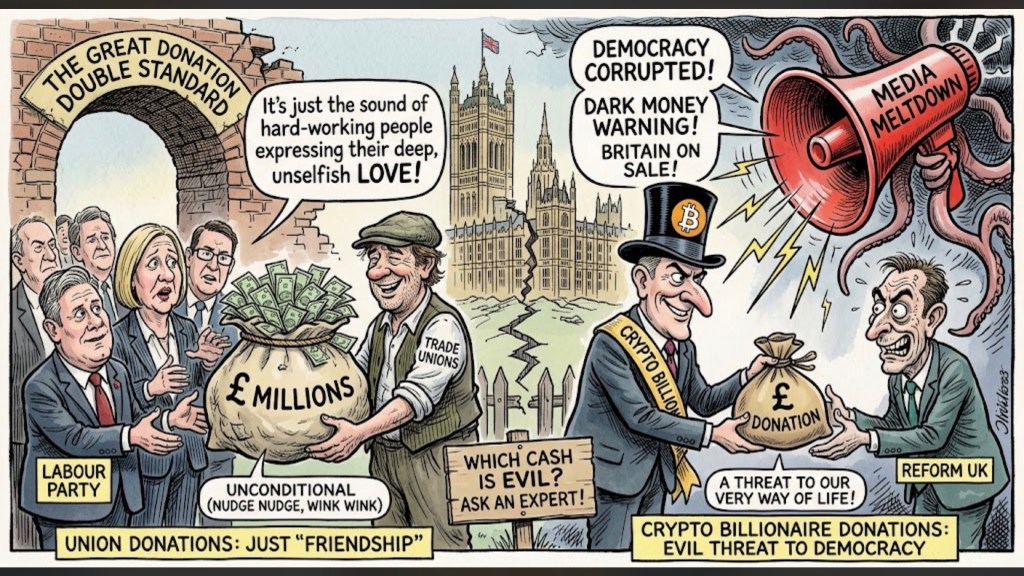
While Westminster hyperventilates over who pays for the sausage rolls at party conference, a familiar dynamic has once again settled over British politics: some political donations are a threat to our very democracy, while others are simply the sound of hard-working people expressing their deep, unselfish love for the Labour frontbench.
When two cryptocurrency entrepreneurs handed a slice of their digital fortunes to Reform UK, the media reaction was swift, dramatic, and predictably apocalyptic. Newsrooms treated the transfer with the kind of urgent gravity usually reserved for rogue state nuclear tests. Panelists stroked their chins, commentators warned of dark money corrupting the body politic, and the general consensus emerged that democracy itself was being auctioned off to the highest bidder in Bitcoin.
Yet when former Shadow Chancellor Ed Balls took to the airwaves to explain away the massive financial pipeline connecting trade unions to the Labour Party, the tone was decidedly softer. The millions flowing into party coffers weren’t an attempt to buy policy, influence legislation, or secure access, we were assured. Heaven forbid. It was merely the collective voice of working people, given out of pure, high-minded altruism, with absolutely zero expectation of anything in return.
A Tax on Cash, A Free Pass for Influence
The institutional reaction to all of this has been a masterclass in performative outrage. Select committees will convene, regulators will publish stern warnings, and politicians will spend endless hours on television demanding greater transparency from their opponents while defending their own donors as selfless philanthropists. The Electoral Commission will no doubt audit the paperwork, verify that every form has been stamped in triplicate, and ensure that all money was transferred through the correct legal channels.
And then what?
What actually changes after weeks of breathless headlines and parliamentary point-scoring? Absolute square root of zero.
The reformists will keep taking cash from tech barons, Labour will keep taking cash from union bosses, the Conservatives will keep taking cash from hedge fund managers, and the public will be treated to another five years of lectures on ethics from people whose campaigns are underwritten by interest groups. The grand institutional output of this entire cycle will likely be a minor update to a reporting deadline, a couple of compliance notices, and the solemn assurance from all sides that “the highest standards of integrity have been maintained.”
The absurdity of the debate lies in the complete refusal to address the obvious core problem. If a political donation is capable of buying influence, then every large donation buys influence—regardless of whether it comes from a crypto exchange in London or a union headquarters in Brighton. The idea that a million pounds from a trade union comes with no strings attached, while a million pounds from a businessman is inherently corrupting, requires a level of mental gymnastics that would qualify for the Olympics.
The solution isn’t complicated, nor does it require months of parliamentary inquiries. If parliament actually wanted to remove the perception of influence-peddling, it would simply place a strict, universal cap on all political donations from all sources—individuals, corporations, and trade unions alike. Clear rules, equal enforcement, and meaningful limits would instantly level the playing field and stop political parties from acting as subsidised branches of their wealthiest supporters.
Until then, we are left with a system where the origin of the money matters far more than the influence it buys. Big money will continue to bankroll British politics, and the only real rule will remain unchanged: it’s only a scandal when the other side gets the cheque.
🔥 Challenges: If all major political parties rely on massive financial backing from interest groups, can any government ever claim to represent the public rather than their donors? Tell us where you stand in the comments below!
If you enjoyed this article, make sure to like, share, and drop your thoughts in the comments section below!
🏆 The best comments will be included in the magazine.


Leave a comment