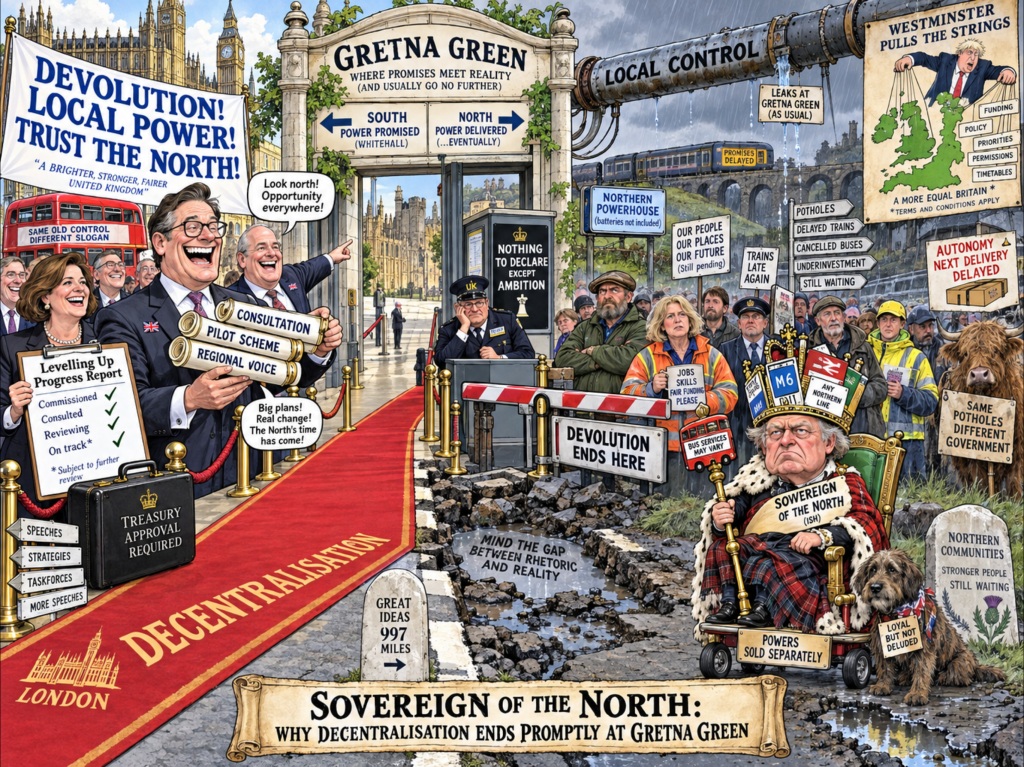
In a display of geographic ambition that has left constitutional lawyers scratching their heads and cartographers reaching for their compasses, Prime Minister Andy Burnham has unveiled the grand machinery of “Number 10 North.” The objective, we are told, is to break the iron grip of London centralism by creating a shiny new hub of governance in Manchester. However, the noble crusade to decentralise the state appears to come with a very strict boundary marker: regional empowerment is a vital democratic right, right up until you hit the Scottish border, at which point it suddenly becomes an existential threat to the Union.
The logic is as fascinating as it is selective. Shifting power 200 miles up the M6 to Greater Manchester is hailed as a historic, visionary triumph for local self-determination. But suggesting that those who live another 150 miles further north might also quite like a say over their own affairs is dismissed with a stern shake of the head and a firm reminder that border polls and referendums remain strictly off-limits. Decoupling decision-making from Westminster is progressive genius in Lancashire, but total madness once you cross the Solway Firth.
The Border Control of Devolution
The official response to this geographical paradox has been an absolute masterclass in institutional mental gymnastics. Task forces are convening, regional strategy boards are being populated by mayors in sharp suits, and civil servants are being shuffled up the West Coast Main Line to populate newly minted situation rooms. White papers are being published to declare that power must be distributed to “every corner of the country”—provided those corners fit neatly within the designated limits of English regional mayors.
And then what?
What actually changes after months of breathless speeches about “rewiring the nation,” endless press releases, and high-profile cabinet meetings convened in Manchester? Absolute square root of zero.
The grand institutional outcome will be a few shiny administrative buildings, a handful of rebranded regional committees, and the permanent establishment of a nation managed by two distinct brands of central authority. Westminster will continue to hoard power, Manchester will manage the northern outposts of English administration, and Scotland will be treated to the solemn assurance that while regional self-governance is brilliant for the North of England, Gretna Green represents the exact line where local democracy goes entirely too far.
The absurdity of the policy lies in the complete refusal to treat regional autonomy as a universal principle rather than a regional perk. You cannot credibly lecture the nation on the evils of centralised rule while insisting that self-determination ends precisely where your own electoral boundary begins. If bringing government closer to the people is an unalloyed good, then the right to determine one’s governance cannot depend on whether your regional accent features a flat ‘a’ or a Scottish burr.
The solution to this constitutional comedy isn’t complex. If the state genuinely wants to decentralise power, it requires clear, consistent, and universal rules: equal devolution across all regions and nations, binding local powers, transparent limits, and a system where democratic consent is treated as a fundamental right rather than a gift rationed out from a situation room in Manchester.
Until then, we remain trapped in a world of selective regionalism, where moving power to the North is heralded as a democratic revolution—right up until it reaches the border, at which point the revolution promptly stops for a cup of tea and a look at the map.
🔥 Challenges: If decentralising power is essential for the North of England, why does official enthusiasm for self-determination evaporate the moment it crosses into Scotland? Tell us where you stand in the comments below!
If you enjoyed this article, make sure to like, share, and drop your thoughts in the comments section below!
🏆 The best comments will be included in the magazine.


Leave a comment