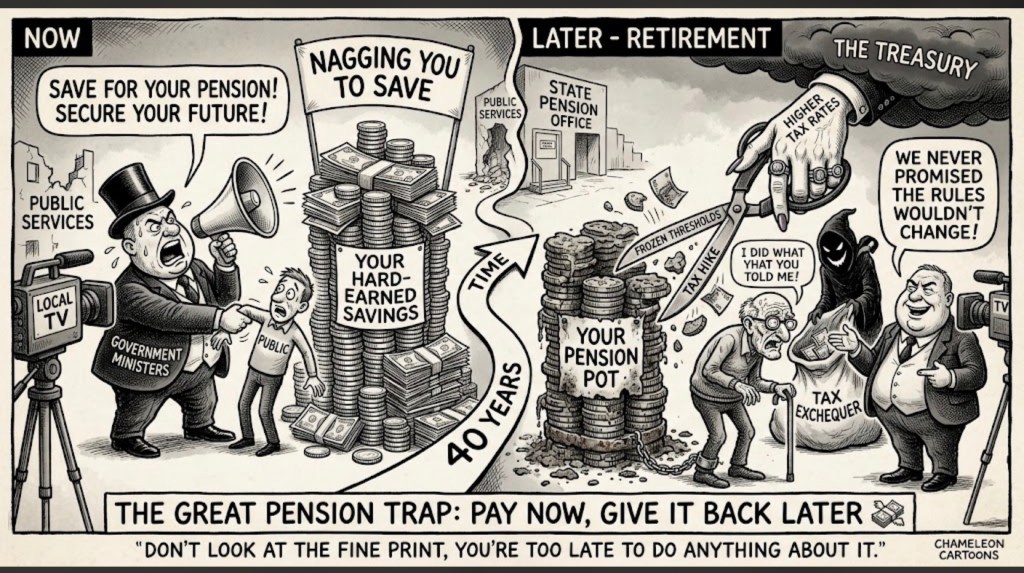
There is a breathtaking audacity to the state using tax-funded local television advertising to hound you into saving for retirement, while quietly sharpening its cutlery to carve up the very nest egg it begged you to build.
The pitch from ministers is simple enough to fit on a colorful leaflet: be a good, responsible citizen, set aside your hard-earned income for forty years, and enjoy the tranquil autumn of your life without leaning on the public purse. What they omit from the glossy broadcast, however, is the punchline. Once you finally reach state-sanctioned decrepitude and attempt to draw on that pot, the Treasury reappears like an uninvited dinner guest, demanding a substantial slice of the very money you were ordered to save—at a higher rate than ever before.
Save for the future, so the Treasury can harvest it later
The mechanism is a masterclass in institutional gaslighting. For decades, the public is subjected to a relentless campaign of official nagging about the impending insolvency of the state pension and the moral duty of self-reliance. Regulators issue stern warnings, politicians nod gravely on morning panel shows, and public service broadcasts urge young workers to lock their cash away where they cannot touch it.
Yet, as pension thresholds remain frozen against relentless inflation, an ever-larger chunk of modest retirement savings is dragged into income tax brackets. You are trapped in a financial time capsule: your money is locked away for half a century, during which time the government reserves the right to alter the tax rules as often as it pleases. By the time you discover the deal has been unilaterally rewritten, you are seventy years old and entirely powerless to do anything about it.
Naturally, the official response to this quiet plunder is not a policy review, but a fresh wave of public communications. Committees will be formed to study “pension literacy,” regulators will mandate clearer risk warnings on annual statements, and ministers will insist that frozen thresholds are merely a “prudent fiscal measure” to ensure economic stability.
And then what? What actually changes after the debates, the explanatory pamphlets, and the ministerial media rounds? Absolutely nothing. The bureaucratic machinery continues to applaud itself for encouraging personal responsibility, while the tax system systematically penalizes anyone foolish enough to have taken the advice.
The obvious solution is not complicated: if the state insists on forcing people to lock their money away for forty years, it should freeze the tax rules at the point of deposit, raise exemption thresholds in line with actual living costs, or simply tell the truth on local television.
Instead, we are left with a retirement strategy that resembles a government-sanctioned pyramid scheme—one where you provide the capital, the state takes the credit, and the taxman gets the final say.
🔥 Challenges: If the government demands forty years of discipline from savers, should it be legally bound to stick to the tax promises it made when the money was deposited? Drop your thoughts below.
Share your take in the comments, like the article, and spread the word!
🏆 The best comments will be included in the magazine.


Leave a comment