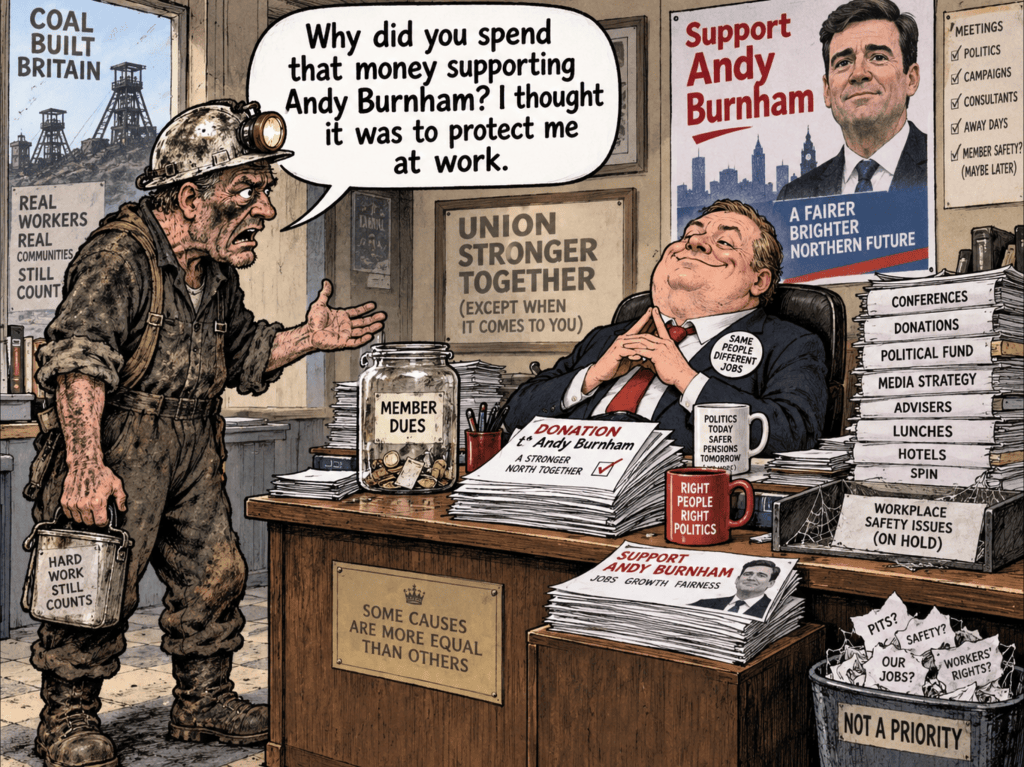
If a trade union wants to support the Labour Party, fair enough. If individual members want their money used for that purpose, fair enough too. But between “I joined for representation at work” and “congratulations, you’re helping bankroll a political party,” there is one rather important question: did the member actually consent?
That question can disappear beneath the grand language of solidarity, collective action and political influence. A union represents workers’ interests, but its members are not one enormous ideological organism marching towards the same ballot box.
Some vote Labour. Some vote Conservative, Liberal Democrat, Reform, Green or Monster Raving Loony. Some would sooner lick a railway platform than vote for any of them. Yet a donation made in the name of organised labour can create the impression that millions of members have reached for their wallets and shouted, “Here you are, Labour — spend it wisely.”
That seems rather a lot to infer from paying your subs.
Membership Card or Party Donation Form? 🎟️🗳️
The issue is not whether unions should engage in politics. Of course they should. Governments make laws affecting pay, pensions, employment rights, industrial action and workplace protections, so unions have every reason to take an interest.
The real question is whether members’ consent is clear, informed and freely given.
A member who knowingly contributes to a political fund and understands where the money may go is making a perfectly legitimate choice. Adults are allowed to support political causes.
But if that choice is buried beneath forms, rules, fund allocations and paperwork that make the average member feel they are deciphering the terms and conditions of a new washing machine, the system has a problem.
Union membership and political allegiance are not the same thing. Joining because you want support during a disciplinary meeting does not mean you have volunteered to sponsor Keir Starmer’s next campaign leaflet. Wanting help negotiating your pay does not make you a tiny human standing order for Labour HQ.
This is where institutions can replace a question of principle with a question of procedure. Ask, “Did members genuinely agree to this?” and the answer may arrive as three pages on constitutional rules, reporting requirements and correctly completed forms.
Splendid. The paperwork may be immaculate.
But what did Dave from accounts think he was paying for?
That is the point.
There is also a perception problem for Labour. Large union donations may be lawful and properly declared, but the closer the financial relationship appears, the easier it is to ask whether political influence is being purchased in bulk.
That does not prove wrongdoing. Nor does a union donation mean every member personally endorsed it. In fact, that is precisely why transparency matters. “The union donated” is often discussed as though every member gathered in a sports hall, raised a hand and passed a novelty cheque down the rows.
Reality is less cinematic.
The answer is not necessarily another six-month inquiry followed by a 140-page report entitled Strengthening Transparency Going Forward. Britain has enough reports whose main achievement is keeping office printers economically viable.
The answer is clarity.
Members should be able to see, plainly and easily, whether any part of their money can support political activity, how much is involved and what choices they have. No archaeological expedition through union rulebooks. No linguistic fog. No procedure that technically offers a choice while relying on nobody noticing it exists.
If political support genuinely commands members’ backing, transparency should strengthen the argument rather than threaten it.
And then what?
This is where the whole affair becomes magnificently British. There will be complaints, statements, counter-statements, accusations of political bias, solemn television interviews and perhaps somebody demanding an investigation before breakfast.
Then, quite possibly, very little changes.
A form gets redesigned. A paragraph appears on a website. A committee recommends “improved communication”. Everyone announces that procedures will be reviewed.
Meanwhile, the political money carries on moving.
The principle should be straightforward: union members deserve representation as workers without anyone casually assuming their political allegiance as voters.
If unions want to fund political parties, the choice should be unmistakable. If parties want the money, they should be equally comfortable showing that the people ultimately contributing understood what they were supporting.
Democracy is supposed to involve citizens choosing political parties. It becomes rather stranger when somebody else appears to choose one on behalf of their direct debit.
🔥
Challenges: Should paying union membership automatically place your money anywhere near party politics?
If unions financially support political parties, should every contributing member have to give clear and obvious consent — or is the current collective system perfectly reasonable? Tell us where you draw the line between union representation and political endorsement in the Chameleon News blog comments. 💬
👇 Comment, like and share — especially if you think political donations should come with something slightly more convincing than “it was all in the paperwork.”
🏆 The best comments will be included in the magazine.


Leave a comment