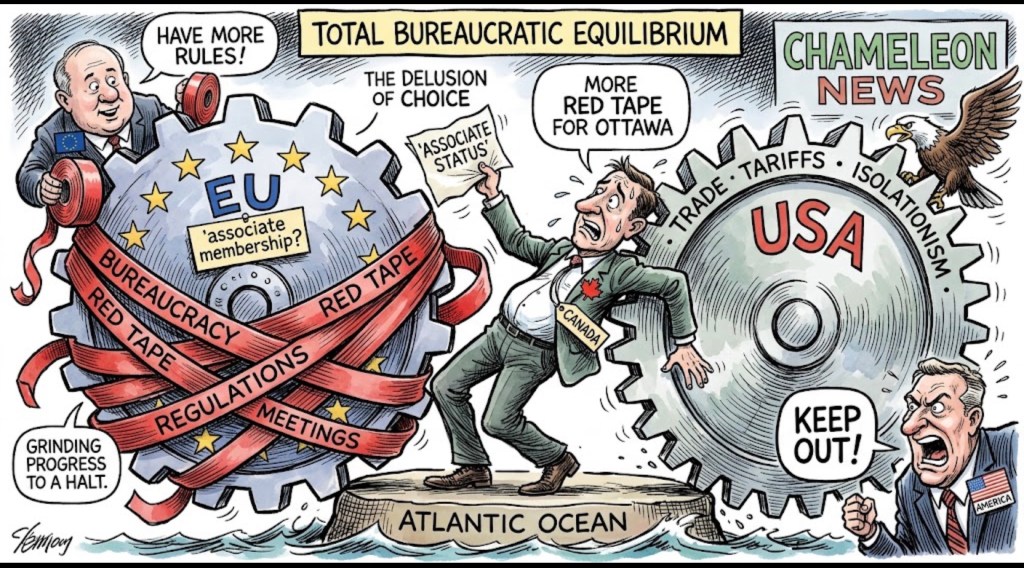
The diplomatic geopolitical masterstroke of the decade has finally landed. Saddled with mounting trade tensions and unpredictable noise from their powerful southern neighbor, Canadian politicians have hit upon a brilliant strategy: ask the European Union for an unprecedented “associate membership”.
The logic is breathtaking in its delusion. If Washington is giving Ottawa a headache, why not simply cross 3,000 miles of Atlantic Ocean to hitch your wagon to a 27-nation regulatory megabloc renowned worldwide for taking six years to standardise the curvature of a cucumber?
The Grand Strategic Retreat to Brussels
Diplomats in Ottawa are pitching this as a “unique alliance” that brings Canada closer to the European single market, defense, and research initiatives. Opponents scream that it’s a stealth takeover by European technocrats, while optimists dream of a frictionless transatlantic paradise where maple syrup flows freely down the Champs-Élysées.
The reality, naturally, is far more mundane.
What we are witnessing is not a dramatic geopolitical realinement, but a desperate cry for institutional comfort. Faced with aggressive American tariffs and unpredictable rhetoric, Canadian leaders have looked into the void and decided what they actually need is more paperwork. They don’t want a fight; they want a 400-page bilateral harmonization framework written in three official languages.
Brussels, of course, has reacted to the proposal with its signature brand of unbridled, soul-crushing enthusiasm. European officials didn’t reject the idea. They did something far worse: they opened a exploratory file.
Special envoys will be dispatched. Working groups will be formed. Joint committees on agricultural alignment, maritime quotas, and ethical forestry will convene in Strasbourg, Ottawa, and Geneva. Endless PowerPoint presentations will be delivered on whether Canadian poutine meets strict EU dairy purity directives.
And Then What?
So, after months of high-stakes headlines, tense summits, and grand speeches about protecting shared values, what actually changes?
Will a truck driver from Ontario be able to seamlessly drop off freight in Frankfurt without filling out a single customs form? Will a tech worker from Toronto suddenly have the legal right to pack up and open a café in Madrid overnight?
Of course not.
Instead, after three years of grueling negotiation, two trade minister resignations, and millions spent on transatlantic flights for civil servants, the public will be handed the ultimate prize: a non-binding Memorandum of Understanding on Mutual Regulatory Dialogue.
The grand outcome of this bold geopolitical pivot will consist entirely of:
A joint committee that meets twice a year to discuss timber standardisation.
A streamlined visa waiver application process that saves Canadians roughly four minutes at airport security.
A shared $12 million research fund to study clean energy transition in sub-arctic climates.
And, inevitably, the immortal diplomatic declaration from both sides that “deeply constructive lessons have been learned.”
The sheer proportion of political effort being burned here is magnificent. We are watching entire governments mobilize their top legal minds, issue endless press releases, and dominate global news cycles—all to achieve an outcome that could be summarized as a glorified trade newsletter.
If Canada genuinely wants to shield its economy from external trade shocks, the solution isn’t creating a fictional “associate EU status” that takes a decade to draft. It is doing the boring, unsexy work at home: cutting domestic inter-provincial trade barriers, investing in actual port infrastructure, and signing straightforward, binding trade deals with clear rules and real enforcement.
Instead, we get institutional theater at its absolute finest: maximum drama, endless meetings, and a treaty whose only practical effect will be keeping two hundred civil servants gainfully employed until retirement.
🔥 Challenges: Is Canada’s push for EU “associate membership” a visionary diplomatic pivot, or just an expensive way to add more red tape to every cross-border trade deal? Let us know your thoughts in the comments on the Chameleon News Blog!
Enjoyed this article? Don’t forget to LIKE, COMMENT, and SHARE with your friends!
🏆 The best comments will be included in the magazine.


Leave a comment