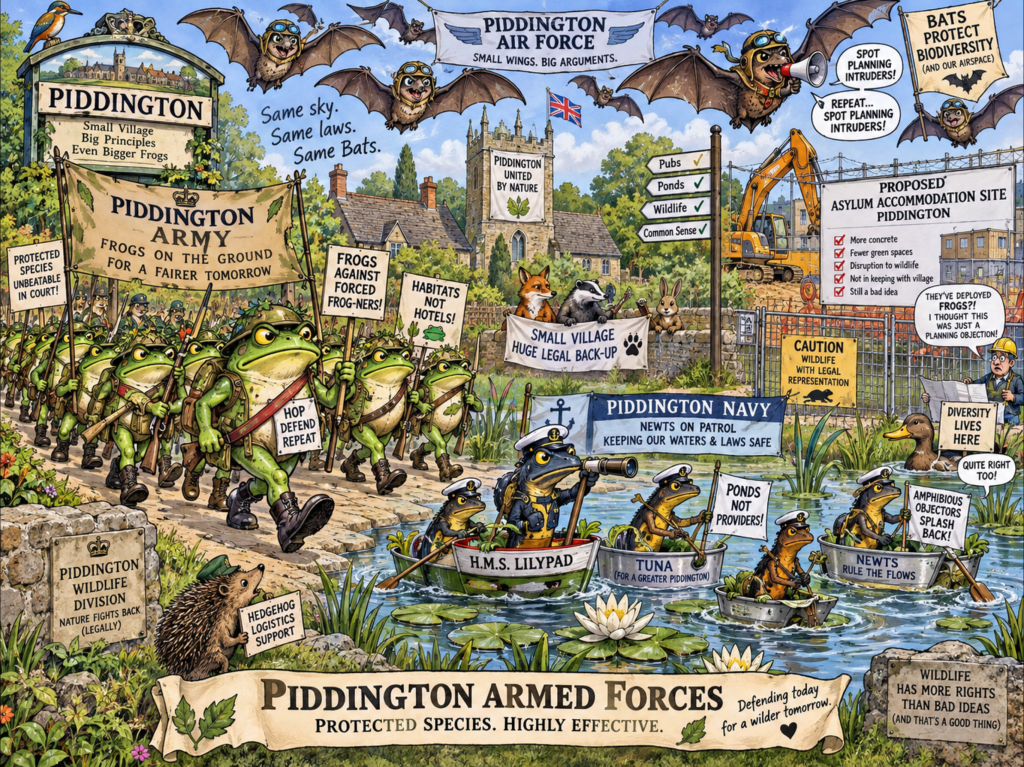
There is a long and noble British tradition of NIMBYism, but the fine citizens of Piddington have achieved something truly magnificent. Having exhausted the standard armoury of passive-aggressive parish council meetings, angry petitions, and solemn warnings about country traffic, Piddington campaigners opposing plans for a local asylum accommodation site have deployed Britain’s most formidable legal fighting force: protected amphibians.
Reports indicate that the Piddington campaign has expanded its ranks by recruiting great crested newts, bats, and rare frogs to halt the development. It is an inspired piece of tactical maneuvering. Human residents can be ignored, dismissed, or outvoted by planning inspectors. But a solitary, slightly moist amphibian crossing a Piddington lane carries the statutory weight of the High Court, the European Convention on Human Rights, and the wrath of God Almighty.
The Amphibian Injunction
Consider the sheer scale of institutional machinery now swinging into motion over this quiet corner of the countryside. When Piddington residents object to a facility, the council merely schedules another tedious meeting. But the moment a great crested newt is spotted on the proposed Piddington site, the entire apparatus of the British state grindingly shifts into gear.
Ecological consultants are dispatched at £1,500 a day to sit in high-vis jackets near a puddle. Environmental impact assessments, spanning four hundred pages of unreadable jargon, are commissioned to determine whether a local toad’s mental well-being might be compromised by human presence. The Home Office, armed with millions of pounds and the full authority of executive government, finds itself completely paralyzed by a creature that eats slugs and struggles to navigate a doorstep.
And what actually changes as a result of this colossal legal, financial, and administrative circus?
Nothing. Absolutely nothing, except the speed at which money is transferred into the bank accounts of environmental lawyers and ecological surveyors.
Lessons Will Be Surveyed
After eighteen months of headlines, emergency injunctions, judicial reviews, and frantic debates, we all know precisely how the battle of Piddington ends. The government will not simply abandon the site, nor will the locals accept defeat. Instead, a complex diplomatic compromise will be brokered between Her Majesty’s Government and the local pond life.
A seven-figure sum of public money will be spent constructing bespoke amphibian corridors under the Piddington access road. Plastic anti-newt fencing—the most expensive polythene in human history—will be erected along every perimeter. Construction will be delayed by two years to accommodate the delicate mating season of a specific species of bat. And at the end of it all, the asylum center will be built anyway, slightly to the left, while Piddington declares a moral victory because a frog was safely relocated three yards to the east.
After all this noise, expense, and institutional drama, what has actually been achieved? The taxpayers are poorer, the national policy backlog remains unchanged, and Piddington is still furious—only now it is furious right next to an extremely well-funded reptile sanctuary.
If our planning system is so hopelessly compromised that a major government infrastructure decision hinges on whether a crested newt happens to be hibernating under a piece of rotovated turf, perhaps the solution isn’t more eighteen-month ecological surveys. Plain English rules, clear legal thresholds, and a planning regime that doesn’t treat every ditch in Piddington as a UNESCO World Heritage site might actually allow decisions to be made in under a decade. Until then, the state remains powerless, and the humble pond-dweller reigns supreme.
🔥 Challenges: Should the residents of Piddington hand over full legal representation to the local frog population? Tell us your thoughts specifically on the Chameleon News blog!
Like, comment, and share this article if you’ve ever been outmaneuvered by a toad!
🏆 The best comments will be included in the magazine.


Leave a comment