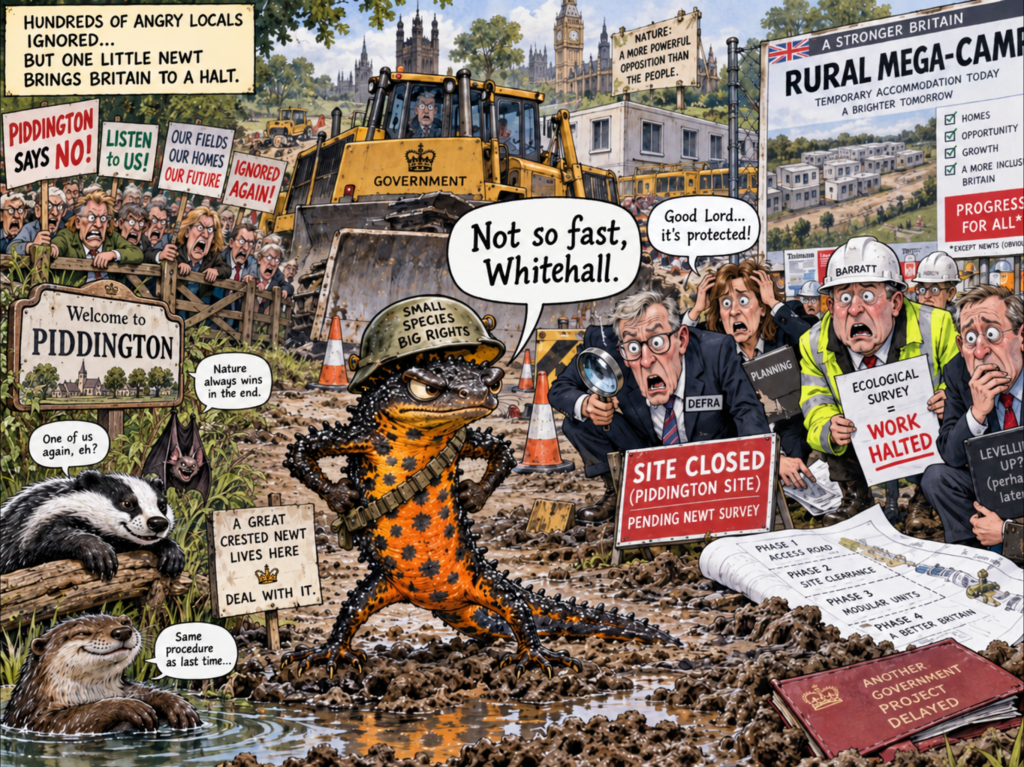
Whitehall can easily ignore 358 furious local residents, a dozen angry letters to the editor, and a petition signed by everyone down at the parish hall. But the moment a four-inch amphibian with a high-visibility orange belly turns up on a surveyor’s clipboard, the entire apparatus of the British state hits the emergency brakes.
The government’s grand proposal to install a massive temporary accommodation facility for up to 1,256 people complete with modular housing, security fencing, and new roads was proceeding with all the relentless momentum of central authority. Local campaigners argued against the disruption, the scale, and the sheer absurdity of dumping a small town’s worth of infrastructure into a quiet rural community. Whitehall barely blinked. Then the campaigners checked the biological records and discovered that the site appears to be inhabited by great crested newts, bats, badgers, and otters—species that possess something local human taxpayers can only dream of: statutory legal protection.
The Unstoppable Force Meets the Protected Crest
The government confirmed on 14 September that no final decision has actually been made on the site and that the project remains subject to feasibility, due diligence, and formal planning assessments. However, the ecological documentation accompanying the proposal somehow managed to miss the potential presence of these legally protected residents. This is not a minor administrative typo. Under British environmental law, you cannot simply bulldoze over a great crested newt because a civil servant has a target to meet.
If a site contains protected species, the law requires exhaustive ecological surveys, elaborate mitigation strategies, and potentially a formal licence from Natural England. Depending on what those surveys turn up, the developer faces a tedious gauntlet of forced redesigns, multi-month delays, expensive habitat creation schemes, or a direct legal challenge to the entire planning application.
So the government finds itself in a magnificent institutional trap. The state can comfortably brush aside human objections, but it remains entirely helpless against a tiny, slimy creature that spends most of its life sitting in a damp ditch doing absolutely nothing.
The Endless Ritual of Ecological Mitigation
And what happens next? What actually changes after the lawyers assemble and the ecological consultants invoice their astronomical fees?
Predictably, we are about to enter a multi-month spectacle of pure bureaucratic theatre. The mega-camp will not be cancelled outright tomorrow by a sudden flash of ministerial common sense. Instead, an army of specialists in hi-vis jackets will descend upon the hedgerows with tiny plastic traps and high-frequency bat detectors. Hundreds of thousands of pounds of public money will be spent determining whether a specific pond contains a protected amphibian population, followed by months of meetings to negotiate an acceptable mitigation strategy.
Ultimately, the most likely outcome of this immense institutional drama is not a victory for sensible planning or local democracy, but a compromise written by environmental lawyers. The taxpayer will fund a bespoke, multi-million-pound amphibian relocation corridor, complete with specialized newt fencing and artificial hibernacula, just so the government can build its modular camp fifty yards to the left.
Instead of addressing the core issue—whether dumping massive infrastructure into tiny villages without proper local assessment is a sensible way to run a country—the state will simply spend half a year learning how to build a luxurious retirement village for newts before carrying on regardless.
If planning authorities want to save time, money, and sanity, the solution is embarrassingly simple: conduct thorough, honest ecological and community impact assessments before announcing national projects, rather than relying on local volunteers to point out that the site is already occupied by protected wildlife. Until then, the British planning system remains an absurd game of chance, where three hundred citizens have no voice, but one small lizard holds an absolute veto.
🔥 Challenges: If a small amphibian has more legal leverage over Whitehall than an entire parish council, should we just appoint the great crested newt as the Head of the Planning Inspectorate? Share your thoughts on the Chameleon News blog below!
Like, comment, and share this article to keep the conversation going!
🏆 The best comments will be included in the magazine.


Leave a comment