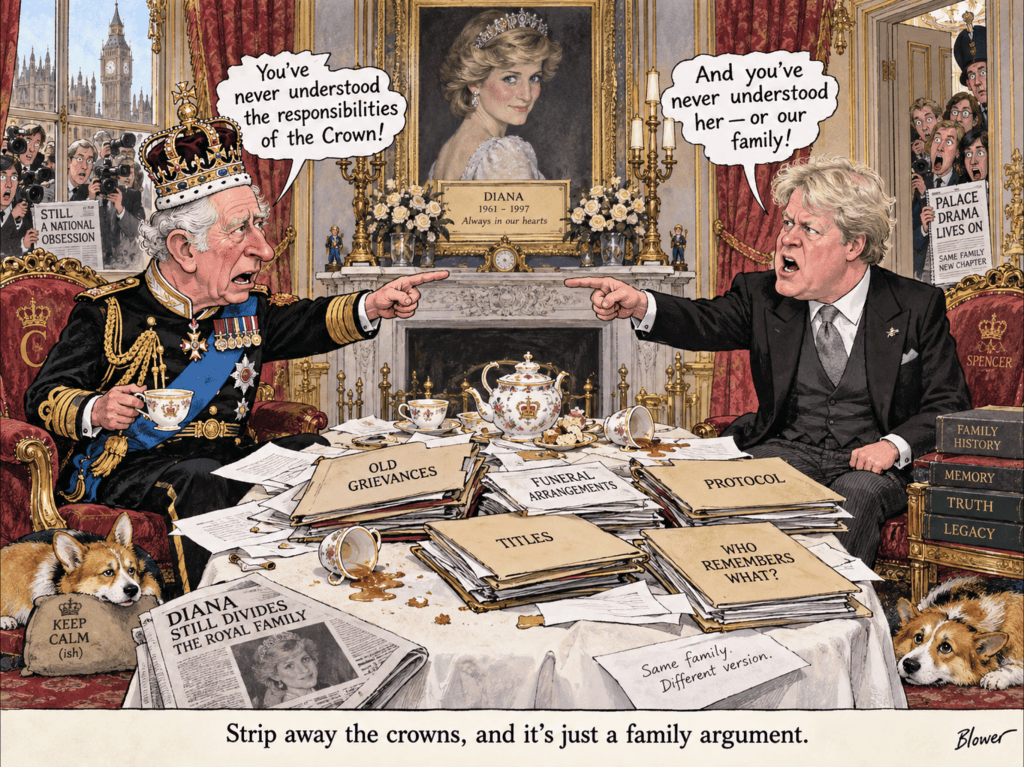
Nearly three decades after the tragic passing of Princess Diana, the nation has once again been dragged into the living-room skirmishes of the aristocracy. Earl Spencer has surfaced to double down on his memory of a heated phone call with the then-Prince Charles back in 1997. Buckingham Palace, in a move of exquisite passive-aggressiveness, responded by gently suggesting that grief can do funny things to a man’s memory. It is the ultimate upper-class dispute: one side holds an unshakeable grudge; the other implies you are simply losing your marbles.
Lessons Will Be Ignored
What we are witnessing is not a constitutional crisis, but a standard family row played out via institutional press offices. Strip away the velvet, the centuries of divine right, and the heraldic titles, and this is identical to two estranged uncles arguing over who left the freezer door open at Christmas—except it involves courtiers, royal correspondents, and millions of pounds of public bandwidth.
Naturally, the institutional machine has sprung into action. Advisers are holding strategic briefings, royal commentators are analyzing tone, and both camps are issuing carefully calibrated statements designed to sound dignified while landing maximum personal damage. The machinery of state, media, and public relations is operating at full capacity to process a squabble that could easily be resolved with a short, painful, muted family WhatsApp thread.
And then what? What actually changes as a result of this massive outlay of public attention, historic outrage, and high-level PR maneuvering?
Nothing. Absolutely nothing.
When the dust settles on this latest round of royal memory-wars, no policy will be rewritten, no constitutional precedent will be set, and no ancient estate will change hands. There will be no tribunal, no independent inquiry, and no binding arbitration. Instead, after months of solemn panel discussions and front-page news, we will arrive at the familiar British destination: a polite statement expressing deep mutual respect, a subtle briefing from a “friend of the family,” and the implicit understanding that lessons have been selectively learned.
The practical alternative to this grand institutional theatre is disarmingly simple: treat personal family grievances as personal family grievances. If two wealthy men in their sixties cannot agree on what was said on a landline in 1997, the state need not convene to deliberate. Clear boundaries, quiet private resolution, and an absolute ban on using royal press offices as personal revenge vehicles would spare the public yet another cycle of high-stakes melodrama with zero practical outcome.
Until then, we remain trapped in an eternal cycle where the most privileged people in the country use the full apparatus of the British establishment to conduct arguments that normal families resolve by ignoring each other at weddings.
🔥 Challenges: Should the monarchy’s personal family disputes be handled behind closed doors, or does the public have a right to every detail of royal history? Drop your thoughts below and join the debate on the Chameleon News blog!
Like, comment, and share this article to keep the conversation going!


Leave a comment