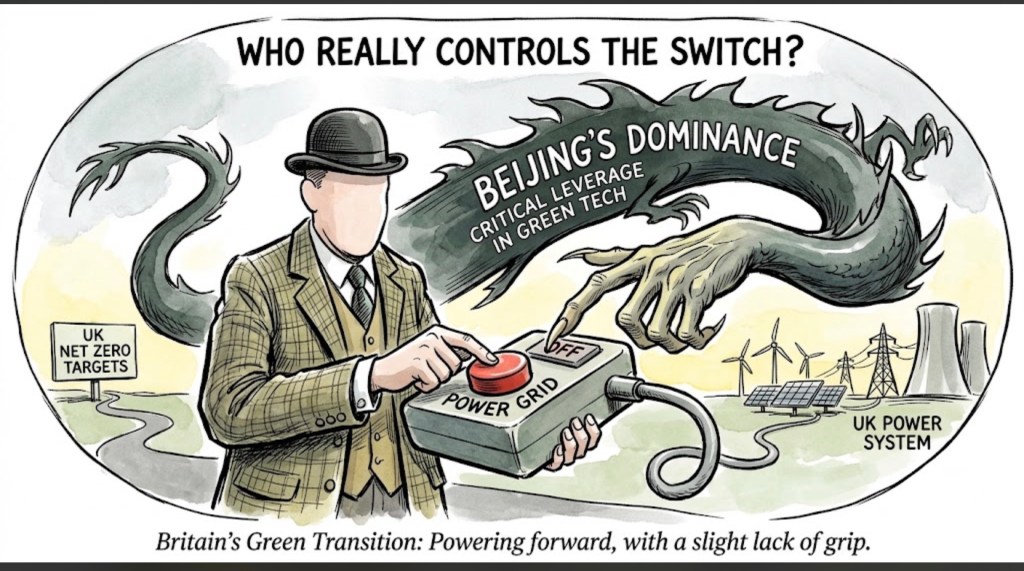
Having successfully outsourced our entire manufacturing base, our steel industry, and the ability to build a railway line to Birmingham, Whitehall has hit upon its next great strategic triumph: handing the remote control for the entire British electricity grid directly to Beijing.
Lessons Will Be Learned (In Mandarin)
According to a flurry of breathless reports and solemn parliamentary warnings, the UK’s frantic rush toward Net Zero has created a mild, almost imperceptible design flaw. Namely, that virtually every solar panel, battery storage unit, and smart inverter currently plugged into the British countryside was manufactured in China. Experts now warn that Beijing could theoretically flick a switch in Guangdong and plunge three-quarters of Sussex into medieval darkness.
Naturally, the institutional response to this existential national security threat has been swift, decisive, and relentlessly bureaucratic. Whitehall has done what Whitehall does best: it has convened a taskforce.
Ministers have launched an urgent inquiry, civil servants are drafting a comprehensive risk-management framework, and parliamentary committees are preparing to issue a sternly worded report sometime in late 2028. White Paper after White Paper will be published, complete with glossaries defining terms like “supply chain resilience” and “strategic autonomy.”
And then what? What actually changes?
Absolutely nothing. Because once the meetings conclude, the risk assessments are filed, and the ministers finish looking deeply concerned on the evening news, Britain will quietly go right back to buying half a million budget solar panels from China.
The alternative, after all, would require building our own factories, mining our own minerals, or—heavens forbid—asking British taxpayers to pay double for a domestic solar panel that takes four years to clear local planning permission. When forced to choose between a mild threat of foreign espionage and the terrifying prospect of failing to meet a self-imposed climate deadline, the government will choose the cheap batteries every single time.
If Beijing ever decides to shut down our energy infrastructure, the official British government retaliation will be devastating: a six-month delay on a bilateral trade summit, a polite statement from the Foreign Office expressing “grave concern,” and a quiet promise that lessons will indeed be learned.
The practical solution, of course, isn’t particularly complicated. If you don’t want a foreign superpower to hold the kill-switch to your national grid, you either diversify your supply chains properly, enforce strict security standards on imported infrastructure software before it’s plugged into the wall, or build the hardware yourself. But doing any of that requires long-term planning, actual industrial strategy, and money—three things currently in exceedingly short supply.
Until then, we can all rest easy knowing that while Britain may not control its own electricity supply, we lead the world in producing high-impact policy briefs about the danger of losing it.
🔥 Challenge: If Beijing actually turned off the UK power grid tomorrow, do you think Whitehall would notice the blackout before or after they finished drafting the 400-page impact assessment? Drop your thoughts in the comments on the Chameleon News blog!
Enjoyed this piece? Don’t forget to LIKE, COMMENT, and SHARE with your friends!


Leave a comment