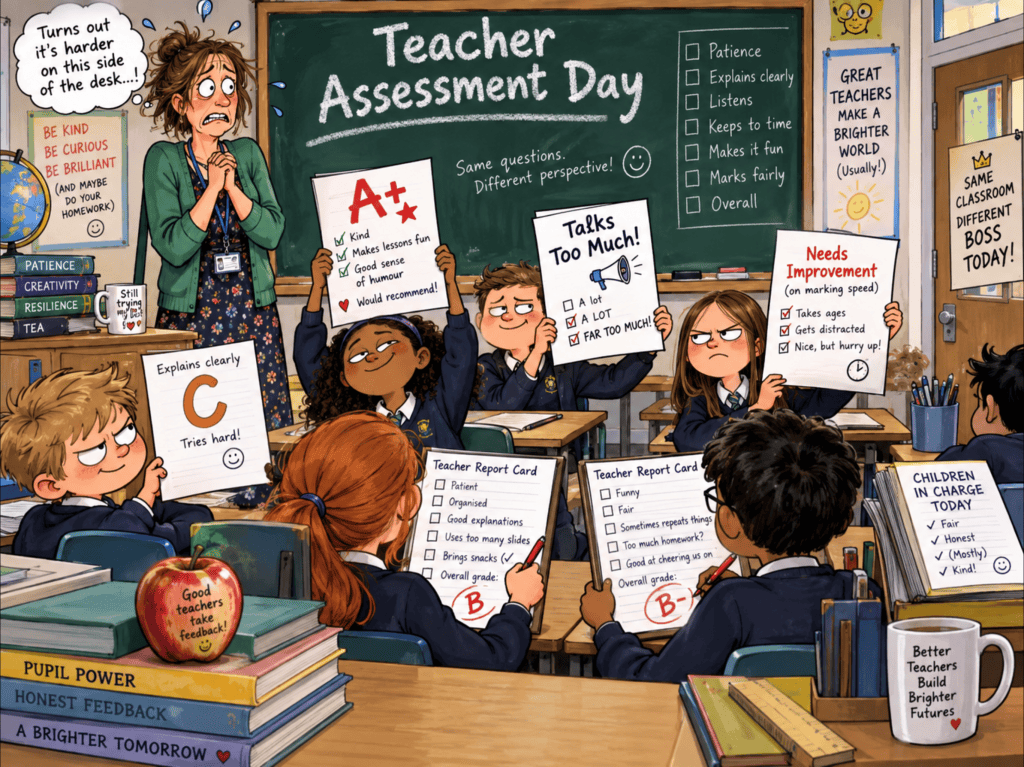
There is something magnificently British about an education system built around assessment discovering that assessment can be terribly stressful when the red pen points the other way.
Headteachers in England, through the National Association of Head Teachers, are calling for Ofsted to pause grading under its new inspection framework. Their argument is serious: the union says inspections are causing considerable stress and harm to some school leaders, and it has presented evidence to Education Secretary Lucy Powell about the effect the system is having.
Fair enough. Nobody should dismiss genuine concerns about workplace pressure.
But the irony is sitting in the classroom with its hand enthusiastically raised.
Welcome to the School of “Assessment Is Important, Except When It’s Us”
Children spend their entire school lives being assessed. Tests, coursework, predicted grades, attainment levels, mock exams, final exams, attendance records, behavioural reports and progress reviews. From roughly the moment they learn to hold a pencil, somebody begins measuring how well they are holding it.
Parents are told assessment is necessary because standards matter.
Universities assess students. Employers assess staff. Hospitals inspect clinical performance. Airlines examine pilots. Engineers have their work checked because bridges collapsing tends to produce rather poor customer feedback.
Yet when Ofsted turns up with the educational equivalent of a clipboard, suddenly the philosophical foundations of grading appear open to negotiation.
To be accurate, Ofsted no longer gives schools one overall label such as “good” or “outstanding”. Since November 2025, schools have instead received report cards grading different areas on a five-point scale: “exceptional”, “strong standard”, “expected standard”, “needs attention” and “urgent improvement”. Ofsted says the purpose is to give parents a more detailed picture rather than reducing an entire school to one word.
In other words, Ofsted has already done what teachers frequently tell pupils to do: provided more detailed feedback.
Apparently even that can still earn you detention.
The strongest case made by school leaders is not that accountability should disappear altogether. It is that the present system may be excessively stressful and that grading itself can turn inspection into a high-stakes event rather than a constructive exercise. That deserves examination, particularly after the tragic death of headteacher Ruth Perry became central to the debate over inspection reform.
But here comes the uncomfortable question.
If grading creates unhealthy pressure, what exactly are we teaching children every day?
Because pupils are routinely told that examinations are stressful but necessary. They are expected to prepare properly, perform under scrutiny, receive a result and cope with it. Nobody cancels GCSE mathematics because Dylan from Year 11 reports that algebra is affecting his work-life balance.
We tell children that resilience matters.
We tell them that constructive criticism helps them improve.
We tell them that results identify strengths and weaknesses.
Then the adults receive “Needs Attention” and begin looking for the appeals procedure.
Ofsted, for its part, says the new system was specifically designed to be fairer and more collaborative, while giving parents clearer information. Schools receiving weaker assessments can also receive additional monitoring so improvements can be checked.
And that is where the argument becomes more important than the comedy.
Parents surely have a right to know whether the school educating their child is performing properly. Teachers and headteachers equally have a right to an inspection system that is proportionate, evidence-based and does not manufacture unnecessary pressure simply to satisfy bureaucracy.
Those two things are not mutually exclusive.
The answer cannot be to pretend assessment itself is the problem whenever the people being assessed dislike the consequences.
If Ofsted’s methodology is unfair, fix the methodology.
If inspectors are inconsistent, improve consistency.
If inspections generate pointless mountains of paperwork, remove the paperwork.
If the grading criteria are unreasonable, rewrite them.
But accountability should survive the reform.
Otherwise we arrive at the extraordinary educational principle that grades are excellent instruments for motivating improvement right up until somebody reaches the staffroom.
And then what?
Pause grading, conduct another review, establish another working group, commission another report, hold stakeholder meetings, produce revised guidance and eventually announce a “new collaborative accountability framework” containing absolutely no frightening words such as grade, score or failure.
Perhaps every school could simply receive a certificate saying:
“You participated brilliantly.”
Parents may find that slightly less useful when deciding where to send their children.
The sensible objective should be simple: inspect schools fairly, judge them against clear standards, support those that need improvement and protect staff from genuinely unreasonable processes.
Because accountability without humanity is bad management.
But humanity without accountability is just everybody marking their own homework.
🔥 Challenges: If pupils are expected to accept grades, exams and assessments as part of improving their performance, should schools and their leaders also expect meaningful grading — or has Ofsted created a system so stressful that the method of accountability now needs another rethink? Tell us what you think on the Chameleon News blog.
🔥 COMMENT. LIKE. SHARE. And perhaps, just this once, feel free to grade the article.


Leave a comment