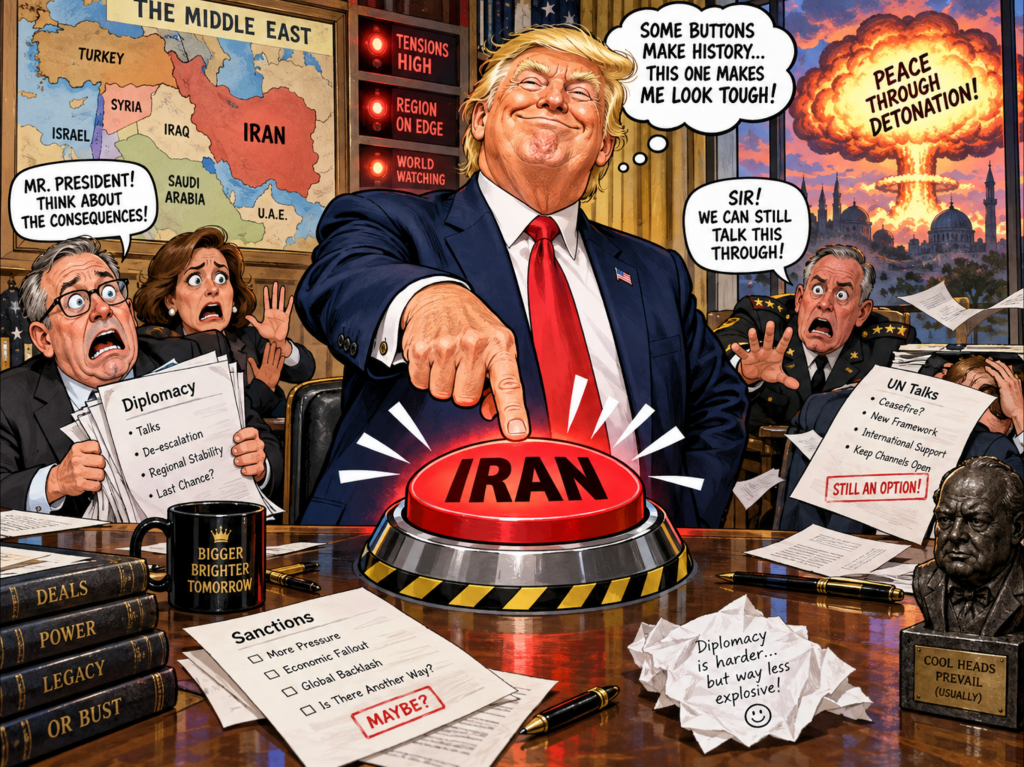
There was a time when presidents discussed war using carefully polished phrases such as “all options remain on the table”. Donald Trump has apparently decided the table is unnecessary. Asked about Iran, the US president said his question was essentially whether — and when — to “blow the entire nation up”, while also describing alternatives of further economic pressure or reaching a deal.
That is quite a range of diplomatic options. Negotiate. Squeeze the economy. Or remove several hundred thousand square miles from the Middle East.
Diplomacy, but with considerably more explosives
Trump told Fox News that he was in “deciding mode” and suggested “very big things” could happen soon. Iran, meanwhile, has warned that another American attack would bring retaliation against US interests and bases in the region. At the same time, Trump has said he would “probably” be open to meeting Iranian President Masoud Pezeshkian while both are in New York for the United Nations General Assembly.
So we have reached that wonderfully modern stage of international diplomacy where one leader can contemplate meeting another for talks while simultaneously discussing whether his country should be blown up.
Presumably the UN catering department is still preparing the coffee.
The important distinction, however, is between rhetoric and an actual military decision. Trump’s language is extraordinary, but saying something explosive on television is not the same thing as issuing operational orders to the Pentagon. Reports indicate that Washington is considering several courses of action, including diplomacy and further economic pressure as well as military escalation.
And that is where the real story sits.
The world gets the headline: TRUMP CONSIDERS BLOWING UP IRAN.
Governments get security alerts. Markets watch oil. Diplomats start ringing one another. Military commanders review contingencies. Television studios discover another enormous electronic map of the Middle East.
Then everyone waits to discover whether the policy behind the headline is actually different from the policy that existed before it.
That distinction matters because threatening to destroy a country is easy. Deciding what happens the morning afterwards is considerably harder.
Iran is not an empty patch of desert containing a government building with a large red arrow pointing towards it. It is a country of roughly 90 million people, sitting beside some of the most economically and strategically important waterways on Earth. Escalation could affect civilians, US forces, neighbouring states, shipping and energy markets, while Iran has explicitly threatened retaliation if attacked again.
Which brings us to the missing sentence in most dramatic discussions of war:
And then what?
Suppose America launches major strikes. What is the political objective? Regime change? Deterrence? Negotiation? Destruction of military capability? Reopening shipping routes? A better deal?
Those are rather different missions.
“Blow everything up” may fit comfortably into a television soundbite. It is less useful as a post-war reconstruction programme.
The irony is that diplomacy remains on the table even while the language becomes apocalyptic. Trump has indicated openness to meeting Pezeshkian during the UN gathering, while Qatar has reportedly been involved in contacts aimed at restarting negotiations.
Which suggests that somewhere underneath the fireworks, the traditional machinery of international relations is still grinding away: intermediaries talking, diplomats negotiating, governments testing conditions and everyone trying to discover what the other side will actually accept.
That is probably less exciting than threatening national obliteration.
Unfortunately, international relations usually is.
The practical alternative is painfully boring: define the objective, establish what Iran must do, establish what America will do in return, maintain credible deterrence and negotiate wherever negotiation can achieve the same objective without adding another war to a region already overflowing with them.
Not much of a television trailer.
But perhaps foreign policy occasionally benefits from being boring.
Because once presidents start publicly discussing whether to “blow the entire nation up”, the central question is no longer whether the rhetoric sounds tough.
It is whether anybody has worked out what happens after the smoke clears.
🔥 Challenges: Is language like this useful deterrence because opponents believe the threat might be real, or does publicly discussing the destruction of an entire country make diplomacy harder and escalation more likely? Join the discussion specifically on the Chameleon News blog.
🔥 Comment. Like. Share. And tell us what you think happens when diplomacy starts sounding like the instruction manual for a detonator.


Leave a comment