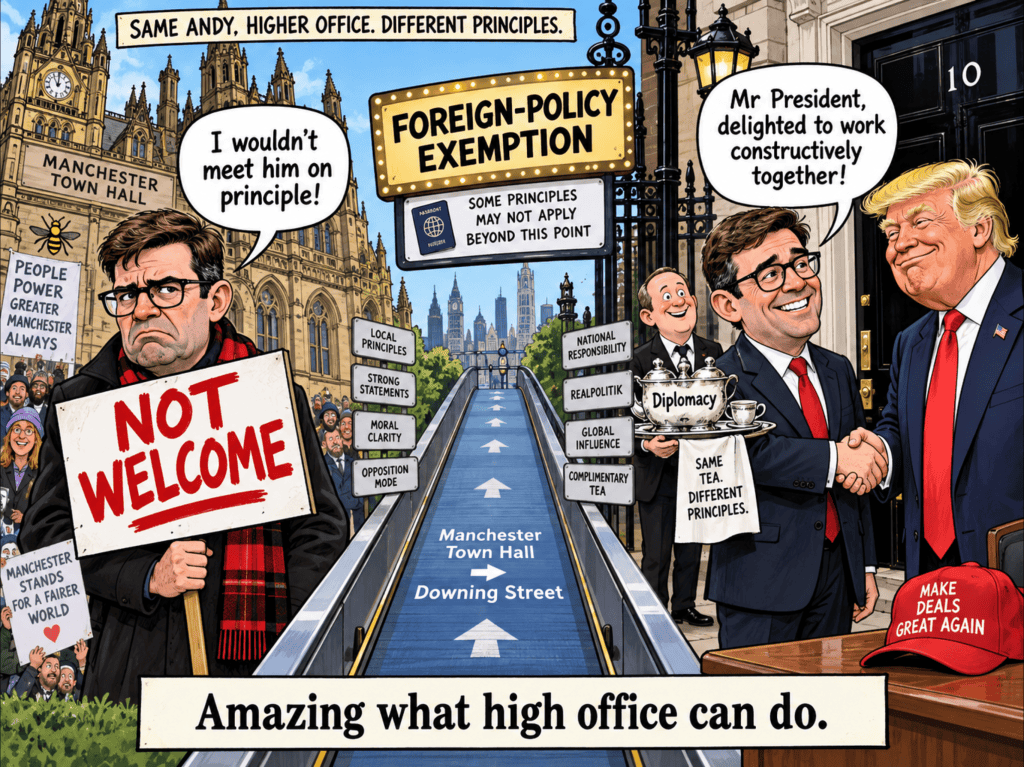
☕🇺🇸Andy Burnham’s position on Donald Trump has certainly travelled. As Greater Manchester mayor, Burnham said in 2017 that he would refuse to meet Trump “as a matter of principle”, and later said Trump was not welcome in Manchester. After the 2021 Capitol riot, he said British politicians who gave Trump “the time of day” should be ashamed.
Now Burnham is Prime Minister — a role he took on July 20, 2026 — and the language is markedly different. He has spoken with Trump, invited him to Manchester, described their first exchange positively and, ahead of their September meeting, talked about trust, pragmatism and protecting the UK-US relationship.
🚪 Amazing What Happens When the Door Says “10 Downing Street”
There are few journeys in British politics quite as efficient as the one from “I wouldn’t meet him” to “Mr President, Manchester would be delighted to have you.”
No passport required. No connecting flight. Apparently you just need a removal van from Greater Manchester and the keys to Number 10.
Back when foreign policy was largely somebody else’s headache, Burnham could afford the luxury model of political principle: reinforced moral chassis, leather upholstery and absolutely no awkward bilateral meetings.
Then came the premiership.
Suddenly America isn’t merely a country containing a politician you dislike. It’s Britain’s biggest security partner, a central NATO power, a crucial player on Ukraine and a government whose cooperation matters on defence, trade and the Middle East. Reuters reports that Burnham is approaching his first face-to-face meeting with Trump with “pragmatism” in mind.
And voilà: the megaphone goes into storage and somebody wheels out the diplomatic crockery.
☕ “Common ground?”
“Certainly, Prime Minister.”
☕ “Constructive relationship?”
“Coming right up.”
☕ “Would you also like the special relationship?”
“Oh yes. Extra strong.”
None of this necessarily means Burnham’s earlier objections disappeared. His government can argue that running the country requires dealing with leaders you profoundly disagree with — which is, inconveniently for satire, a fairly ordinary feature of diplomacy.
But that doesn’t make the contrast any less spectacular.
The man who once treated giving Trump “the time of day” as something shameful is now publicly saying he trusts the US president and stressing the depth of the bilateral relationship.
Politics, ladies and gentlemen: where principles remain absolutely immovable until they encounter national security, international trade, NATO, Ukraine, energy prices and a scheduled bilateral at the United Nations.
Yesterday: “Not welcome.”
Today: “We trust our allies.”
Tomorrow?
📸 Handshake.
🇬🇧🇺🇸 Flags.
📝 Communiqué.
And the immortal phrase beloved of governments everywhere:
“The leaders held warm and productive discussions.”
Perhaps Burnham hasn’t abandoned his principles at all.
Perhaps he’s simply discovered the small print:
Terms and conditions apply. Not valid when serving as Prime Minister.
🔥 Challenges 🔥
So what do you reckon: hypocrisy, political maturity, or simply the unavoidable reality that prime ministers have to talk to people they once condemned?
That’s the interesting bit — because the change in rhetoric is real, but what it means is where the argument begins. Drop your verdict in the blog comments and tell us where you think principle ends and governing begins. 💬👇
Comment, like and share the post — and bring your sharpest argument with you.
The best comments will be included in the magazine. 🎯📝


Leave a comment