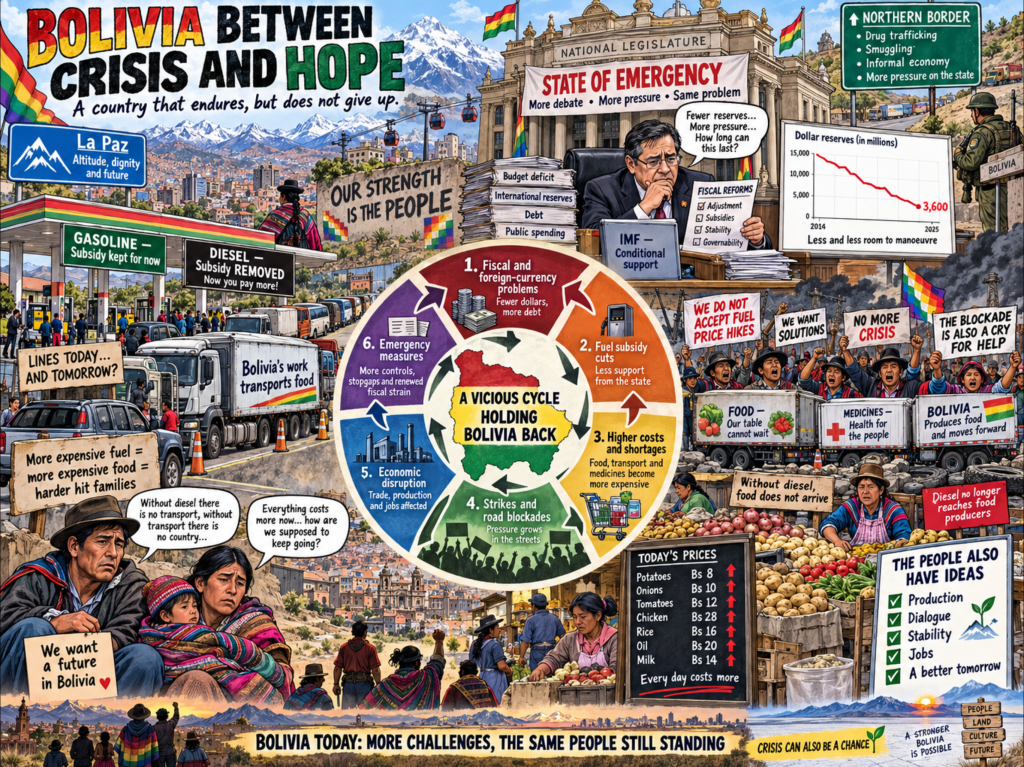
⛽🔥🇧🇴Bolivia has found itself trapped in an economic feedback loop with all the charm of a washing machine full of bricks: fiscal pressure leads to subsidy reform, subsidy reform raises fears about costs, unrest disrupts supplies, shortages make the economy worse, and the government responds with emergency measures intended to stop the disruption.
At the centre is President Rodrigo Paz’s economic programme and a roughly $1.9 billion IMF agreement, approved by Bolivia’s Congress but, as of 19 September, still awaiting final approval from the IMF Executive Board. The programme is intended to stabilise public finances and potentially open the door to billions more in international financing. Diesel subsidies have now been scrapped, while petrol subsidies remain in place for the moment. (AP News)
⛽ When the Fuel Tank Becomes the National Mood Ring
For years, subsidised fuel helped hold down transport and production costs. The problem is that subsidising imported fuel becomes rather expensive when the government itself is short of foreign currency.
The Paz government argues the previous system could not continue indefinitely. Labour organisations and other opponents of the reforms argue that removing support risks pushing transport, farming, manufacturing and ultimately food prices higher. Both sides are arguing over the same deeply inconvenient object: a national balance sheet that stubbornly refuses to run on political slogans.
Meanwhile, fuel shortages have already caused disruption. Earlier in 2026, more than 50 days of road blockades interfered with supplies of food, fuel and medicines and worsened the wider economic crisis. (Reuters)
Then comes the political problem.
Supporters of former president Evo Morales, including cocaleros, farmers and other social organisations, have participated in demonstrations against Paz government economic measures. Some earlier protests also demanded Paz’s resignation. (EFE Noticias)
So Bolivia has acquired the economic equivalent of one of those circular diagrams consultants love drawing:
budget and foreign-currency pressure → subsidy reform → higher-cost fears and fuel disruption → strikes and blockades → more economic damage → emergency powers → repeat as necessary 🔄
On 17 September, Bolivia’s legislature approved another 90 days of the state of emergency, after the government cited police and military assessments warning of further blockades, marches and strikes. Government ministers say the measure is meant to protect movement, economic activity and supplies including food, medicine and fuel. Critics argue emergency measures address disruption without resolving the economic grievances behind it. (Ministerio de Gobierno de Bolivia)
And even the economic team has taken casualties. Economy Minister José Gabriel Espinoza was dismissed on 21 August, after lawmakers censured him for failing to attend a legislative interpellation on government economic policy. (EFE Noticias)
In other words, this isn’t simply a story about people being angry because diesel costs more.
It is a collision between depleted public finances, fuel dependence, organised social movements, a government attempting rapid economic reform and a political system in which blocking a highway remains considerably easier than repairing a balance sheet.
There is a separate security concern too. The government has also pointed to organised-crime pressure near Bolivia’s border with Brazil when discussing national security risks, although that is distinct from the immediate dispute over subsidies, fuel and economic policy. (El País)
🔥 Challenges: Can Bolivia Break the Loop Without Breaking the Country?
Here’s the difficult question: how do you repair government finances when the cure can make daily life more expensive before the benefits arrive?
Cut subsidies too rapidly and households, transport operators and producers can absorb the shock. Keep financing them indefinitely and the state risks burning through money it increasingly does not have. Add political mobilisation and road blockades, and suddenly an economics problem becomes a transport problem, a food problem and a government problem simultaneously.
So what would you prioritise: slower subsidy reform, stronger financial support for households, tougher action against disruptive blockades, or an entirely different economic strategy?
💬 Put your argument in the blog comments — not just on Facebook.
👇 Comment, like and share the post. Tell us what you think Bolivia should do next, and tell us why.
The strongest comments will be included in the next issue of the magazine. 🎯📝


Leave a comment