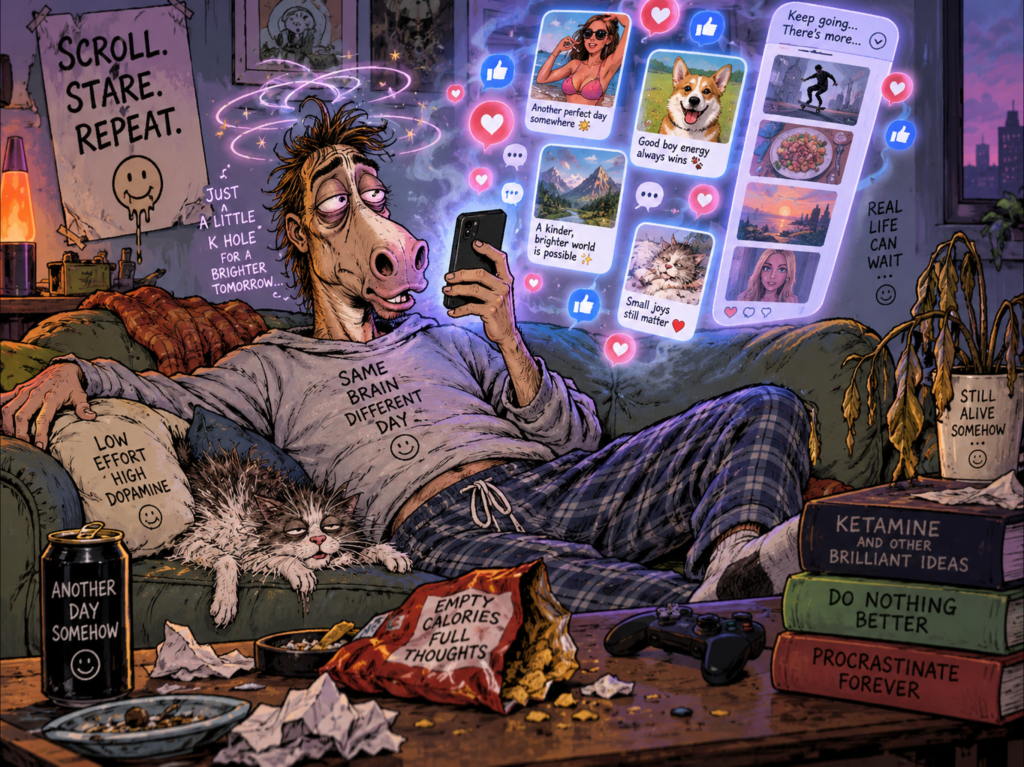
Britain is building an increasingly sophisticated system to stop children accessing social media.
Age checks. Platform duties. Ofcom enforcement. Restricted features. Corporate fines. From spring 2027, under-16s are due to face a much tougher regime for accessing social-media services.
Meanwhile, ketamine use among young people has been rising.
And that is the absurd contrast.
The state is developing technology to stop a fifteen-year-old opening TikTok — while still struggling to stop the same fifteen-year-old buying ketamine.
The difference in approach is striking.
With social media, government is trying to control access at the point of entry. Platforms must know who is using them. Features can be restricted. Companies can be punished. Regulators can intervene.
With ketamine, the drug is already illegal. Supply is already illegal. The health risks are already well known. Yet government advisers have acknowledged that use has continued to rise among younger people, while some recommendations from previous reviews remain incompletely implemented.
In other words, social media gets an enforcement architecture.
Ketamine gets another review.
That does not mean social-media regulation is pointless. Harmful online content, grooming, bullying and addictive design are real problems.
But look at where the energy goes.
For social media, the question is: How do we stop children getting access?
For ketamine, the question too often seems to become: How do we manage the damage once they already have?
That is the wrong way round.
If government can require billion-pound technology companies to redesign systems around child protection, it should be capable of applying equal urgency to disrupting the people supplying dangerous drugs to children.
The objective ought to be just as simple.
Make ketamine harder to buy.
Target the supply chains more aggressively. Act faster against repeat dealers. Put serious prevention work into schools and communities. Expand treatment before experimental use becomes dependency. Measure success by whether fewer young people are actually taking the drug.
Not by how many reports have been published.
Because reports are not prevention.
Warnings are not prevention.
Reclassifying a drug and then discovering years later that use is still increasing is not prevention either.
The uncomfortable truth is that social media is probably the easier problem for government to regulate.
There are identifiable companies. Headquarters. Compliance departments. Regulators. Terms of service. Algorithms that can be altered. Executives who can be summoned before committees.
Drug markets are messier.
They operate through criminals, local networks, encrypted messaging, street dealing and organised supply chains.
But difficulty is not an excuse for imbalance.
In fact, it should mean the opposite.
The harder problem deserves more effort, not less.
And that is where the whole thing starts to look ridiculous.
Britain may soon have a system capable of deciding whether a teenager is old enough to watch a thirty-second video online.
But that same teenager may still be able to buy ketamine from someone a few streets away.
So what exactly have we protected?
The smartphone?
There is a wider lesson here.
Government loves problems it can regulate visibly.
Create a regulator. Publish a code. Impose a duty. Launch a consultation. Announce a framework.
It looks like action because there is paperwork attached to it.
Real prevention is harder because it has to produce an actual result.
Fewer drugs on the street.
Fewer young people taking them.
Fewer hospital admissions.
Fewer families dealing with the consequences.
That is the comparison that matters.
Social media should be regulated where necessary.
But if Britain can summon enormous political, regulatory and technological effort to keep children away from Instagram and TikTok, it should be capable of showing the same determination over ketamine.
Otherwise we risk creating one of the strangest child-protection systems imaginable:
A country where a fifteen-year-old is considered too vulnerable to scroll social media unattended — but apparently old enough to navigate the illegal drug market.
🔥 Challenges: Why does stopping children accessing social media seem to attract more visible enforcement than stopping them accessing ketamine? Should the same urgency now be applied to drug supply and prevention? Have your say on the Chameleon News blog.
Comment. Like. Share. And tell us where you think the real child-protection priority should be.


Leave a comment