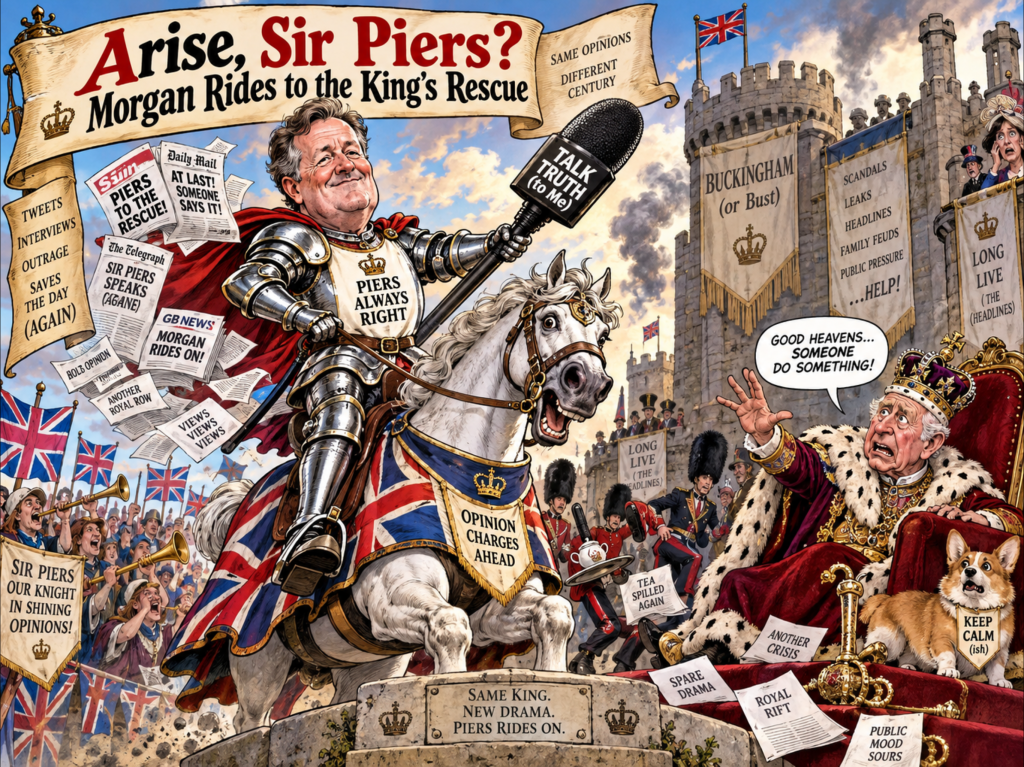
Piers Morgan has discovered something rather useful in Earl Spencer’s new book about Princess Diana: Spencer got something wrong about Piers Morgan.
And suddenly, apparently, the entire book is on trial.
Spencer’s memoir, Swan Song: Diana, My Sister, contains highly controversial allegations about King Charles, including Spencer’s claim that Charles behaved coldly after Diana’s death. Buckingham Palace has disputed Spencer’s account, saying grief can affect memory and judgement. The allegations remain Spencer’s account, not established fact.
But then Spencer made a much more dangerous mistake.
He mentioned Piers.
Never Waste a Good Error
Spencer incorrectly linked Morgan to the publication of intrusive gym photographs of Diana in 1993. Morgan pointed out, correctly, that he did not join the Daily Mirror until 1995. Spencer subsequently admitted that particular assumption was wrong and apologised.
Fair enough.
If somebody publishes a false statement about you, you are perfectly entitled to challenge it.
Morgan has now said he intends to take legal action against Spencer and the publisher despite the apology.
But Morgan has gone considerably further than correcting the passage about himself. He has used the error to challenge Spencer’s wider credibility, effectively asking: if this fact was wrong, what else in the book can be trusted?
And there lies the wonderfully convenient bit.
Because the most explosive claims in Spencer’s book are not actually about Piers Morgan.
They are about the King.
Charles Spencer alleges that after Diana died, the then Prince Charles behaved in a way Spencer regarded as shockingly insensitive. Buckingham Palace has issued a rare rebuttal, but the King himself is hardly going to appear on Good Morning Britain with Susanna Reid, a mug of tea and three decades of family correspondence spread across the desk.
Monarchs generally do not conduct public family arguments.
Piers Morgan, fortunately, suffers from no such constitutional restriction.
So into the breach rides Piers.
Not merely correcting what Spencer wrote about him, but attacking the credibility of the wider work and questioning whether the rest should be believed.
At this rate, somebody had better start measuring him for the ceremonial tights.
There is no verified evidence that Morgan is about to receive a knighthood for services to Charles III, of course. The current honours information I can find does not establish that. But as satire goes, the image is irresistible: Buckingham Palace maintains dignified restraint while Piers arrives outside Althorp carrying a legal letter and shouting, “Don’t worry, Your Majesty, I’ve got this.”
The problem is that one factual error does not automatically prove every other allegation in a book is false.
Nor does correcting one mistake prove the rest of the book is true.
It proves something much less exciting:
One mistake was wrong.
That is why evidence matters.
Spencer’s allegations concerning private conversations with Charles ultimately depend heavily on recollection. Buckingham Palace disputes the picture he paints. Other royal commentators and former staff have also challenged aspects of Spencer’s account.
Readers therefore have to decide what weight to give conflicting memories from an intensely emotional period nearly thirty years ago.
That is a legitimate debate.
But it becomes rather more entertaining when Piers Morgan finds himself simultaneously a complainant, critic, credibility inspector and apparently unpaid Palace artillery unit.
Morgan’s argument is straightforward enough: Spencer got a demonstrable fact about him wrong, so readers should scrutinise the rest carefully.
Quite right.
But scrutiny works both ways.
If we are going to examine Spencer’s claims closely, we should examine the rebuttals closely as well. We should distinguish provable factual errors from disputed recollections, and neither side should get to turn one victory into ownership of the entire truth.
Because otherwise we arrive at the magnificent modern system of historical investigation where whoever shouts “FALSE!” loudest on YouTube gets appointed chairman of the inquiry.
Spencer has already paid the price for his provable mistake: he corrected it and apologised. Morgan is entitled to pursue whatever legal remedies he believes appropriate, and a court may eventually determine whether anything defamatory occurred.
But the allegations concerning the King remain a separate question.
They cannot sensibly be disproved merely because Earl Spencer got Piers Morgan’s employment history wrong.
Nor can they be accepted simply because Spencer says he remembers them.
That leaves Britain exactly where Britain loves to be when Diana, the monarchy and the newspapers collide: staring into a fog of memories, grievances, old battles and people insisting that their version of history is the definitive one.
The King maintains royal restraint.
Earl Spencer sells the book.
And Piers Morgan, naturally, supplies the cavalry.
🔥 Challenge: Does Earl Spencer’s admitted error about Piers Morgan genuinely undermine the credibility of his wider allegations about King Charles, or is one mistake being used to discredit an entirely separate argument? Tell us what you think on the Chameleon News blog.
🔥 Comment. Like. Share. And if a knighthood does eventually arrive, somebody please check whether the citation reads: “For services to correcting Earl Spencer.”


Leave a comment