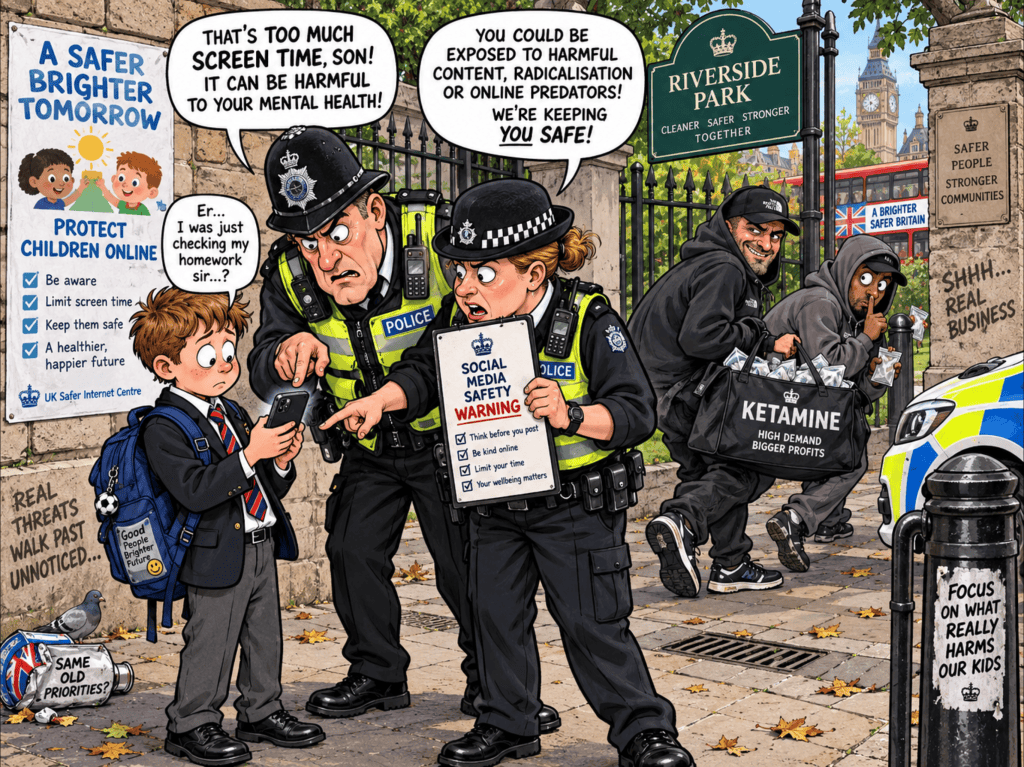
Britain has decided that one of the great threats facing young people is social media, and to be fair there are genuine reasons for concern. Online bullying, grooming, harmful content and addictive design are serious issues. The government has therefore been pushing tighter controls, age restrictions and limits on how young people use social platforms. All very worthy. All very visible. All very easy to turn into a ministerial announcement.
Meanwhile, in the less fashionable offline world, Britain also has a growing ketamine problem.
Border Force recently recorded its highest quarterly ketamine seizure in 15 years, with almost 1.3 tonnes seized in the first three months of 2026. The National Crime Agency has also reported a sharp rise in people entering treatment with ketamine problems, including a significant increase among children and teenagers. (gov.uk) (nationalcrimeagency.gov.uk)
And that raises an awkward question.
Why does social media seem to generate more political noise than a drug capable of causing serious bladder and urinary-tract damage?
The Convenient Villain
Social media is perfect political territory because it provides a neat villain. There are enormous companies, recognisable logos, algorithms, executives and apps that can be summoned before committees. Politicians can demand age checks, overnight restrictions, warning labels and new rules, then appear on television looking terribly determined.
Illegal drugs are much less cooperative.
Dealers do not attend stakeholder meetings. Smugglers rarely respond to consultations. Organised crime groups appear strangely reluctant to comply with new guidance from Whitehall.
That makes the drug problem harder, messier and considerably less suitable for a polished press conference.
The result is a strange imbalance. Britain can spend months debating whether teenagers should have access to social media after midnight while, in parts of the same country, young people can still obtain ketamine cheaply enough to cause a growing public-health problem.
That does not mean social media should be ignored. It means the national conversation about protecting young people has become far too narrow.
A teenager spending too much time scrolling TikTok may have a genuine problem. A teenager repeatedly taking ketamine until their bladder is permanently damaged has another problem entirely.
Both matter.
But only one seems capable of producing a national political crusade.
Government Is Doing Something — Just Not With the Same Volume
It would be unfair to say the government is completely ignoring ketamine. There have been public warnings, drug-awareness campaigns, treatment funding and significant seizures by Border Force. (gov.uk)
But that makes the contrast more striking, not less.
If authorities are seizing record quantities and treatment numbers are rising, then this is clearly not some obscure nightlife issue affecting a tiny group of people. It is a serious and growing problem.
Yet social media still attracts the louder political response because it is easier to regulate a platform than dismantle a drug market.
You can order Instagram to change its settings.
You cannot send a compliance notice to a criminal supply chain and expect it to apologise.
So government naturally gravitates towards the problem where government action can be seen.
The danger is that visibility gets confused with importance.
Protecting Children Means Looking Beyond the Screen
Britain could eventually end up with one of the most tightly controlled online environments for teenagers in Europe while still struggling to stop young people buying dangerous drugs offline.
That would be quite an achievement.
A 15-year-old might soon have to prove their age to access social media, face restrictions on harmful content and be pushed offline at midnight.
But if the same teenager can walk down the road and buy ketamine from somebody carrying a plastic bag, perhaps the country has not quite solved childhood after all.
The sensible answer is not to abandon online safety. It is to apply the same urgency to the drug problem.
That means prevention, treatment, policing, supply disruption and honest education about the physical damage these substances can cause.
Because protecting young people should not become a competition between fashionable dangers.
Government should deal with the problems that are hardest to solve, not merely the ones easiest to regulate.
Otherwise Britain risks congratulating itself for protecting children from scrolling while failing to protect them from something considerably more destructive.
And one day we may discover that switching off autoplay was the easy part.
🔥 Challenge: Are politicians concentrating too heavily on social media because regulating technology is easier than confronting Britain’s drug problem? Tell us what you think on the Chameleon News blog.
🔥 Comment. Like. Share. Protecting young people means looking at what is happening both on their phones and in the real world around them.


Leave a comment