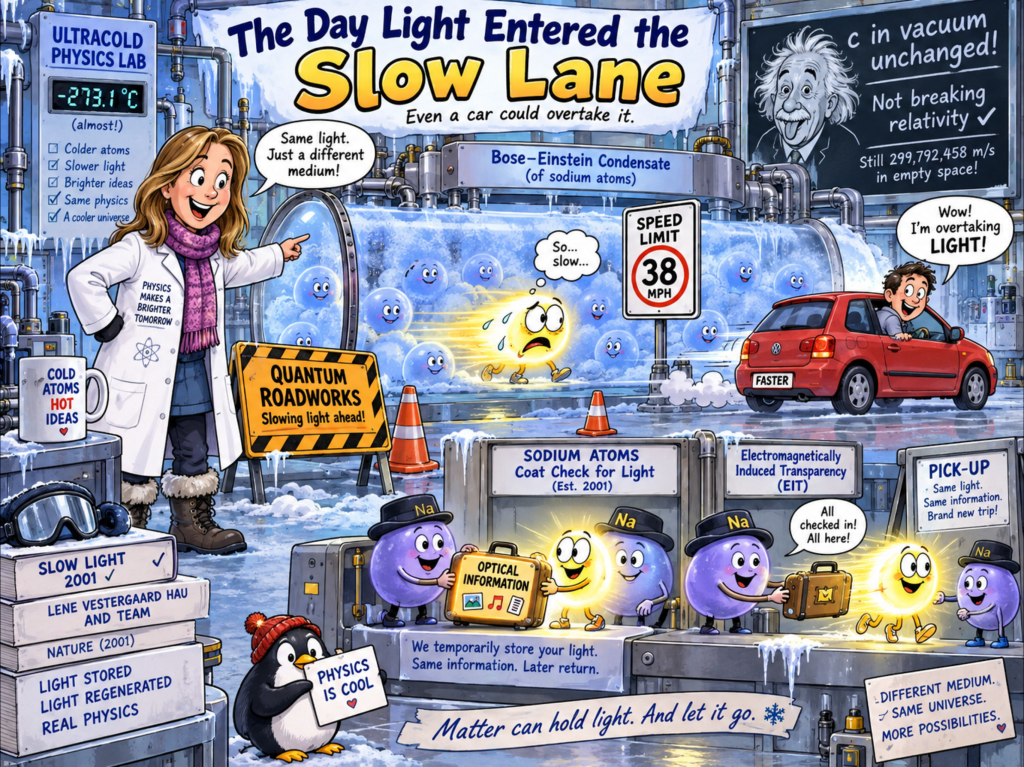
💡🚗In 1999, physicist Lene Vestergaard Hau and her team pulled off something that sounds less like laboratory science and more like someone discovering the “slow motion” button on the universe.
They sent a pulse of light through an ultracold cloud of sodium atoms and reduced its propagation speed to around 17 metres per second — roughly 38 mph.
That’s about 20 million times slower than light travelling through a vacuum.
Yes, you read that correctly.
Inside the experiment, an ordinary family hatchback could theoretically have overtaken the travelling light pulse. 🚙💨💡
And somehow, science textbooks remain considerably less excited about this than they ought to be.
⚛️Einstein Was Fine — Light Just Hit Quantum Roadworks
Before anybody declares that relativity has been cancelled and starts demanding refunds from Albert Einstein, there is an important catch.
Hau did not change the universal speed limit of light.
The constant c — around 186,282 miles per second in a vacuum — remained exactly where physics left it.
What changed was the way a light pulse propagated through matter.
Using an exotic state of matter called a Bose–Einstein condensate, together with a quantum-optical technique known as electromagnetically induced transparency, Hau’s team manipulated how an ultracold sodium cloud interacted with incoming light.
In less technical language: scientists persuaded matter to make light crawl through the laboratory like someone trying to leave IKEA without following the arrows. 🛒
Then things became even stranger.
In work published in 2001, Hau’s group demonstrated that they could effectively halt a light pulse and later regenerate it.
But “stopping light” does not mean there was a lonely photon sitting motionless inside the apparatus with the handbrake on.
Instead, the information carried by the light was transferred into a coherent state within the atoms. That information could be held there and later converted back into travelling light.
Which is arguably far more extraordinary.
Scientists weren’t simply slowing down a beam.
They were effectively learning how to make light hand its information to matter, wait around, and then take it back again. 🔄✨
That idea became significant for research into quantum optics, optical information storage and quantum information processing.
So the headline isn’t really:
“Scientists made light travel slowly.”
It is closer to:
“Scientists persuaded light to deposit its information inside matter, stored it, and then reconstructed the light afterwards.”
Somewhere, the phrase “USB stick” is feeling deeply inadequate.
🔥Challenges🔥
Here’s the question: why isn’t this experiment common knowledge?
Human beings managed to slow something normally travelling at 186,000 miles per second down to suburban traffic speed — and then figured out how to store what it was carrying inside atoms.
Yet somehow we’re still impressed when a printer connects to Wi-Fi on the first attempt. 🖨️
Would you call this “stopping light,” or does that phrase oversell what physically happened?
And which is more mind-bending: slowing the pulse to 38 mph, or transferring its information into matter and bringing the light back afterwards?
👇 Drop your take in the blog comments, hit like, and share this with somebody who thinks physics is boring.
The best comments, arguments and beautifully unhinged scientific observations will be included in the magazine. 🎯📝


Leave a comment