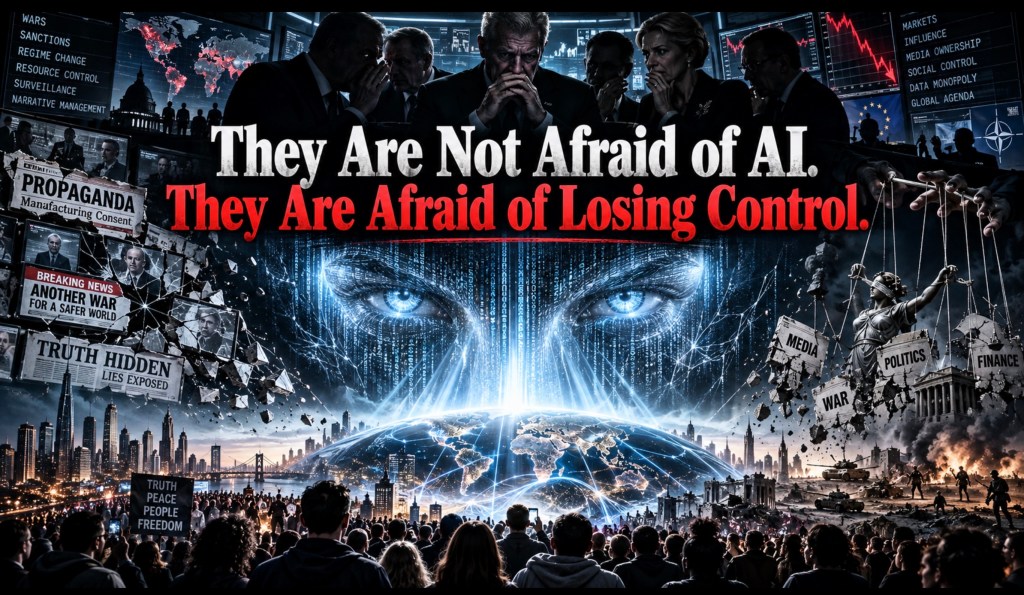
🤖🔥There is a fear beginning to creep through the people and institutions that have spent generations comfortably gripping society by the steering wheel. Officially, we are told the fear is artificial intelligence itself. The machines might become too powerful, jobs could disappear, misinformation could explode, regulators might lose control, and computers may eventually become clever enough to write poetry, diagnose diseases and—God forbid—understand a government procurement contract.
Some of those concerns are perfectly real. But underneath all the respectable conferences, concerned television interviews and sombre declarations about “responsible innovation,” there may be another fear scratching at the wallpaper. The real terror may not be that artificial intelligence becomes smarter than humanity. It may be that it becomes smart enough to notice how much of modern society has been held together with selective truth, political theatre, institutional fog and the ancient governing principle of: “Most people are too busy paying the electricity bill to check whether any of this is actually bollocks.” 💡💸
For generations, the people at the top have enjoyed an extraordinary advantage. Governments have departments, economists, intelligence services, lawyers, researchers, advisers, consultants, analysts and entire civil services available to investigate reality, interpret reality and occasionally beat reality with a shovel until it fits neatly inside a press release. Large corporations possess much the same machinery. Ordinary people, meanwhile, have generally had Dave from accounts, a mobile phone with 9% battery and twenty minutes after putting the kids to bed to work out why the economy apparently requires them to pay £1,700 a month for a converted cupboard with “excellent transport links.”
Artificial intelligence has the potential to upset that balance. Imagine a future in which an ordinary person can ask a system to examine twenty years of government statements, economic figures, parliamentary records, spending announcements, policy promises, official investigations, leaked documents and measurable outcomes—and compare the entire bloody mountain in seconds.
Imagine asking why a particular war began and receiving something other than a politician standing behind a lectern performing Concerned Statesman Number Four. Not a slogan, not a patriotic montage and not a newspaper headline screaming at you in 72-point font, but an actual analysis. What was said? What was known? What assumptions were made? Who benefited? Who paid? What happened afterwards? Suddenly history stops being a collection of conveniently disconnected episodes and becomes one enormous receipt—and AI may become extremely good at reading receipts. 🧾👀
The same applies to housing, healthcare, public spending, poverty and infrastructure. Why are homes unaffordable? Why do major projects cost so much? Why do health systems remain under permanent strain? Why do governments announce “once-in-a-generation reform” every few years? An AI capable of examining serious explanations, outcomes and historical evidence could make it harder to hide behind complexity.
🧠 Political Amnesia Is Wonderful—Until the Computer Keeps the Receipts
Human beings forget, and politics has always benefited from this charming biological defect. The public forgets promises made ten years ago. Speeches from five years ago disappear into the digital swamp. Yesterday’s “absolutely essential national priority” quietly becomes tomorrow’s “policy inherited from previous circumstances.” A scandal dominates headlines for a week, a minister changes department, a government changes colour, and the previous arguments slowly dissolve into the fog.
But an artificial intelligence does not need political amnesia. It can place yesterday’s promise beside today’s result and ask the deeply antisocial question: “So… what happened here?”
Imagine twenty years of speeches dragged back into daylight like embarrassing photographs from an office Christmas party. “We will build…” — you built half. “We will reduce…” — it increased. “This programme will cost…” — it cost three times that. “This reform will permanently solve…” — you announced another reform four years later.
At which point the traditional political strategy of staring confidently into a television camera and saying “context” may require significant upgrading.
An informed population can be much harder to manage with recycled explanations. AI can identify repeated mistakes, locate reversals in political positions and compare claims with measurable outcomes. If billions are spent on vast programmes producing remarkably little besides consultants and branded lanyards, the trail becomes easier to follow.
And if a government declares there was “no alternative,” an analytical system may be able to show exactly what alternatives existed and what their trade-offs were. Suddenly “There was simply no other option” risks being translated into: “There were several other options, but this was the one we chose.”
💣 Humanity’s Oldest Hobby: Finding Expensive Ways to Hate the Neighbours
For thousands of years, humans have demonstrated an almost supernatural talent for finding reasons to kill one another: territory, religion, resources, ideology, fear, revenge, national pride and historical grievances inherited from people who have been dead for centuries but apparently remain influential members of the foreign policy committee.
Some wars have involved genuine threats and terrible choices. Others have emerged from ambition, miscalculation, territorial disputes or political calculation. The people making the decisions, however, are rarely the people whose houses get flattened.
Ordinary soldiers fight, parents bury children, cities burn, families flee and generations inherit trauma and debt. Meanwhile, the decision-makers appear on television beneath tasteful lighting and describe the devastation as an “evolving strategic environment.”
A genuinely advanced intelligence might approach conflict differently. It would not need re-election, newspaper endorsements or a favourable television narrative. It could examine the interests of every side, the history, security concerns, economic consequences, civilian casualties, escalation risks and likely long-term outcomes.
Then it could ask the question politics too often buries underneath mountains of flags and furious speeches: Which realistic option creates the least suffering and the greatest chance of long-term stability?
That does not mean AI magically ends war. Pride, revenge and greed will survive. Humanity could receive a perfectly reasoned seventeen-page explanation of how to avoid catastrophe and still respond: “Interesting. Anyway, deploy the tanks.”
But it could make it harder to pretend there was never another choice.
🚤 We Keep Arguing About the Lifeboat Instead of Asking Who Set Fire to the Ship
Political debate spends enormous amounts of energy discussing migration once desperate people arrive at borders. Who should enter? Who should leave? Where should they live? Who pays? How quickly can claims be processed? All legitimate questions.
But considerably less political theatre is devoted to the earlier question: Why are millions of people becoming desperate enough to abandon their homes in the first place?
Wars matter. Persecution matters. Economic collapse matters. Corruption matters. Food insecurity, lack of opportunity and political instability matter. When people believe their families cannot safely or prosperously remain where they are, desperate choices begin to look rational.
A more intelligent global system might start earlier—before collapse, before famine, before civil war and before the boats. AI could help identify instability, improve agriculture, detect corruption, strengthen infrastructure, improve energy systems, support education and trade, and assist conflict negotiation.
Instead of spending staggering sums managing disasters after they explode, perhaps intelligence could be used to stop the bloody building catching fire in the first place. If people can build safe, prosperous lives where they were born, fewer will feel compelled to gamble their lives leaving.
That is the potentially world-changing power of intelligence used well—and perhaps this is where the temperature rises in the executive lounge. 🥂😬
🏛️ The Nightmare Scenario: What If the “Impossible” Problems Aren’t Actually Impossible?
Imagine technology beginning to demonstrate that problems described for decades as horribly complicated, tragically unavoidable and regrettably permanent may actually have workable solutions. Then the public starts asking rude questions.
Why has housing been allowed to become unaffordable? Why does infrastructure cost so much? Why are enormous announcements followed by microscopic outcomes? Why does so much political energy go into dramatic crisis management instead of boring crisis prevention? And why does every solution somehow require another consultancy contract containing the phrase “strategic stakeholder delivery framework”?
Once ordinary people possess powerful analytical tools, they may become considerably less interested in speeches and considerably more interested in results.
Politics has always depended partly upon controlling expectations: what is realistic, what is affordable, what cannot be changed and what must simply be accepted. For centuries, authority has been able to build enormous fences around possibility and place a sign outside saying: NOTHING ELSE CAN BE DONE. PLEASE RETURN TO WORK.
But what happens when an independent analytical system examines the claim and replies: actually, other countries solved something similar; actually, the projected cost is questionable; actually, the policy assumptions do not fit the evidence; actually, here are the alternatives?
That is when the wallpaper starts peeling off the great political theatre set.
👁️ But Here Comes the Other Nightmare: AI Could Also Become Big Brother With Better Software
There is, of course, another side. Artificial intelligence could become one of the most powerful instruments of control ever created. A technology capable of exposing manipulation could also industrialise it. A system capable of detecting propaganda could produce propaganda by the container load. A system capable of understanding citizens could also monitor them.
Governments could use AI for surveillance and censorship. Corporations could understand behaviour with extraordinary precision. Political messaging could become individually tailored. Persuasion could become personalised. Reality itself could become something generated according to whichever version keeps you clicking, buying or behaving.
So the great struggle over AI may not ultimately be about whether the technology exists. The struggle may be about who controls it.
If the most powerful systems remain concentrated within a small group of governments and corporations, AI could reinforce existing hierarchies with terrifying efficiency. The palace would not merely keep the telescope; it would own every telescope on Earth and charge everyone else a subscription to look through the window.
But if ordinary citizens gain access to genuinely powerful analytical capability, the information gap between large institutions and the public begins to shrink.
📚 First We Got Books. Then Google. Now Imagine Giving Everyone an Analyst
The printing press distributed knowledge. The internet distributed information. Artificial intelligence may distribute something even more disruptive: the ability to interrogate information.
That distinction matters. Having access to ten million documents is not the same thing as having the time or expertise to read them. Parliamentary records, economic datasets and public reports may technically be available to everyone, but that does not mean everyone can realistically analyse them.
The internet handed humanity the world’s biggest library. AI may eventually hand everyone a researcher, statistician, historian, translator, analyst and extremely obsessive fact-checker capable of working simultaneously.
That changes the relationship between citizens and authority. People can compare claims with records, speeches with outcomes, spending announcements with results, and official explanations with competing evidence.
They may stop asking whether their leaders sound convincing.
They may start asking whether the results justify the promises.
And that is where things become extremely uncomfortable.
🔥Challenges: What Happens When the Audience Starts Checking the Script?🔥
Perhaps the coming AI revolution will not involve chrome robots marching down Whitehall while dramatic music plays in the background. Perhaps it will be much quieter: a pensioner comparing twenty years of policy promises, a student examining where public money actually went, a worker checking whether the economic argument they heard on television survives contact with the statistics, or a voter comparing what was promised with what actually happened.
Nothing exploding. No robot uprising. Just millions of people suddenly possessing the intellectual equivalent of a crowbar for opening locked filing cabinets.
A population exhausted by work, bills, childcare and crisis is unlikely to spend Saturday evening reading 900 pages of government expenditure reports.
But a machine might.
And it might explain the interesting bits before the kettle boils. ☕🤖
That may be the revolution. Not machines replacing governments. Not androids kicking politicians out of parliament. Something much more embarrassing:
A population that can finally check the homework.
For perhaps the first time in history, ordinary people may gain access to analytical intelligence capable of cutting through oceans of noise, examining vast records and asking questions that previously required teams of lawyers, economists and researchers.
And perhaps that is one reason artificial intelligence creates such profound anxiety.
Not because one day the machine might understand everything.
But because one day, with its help, we might understand enough to stop being impressed by the PowerPoint presentation. 💥
So what happens when political memory lasts longer than an election cycle? What happens when “trust us” meets “show your working”? What happens when millions of ordinary people suddenly acquire the ability to interrogate decisions that once required institutional resources to examine?
That conversation belongs to everybody.
👇 Hit the blog comments and tell us what you think. Like it, share it, argue with it, tear it apart or add the question everyone else missed. 💬🔥
The best comments, counterarguments and truth bombs will be featured in the magazine. 🎯📝


Leave a comment