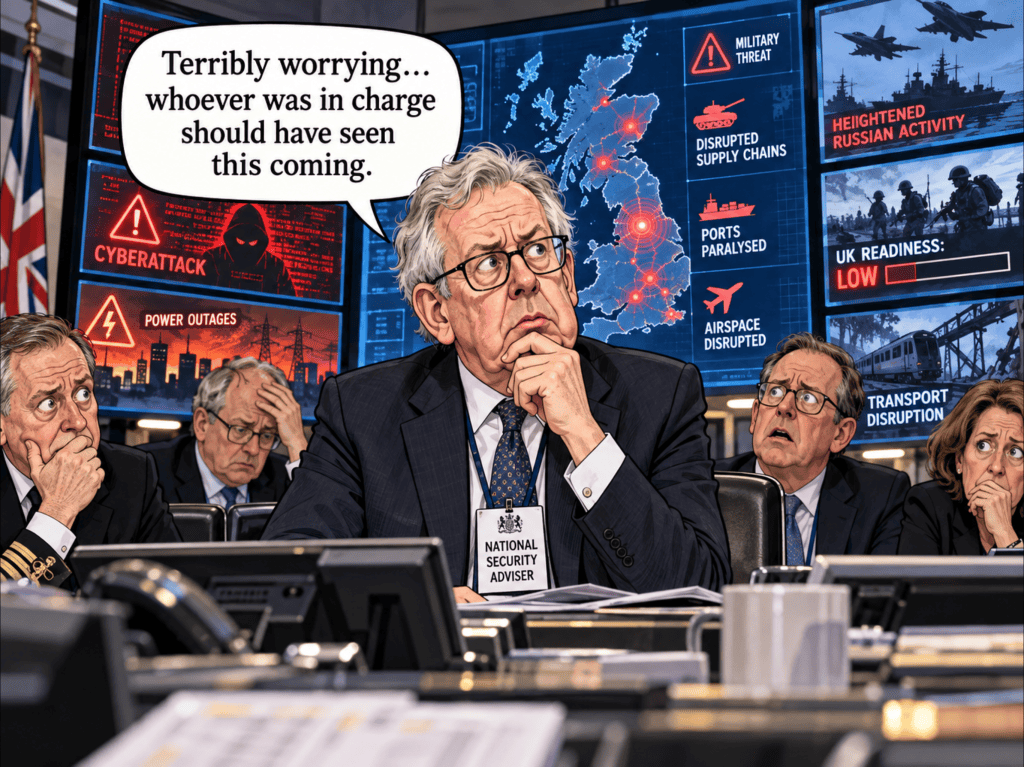
🚨🇬🇧There is something magnificently British about Lord Kim Darroch appearing as the National Security Adviser in The Wargame, a television simulation exploring how Britain might cope with a major confrontation involving Russia. Darroch is not merely playing someone who once worked near national security. He actually served as the UK’s National Security Adviser from 2012 to 2015, leading the National Security Team during crises including the rise of Daesh, Russian aggression in Ukraine, Iran’s nuclear programme and instability in Libya.
Now, more than a decade later, he has effectively returned to the same chair — only this time there are cameras, dramatic music and presumably somebody shouting “cut” before civilisation collapses.
From National Security to National Security: The Reunion Tour
🎬Sky’s The Wargame assembles an extraordinary collection of former politicians, diplomats and security figures and places them inside a fictional national emergency. Michael Gove plays Prime Minister, Nicola Sturgeon serves as Deputy Prime Minister, General Sir Richard Barrons becomes Chief of Defence Staff, and Darroch takes the role of National Security Adviser — precisely the job he once performed for David Cameron.
The programme’s purpose is serious. It explores how Britain might respond to Russian provocation, attacks on infrastructure, disinformation and pressure on NATO. The scenario is designed to expose the horrible choices governments could face when events move faster than committees, briefing papers and carefully worded statements.
Fair enough.
But there is an irresistible irony in watching former members of the British establishment gather around a table to discover that Britain may not be wonderfully prepared for the sort of crisis Britain has spent decades supposedly preparing for.
This is not an accusation that Lord Darroch personally left Britain undefended. National security policy stretches across governments, departments, military leadership, budgets, alliances and decisions taken over many years. Darroch’s tenure as National Security Adviser also coincided with genuine international crises, and his official record shows that his responsibilities covered some of the most serious security questions facing the country.
But that is precisely what makes the television spectacle so deliciously strange.
The people who once sat inside the machinery are now appearing on television to demonstrate what happens when the machinery starts making alarming noises.
It is rather like watching the former manager of a restaurant appear on Kitchen Nightmares and announce, with grave concern, that somebody really ought to clean the fridge.
Of course, The Wargame may prove useful. Simulations are a legitimate way of testing assumptions, exposing vulnerabilities and forcing decision-makers to confront uncomfortable scenarios. The question is what follows once the credits roll.
Because Britain does not suffer from a shortage of reports explaining that Britain should probably be better prepared.
We have reviews. Strategies. Committees. Parliamentary inquiries. Defence papers. Resilience frameworks. Threat assessments. Spending announcements. Spending reviews of the spending announcements. Then another strategy explaining why the previous strategy requires refreshing.
And now, apparently, television.
The programme can dramatise the consequences of cyberattacks, damaged infrastructure, Russian aggression and political indecision. It can make viewers uncomfortable. It can generate newspaper columns and studio debates about whether Britain could survive a serious confrontation.
And then what?
Does a vulnerable cable become less vulnerable? Does an ammunition stockpile refill itself? Does military procurement suddenly stop moving at the speed of a council planning dispute? Does national resilience improve because several former ministers looked extremely worried under studio lighting?
That is the real question raised by programmes like this.
Not whether the scenario is frightening enough.
Whether anything materially changes afterwards.
If The Wargame identifies genuine weaknesses, the useful response is remarkably uncinematic: define the vulnerabilities, publish what can safely be published, assign responsibility, fund the fixes and establish deadlines against which progress can actually be measured.
Less theatre. More maintenance.
Otherwise we risk completing the perfect British national-security cycle: identify the danger, appoint distinguished people to discuss the danger, commission an exercise about the danger, broadcast a programme demonstrating the danger, congratulate ourselves for having taken the danger seriously — and then return to normal until the danger sends an Outlook invitation.
Lord Darroch’s appearance makes that contradiction unusually vivid. A man who once occupied one of the most senior security jobs in government is now helping the country imagine what happens when national security goes catastrophically wrong.
Perhaps that is valuable experience being put to good use.
Or perhaps it is the most British warning imaginable: the people who used to run the emergency planning are now back on television explaining why we should all be worried about the emergency planning. 📺🔥
🔥Challenges: If Britain’s vulnerabilities are serious enough for prime-time television, what should actually change when the programme ends?
Should programmes like The Wargame lead to measurable changes in defence, infrastructure and national resilience — or are we becoming world champions at identifying problems without fixing them? Add your view directly to the Chameleon News blog.
👇 Comment, like and share — and tell us what Britain should actually do once the dramatic music stops.


Leave a comment