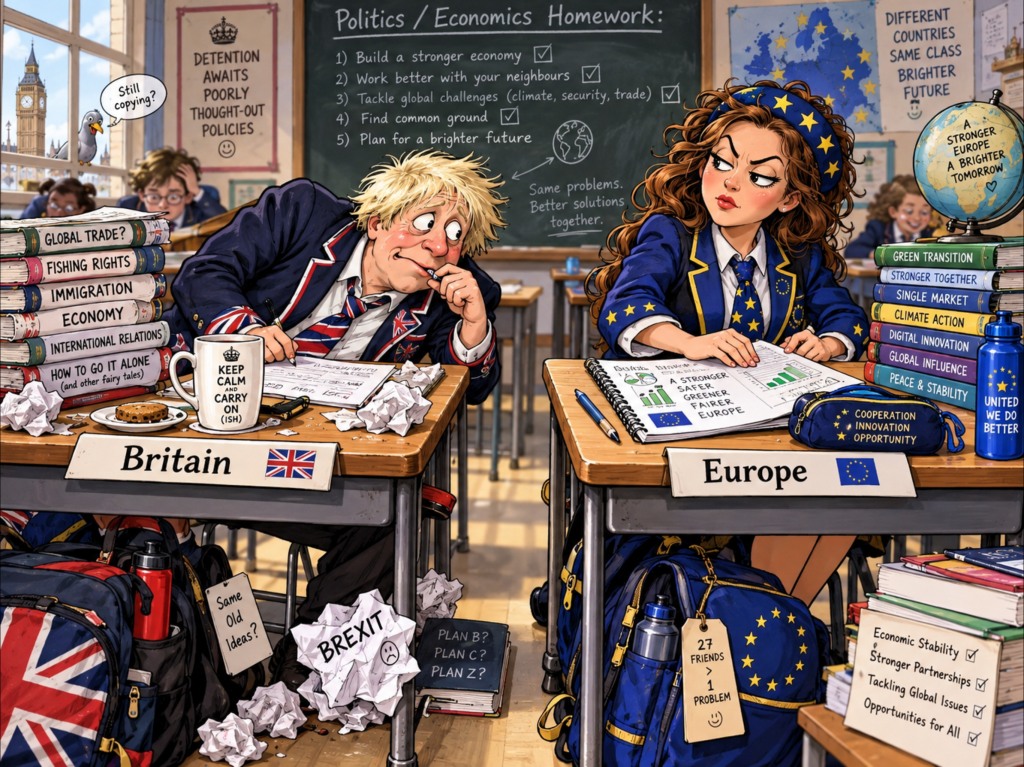
Britain spent years debating whether to leave the European Union, held a referendum, argued over what it meant, formally left — and is now discussing whether to begin the process again.
Sir Tony Blair has urged Prime Minister Andy Burnham to make rejoining a significantly reformed EU within the next decade a national objective. Burnham has not committed to that, saying whether EU membership appears in Labour’s next manifesto is a question “for another day”.
And there, in six words, is British politics at its most efficient:
A question for another day.
But perhaps the more important question is this:
Why can’t MPs do a better job of governing the country they already have?
🗳️ Democracy: Please Keep Your Receipt
The central issue is not whether Britain should rejoin the EU. People are entitled to believe Brexit was liberation, disaster or simply a subject they would rather avoid.
Nor is the 2016 referendum permanently binding. Democracies change direction, and future voters may choose differently. But reversing something as significant as Brexit raises a crucial question: who gets to decide?
Before MPs start discussing another major constitutional project, they should be asked why they cannot concentrate on improving the country under the arrangements already in place.
Britain faces serious problems: pressure on public services, high living costs, weak economic growth, housing shortages, strained infrastructure and declining trust in politics. Yet instead of demonstrating that Parliament can solve those problems effectively, politicians are once again inviting the public to debate whether the country should reopen one of its most divisive arguments.
Closer cooperation with Europe is not the same as full membership. Governments can negotiate agreements that reduce barriers in areas such as energy and agriculture. But EU membership involves wider questions about rules, obligations, contributions and freedom of movement. Those choices should be presented openly, not introduced gradually through vague language about “resets”, “frameworks” and “closer alignment”.
However, MPs should also be honest about their own record. If Parliament cannot deliver competent government without blaming Brexit, Brussels, the previous administration or changing circumstances, why should voters trust it to manage an even more complicated relationship with the European Union?
People who believe Brexit harmed Britain are entitled to campaign for reversal, while those who support it are entitled to oppose them. Politicians may also change their minds as circumstances and evidence change.
What matters is democratic clarity — and competent leadership.
If a future government wants Britain to seek EU membership, it should make that intention explicit through a clear manifesto commitment or another direct democratic process, then defend the proposal and its terms openly. Winning a general election may provide authority to govern, but a decision of this scale should not be hidden behind technical agreements or presented as an accidental consequence of closer cooperation.
At the same time, MPs should explain why they believe rejoining the EU is more urgent than fixing the problems voters expect them to address. Is this genuinely the best use of Parliament’s time, or is it another attempt to distract from the fact that politicians have failed to deliver practical improvements at home?
The debate should not simply be whether British politicians are too incompetent to govern without Brussels. It should be whether they are capable of governing effectively at all.
Sharing particular powers with the EU might produce better results, and voters are entitled to consider those trade-offs. But MPs must first show that they can make sensible decisions, manage public money, improve services and provide stable leadership.
Clear proposals require clear consent.
They also require politicians who can do a better job.
If Britain eventually chooses to rejoin the European Union, that can be a democratic decision. If it chooses to remain outside, that can be one too. What would be difficult to defend is edging towards membership while insisting that nobody has technically decided anything — especially while MPs avoid answering why they have not done more to improve the country in the meantime.
After a decade of Brexit arguments, British politics could try something revolutionary:
Tell people exactly what you want to do, ask them — and then get on with doing the job properly.
🔥
Challenge: Why Can’t MPs Do a Better Job?
Should politicians be discussing rejoining the EU before they have solved Britain’s immediate problems? Should a future government need an unmistakable manifesto commitment or another referendum before seeking EU membership, or is winning a general election enough? Have your say in the Chameleon News blog comments.
👇 Comment, like and share. Whatever your view, tell us whether MPs are doing enough to improve the country — and who should make the final decision on Britain’s relationship with Europe: Parliament, the government or the public.


Leave a comment