The traditional social contract in Britain was straightforward:
You work.
You earn.
You pay your taxes.
You help pay for the pie.
And in return, you get a fair slice, alongside the security of functioning public services.
Today, that balance has fractured. The number of people funding the state is increasingly outnumbered by those drawing from it.
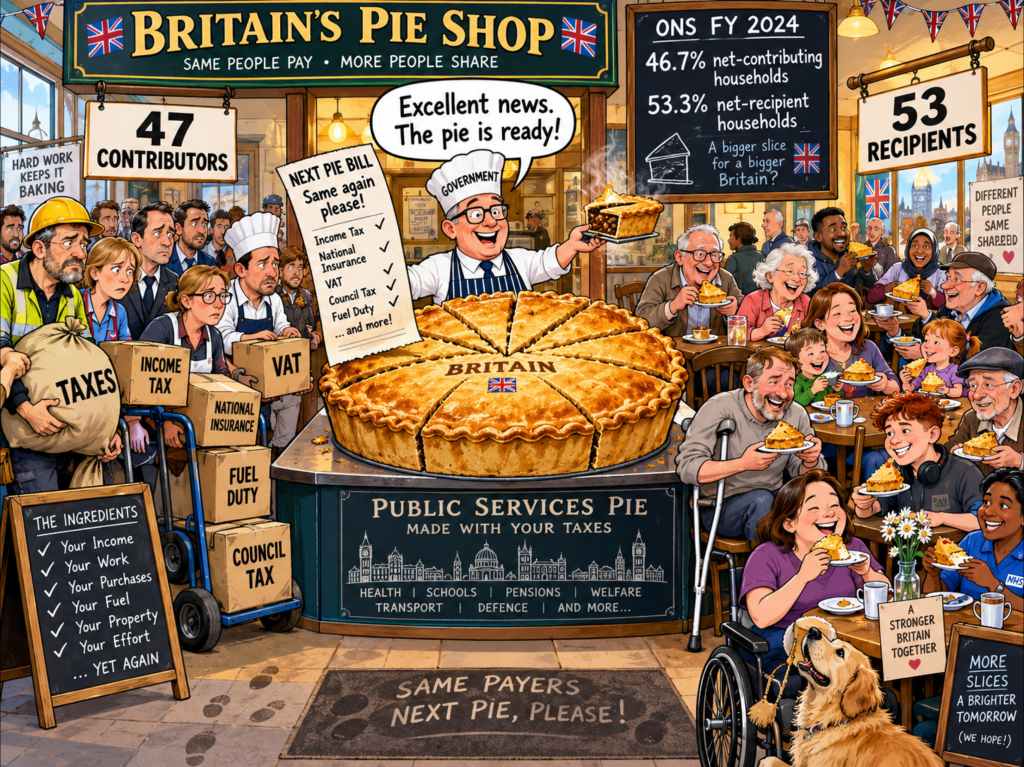
According to data from the Office for National Statistics (FY 2024), 46.7% of people lived in households that paid more in direct and indirect taxes than they received in benefits and public services.
The remaining 53.3% lived in households that received more than they contributed.
The 100-Person Pie Shop
Imagine Britain as a crowded pie shop.
47 people walk in. They bring the flour, butter, and electricity money, pay the baker, and keep the ovens burning.
53 people walk in behind them.
Everyone takes a seat. The pie is served and divided equally among all 100 people.
Once finished, the bill arrives—and it is handed entirely to the original 47.
Then comes the announcement: public services are under strain, so those same 47 will need to pay a little more for the next one.
You Can’t Tax Wealth That Was Never Created
Redistribution does not create wealth; it transfers it.
The government can tax, borrow, allocate, and regulate, but it cannot spend a single pound until a worker or business generates it first.
The current machine relies on a shrinking proportion of net contributors to shoulder an ever-growing tax burden—spanning Income Tax, National Insurance, VAT, fuel duty, and Council Tax.
This is not a moral criticism of those receiving support. The 53% includes pensioners who built the country, families relying on state schools, patients receiving NHS care, and low-wage workers receiving top-ups.
Nor is it an argument against public healthcare, pensions, or a safety net.
It is simply an unavoidable rule of arithmetic: You cannot indefinitely increase the number of people drawing from a system while shrinking the proportion expected to fund it.
🔥 The Real Question
How far can the balance shift before the net contributors decide the deal no longer works for them?
At what point does high taxation combined with declining public services push workers to work less, move abroad, or simply lose faith in the system?
How many people can share the pie before too few are left paying for the ingredients?
👇 Join the Debate
Where should the line be drawn? Let us know in the comments below. Like, share, and bring your sharpest argument.
The best responses will be featured in the next print issue. 🎯📝


Leave a comment