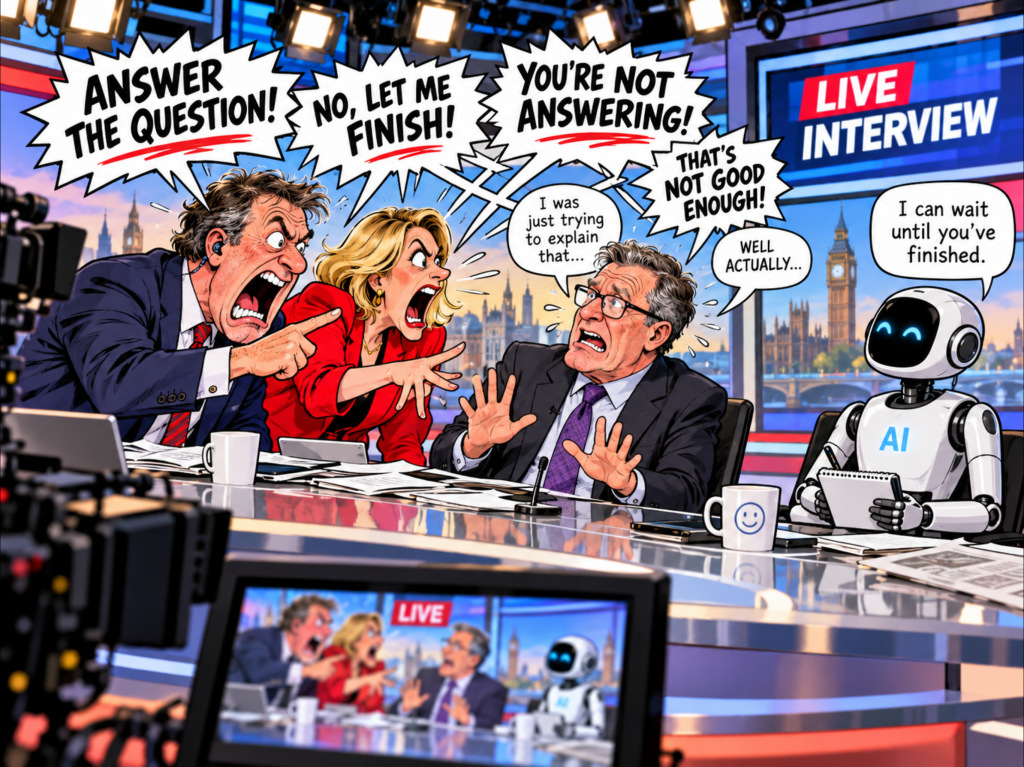
There was a time when a political interview was supposed to be a fairly simple arrangement. A presenter asked a question, the guest answered it, and the presenter then challenged whatever had been said. Sometimes the exchange was uncomfortable, sometimes aggressive, sometimes revealing, but at least there was usually an attempt at conversation.
Watching some television interviews now, that basic principle seems to have disappeared.
Too often, a politician or public figure is invited onto a programme, asked a question and then barely given enough time to form a complete sentence before the presenter begins talking over them. Another presenter may then join in, the guest tries to finish the original answer, everybody speaks at once, and the viewer is left wondering what the point of the interview was in the first place.
If you invite someone onto a national television programme to answer questions, surely there has to be some intention to hear what they actually have to say.
That does not mean politicians should be allowed to waffle endlessly, avoid questions or deliver rehearsed speeches without challenge. Quite the opposite. Good interviewing requires interruption when somebody is deliberately evading a question, correction when a claim is demonstrably false and persistent follow-up when an answer does not address what was asked.
But there is an important difference between challenging an answer and preventing an answer from being given.
Constant interruption is not necessarily evidence of a tough interviewer. Sometimes it is simply evidence of an interviewer who is more interested in hearing themselves than hearing their guest.
The strange thing is that this is happening at exactly the moment we are constantly being warned about artificial intelligence replacing human beings.
Perhaps television presenters should be slightly concerned.
At least artificial intelligence generally understands one of the most basic rules of conversation: wait until the other person has finished before responding.
That is not exactly the technological singularity. It is something most children are taught before leaving primary school.
Yet somehow, on some television programmes, listening now appears to be treated as weakness. The louder the presenter becomes, the more interruptions there are and the more chaotic the exchange, the more it is presented as serious journalism.
But viewers are not stupid.
Most people do not need a television presenter to decide for them whether a politician is believable. They need the opportunity to hear the answer.
Let the politician speak. Then pull the answer apart if necessary. Point out contradictions. Challenge the figures. Ask why they avoided the question. Produce the evidence that undermines their argument.
That is far more effective than shouting over them.
It also matters regardless of which political party is involved. The same principle should apply to Labour, Conservative, Reform, Liberal Democrat, Green or anyone else appearing on a political programme.
The presenter is not there to act as the audience’s political guardian. Their job is to ask the questions viewers want answered and then give the viewers enough of the response to make their own judgement.
Increasingly, however, political interviews appear designed around confrontation rather than information. The objective sometimes seems to be the viral clip, the dramatic interruption, the raised eyebrow or the moment that can be circulated online afterwards as proof that somebody was supposedly “destroyed” on television.
That may produce good social-media content.
It does not necessarily produce good journalism.
Perhaps the most ironic development of all is that, after years of worrying that artificial intelligence will replace human communication, AI may eventually improve it.
Not because it is always correct. It certainly is not.
Not because machines understand politics better than people.
But because somebody has finally developed a technology capable of performing one of the most underrated skills in modern broadcasting.
Listening.
And if television journalism reaches the point where a computer has better conversational manners than the people conducting political interviews, perhaps the real problem is not artificial intelligence becoming too human.
Perhaps it is television becoming considerably less so.


Leave a comment