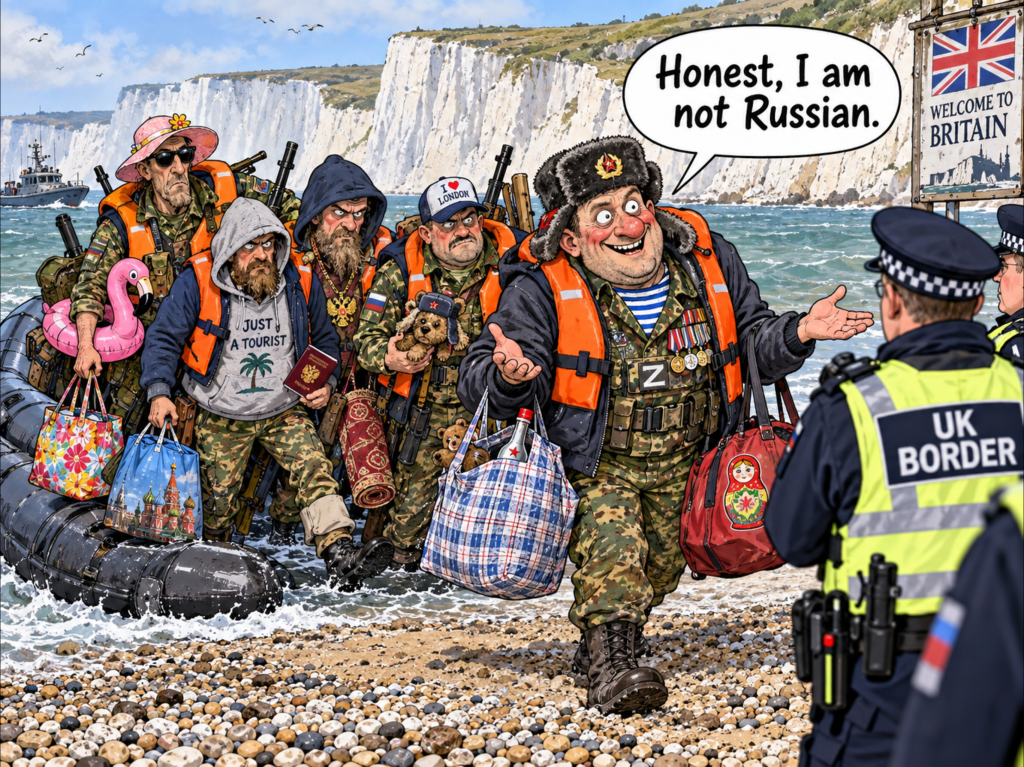
The boats keep coming, the excuses keep growing, and Britain somehow still manages to look surprised every time another one reaches the coast. We are an island. The English Channel is not an undiscovered ocean. It sits directly between us and France, yet we now seem to have developed a border system where some boats can arrive first and the authorities work out what happened afterwards.
If this were a hostile military operation, we would have been caught with our trousers around our ankles while somebody in Whitehall searched for the correct press-release template. That may sound ridiculous, but so does the idea that a country surrounded by water can repeatedly be surprised by people arriving across it.
Every government promises the same thing in slightly different packaging. The border will be secured, the gangs will be smashed, the routes will be disrupted, the system will be reformed and the problem will be brought under control. Then another boat appears. And another. At this point, the real growth industry is not just people-smuggling. It is political vocabulary.
We now have taskforces, operations, agreements, enforcement teams, surveillance, patrols, intelligence sharing and enough official terminology to sink a small vessel under the weight of paperwork alone. Yet the boats remain remarkably unimpressed.
That is the central absurdity. We are repeatedly told how sophisticated the response has become, while the most basic measure of border control remains painfully simple: are people still arriving without permission? If the answer is yes, then perhaps the system is not quite as “under control” as the press conference suggested.
Imagine an airport using the same logic. Security is working extremely well, except for the people who managed to get through without being checked. Most of us would consider that a fairly important problem. Yet when it comes to the Channel, every setback seems to arrive with an explanation of why it is actually evidence of progress.
The boats are fewer than last year. More engines have been seized. More smugglers have been arrested. More agreements have been signed. More money has been spent. Fine. But the public is still entitled to ask the awkward question: what actually changes?
Because increasingly, the whole affair feels like government by announcement. A minister appears on television, promises tougher action, says the gangs are being targeted and assures everyone that the situation is improving. Then another boat arrives and the cycle begins again. It is political Groundhog Day with lifejackets.
The most extraordinary part is how low the bar has become. Britain is one of the most technologically advanced countries in the world. We can track aircraft across continents, monitor ships across oceans and put satellites into space. Yet when a small boat appears in the Channel, parts of the system can still give the impression of somebody peering through the curtains and asking, “Is that ours?”
This is not a problem solved by another slogan. It is solved by outcomes. Detect the boats. Intercept them. Break the smuggling networks. Process cases quickly. Remove people who have no lawful right to remain. And stop pretending that another committee meeting is a substitute for a result.
The public does not need another strategy document. It needs to know whether the border is actually being controlled. Because if people can cross one of the busiest stretches of water in Europe and still arrive unexpectedly, then calling it “border control” begins to sound less like a description and more like branding.
At some point, somebody in government may have to admit the obvious. If the boats are still arriving, the problem has not been solved.
It has merely been discussed at great length.
🔥 Challenges: How many more taskforces, agreements, speeches and “tough new measures” do we need before somebody asks the only question that matters: are the boats still arriving? Tell us what you think on the Chameleon News blog.
Comment. Like. Share. And keep asking what actually changes.


Leave a comment