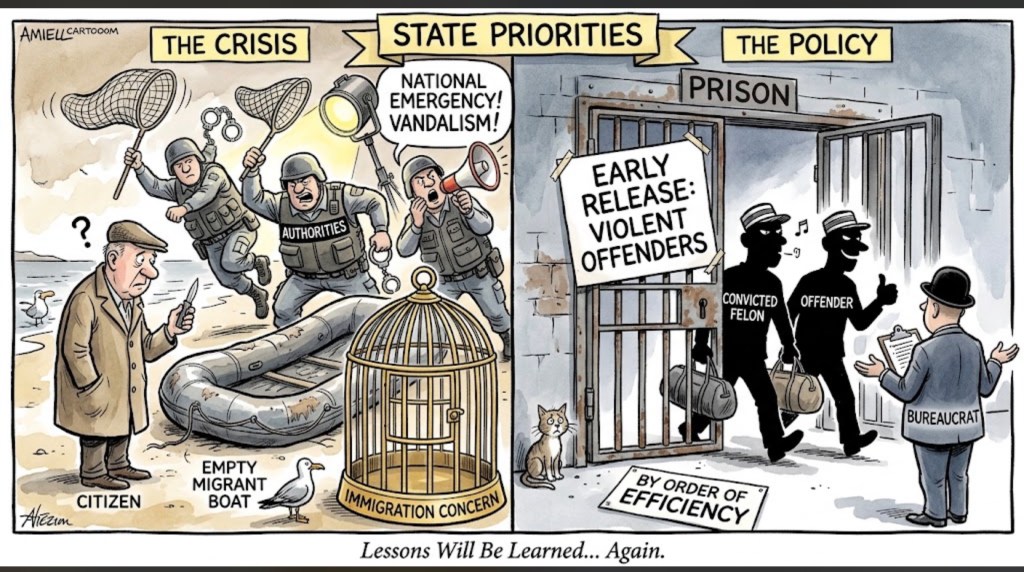
Puncturing an empty boat is a national crisis; letting violent offenders out early is just efficient administration.
If you ever find yourself contemplating a life of crime in modern Britain, it is vital to get your priorities straight. If you rape, assault, or molest a child, you can reasonably expect a sympathetic nod from a justice system currently operating a high-speed revolving door to free up prison space. But if you walk up to a piece of abandoned rubber on a coastline and stab it with a pocket knife, prepare for the full, terrifying majesty of the British state to descend upon your head.
Mayor of Greater Manchester Andy Burnham made this hierarchy of moral outrage remarkably clear recently. Facing a public increasingly bewildered by the government’s policy of letting convicted criminals out of jail early to fix systemic overcrowding, Burnham redirected the nation’s righteous anger toward a far more pressing existential threat: a man who punctured an empty, disused inflatable dinghy previously used for cross-Channel crossings.
The official machinery of state concern immediately swung into action. Politicians expressed profound alarm, commentators warned of the grave dangers to maritime order, and the regulatory apparatus began its slow, majestic roll toward an exhaustive review of rubber-slashing protocols. When the state decides to take an issue seriously, no expense, committee, or solemn press conference is spared. The message to the public is unmistakable: our borders may be porous, our prisons may be overflowing, and our justice system may be on life support, but by God, our empty PVC craft will be protected with the full force of the law.
And then what? What actually changes after all this institutional drama, political grandstanding, and solemn soul-searching?
The answer, as always, is absolutely nothing. The man who stabbed the boat will no doubt be subjected to months of legal processing, risk assessments, and sternly worded court orders, while the broader, catastrophic collapse of public sentencing policy remains untouched. We are treated to the magnificent spectacle of a political class throwing endless energy, headlines, and moral panic at symbolic vandalism, while simultaneously presiding over a policy that sees genuinely dangerous offenders released back onto the streets ahead of schedule.
The contrast is as stark as it is absurd. The public is routinely instructed to accept the early release of violent offenders as a unfortunate, bureaucratic necessity—an unpreventable byproduct of “capacity issues” and “heritage funding shortfalls.” Yet the moment an annoyed citizen pops an empty boat on a beach, the state suddenly discovers an infinite well of moral clarity and prosecutorial zeal. It is institutional theatre at its finest: grand, noisy, expensive, and completely disconnected from the actual safety of the public.
A sensible state would, of course, align its priorities with basic common sense. It would recognize that physical infrastructure, empty vessels, and political face-saving rank somewhat lower than keeping violent predators behind bars. If a government claims it is securing the nation’s borders while actively releasing the worst elements of its jailed population onto the streets, the problem isn’t a slashed dinghy on a shoreline—it is a total collapse of public trust. Real border security and public safety require meaningful deterrents, adequate prison capacity, and a government that knows the difference between a real crisis and a ruined piece of plastic.
Until then, citizens can sleep easy knowing that while rapists and child molesters may be walking the streets a little earlier than expected, our nation’s empty inflatables have never been safer.
🔥 Challenges: Should politicians focus on symbolic acts of vandalism while violent criminals are released early to clear prison space, or has institutional hypocrisy finally gone too far? Let us know your thoughts on the Chameleon News blog!
Like, comment, and share this article to spread the debate!


Leave a comment