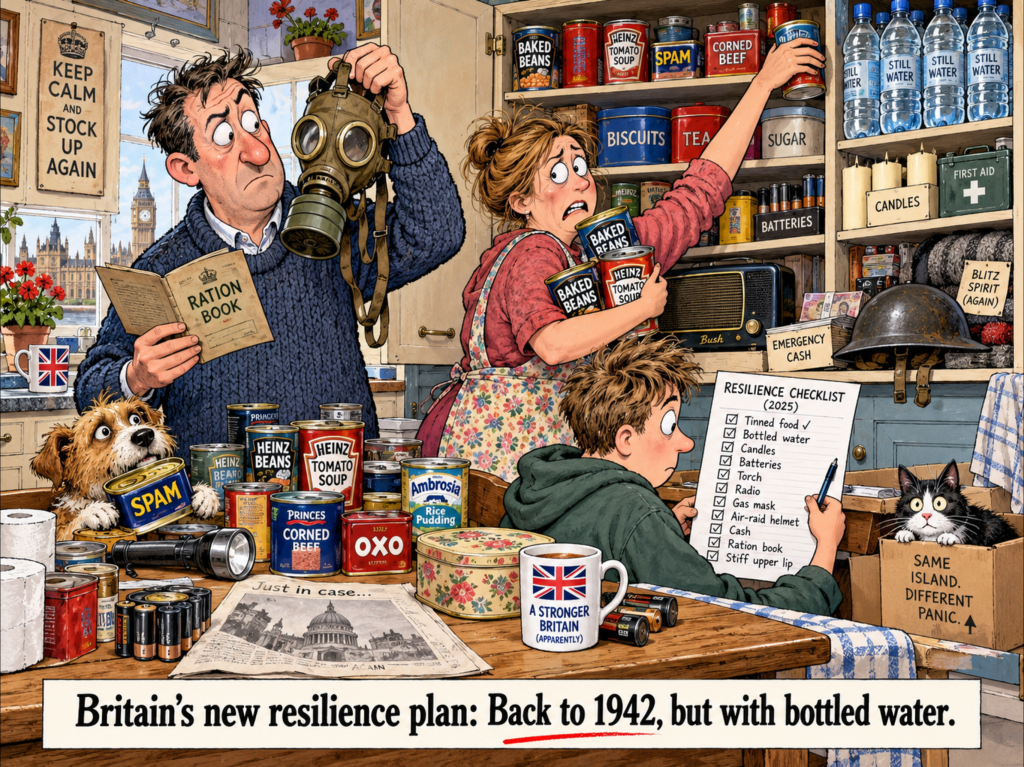
Britain’s Defence Secretary Wes Streeting has a reassuring message for the nation: remain calm, carry on — and perhaps put a few extra tins of beans in the cupboard. Households are being encouraged to keep bottled water, tinned food and some cash available in case power cuts, cyber disruption, natural disasters or, at the more dramatic end of the government’s list, war interfere with normal life. Streeting calls it a “whole society approach” to national resilience.
Apparently the Home Front Now Starts in Aisle Seven
There is something magnificently British about this.
For years, governments have discussed defence spending, NATO commitments, Russia, Ukraine, cyber warfare, critical infrastructure and the increasingly unpleasant state of international affairs. Britain’s 2026 National Risk Register now identifies scores of serious risks, while government strategy increasingly talks about defence becoming a responsibility extending beyond the armed forces into businesses, communities and individual households.
And after all those strategic reviews, intelligence assessments, military conferences and security briefings, the message arriving through the average citizen’s letterbox is essentially:
Have you considered buying Spam?
Streeting says people should think about what happens if the electricity disappears or online banking becomes unavailable. His suggested precautions include keeping cash, bottled water and food that can be eaten without relying on the cooker or microwave. He has stressed that people should be “alert, not alarmed.”
Fair enough. Keeping a few emergency supplies at home is hardly irrational. Floods happen. Electricity fails. Cyber attacks occur. Indeed, government resilience guidance has been encouraging households to keep basic emergency supplies for some time.
But the interesting part is not the beans.
It is how dramatically the language surrounding them has changed.
We have travelled from politicians discussing events thousands of miles away to the Defence Secretary discussing what ordinary Britons should have in their kitchen cupboards if the lights go out.
That is quite a journey.
The government describes this as national resilience. Critics will inevitably ask a rather more awkward question: if the international security situation has deteriorated sufficiently that families are now being asked to prepare themselves for disruption associated with extreme acts of war, when exactly did preparing the public become part of the plan?
Because governments have choices.
They decide military spending. They decide diplomatic priorities. They decide what support Britain provides overseas and how far Britain becomes involved in international conflicts. Those decisions can be defended on national-security, humanitarian or alliance grounds — and governments regularly do precisely that.
But once the public is being asked to make preparations at home, it is reasonable for the public to ask what the strategy ultimately leads to.
“And then what?” suddenly becomes an important question.
Suppose millions of households obediently assemble their emergency collection: twelve tins of soup, bottled water, batteries, torch, radio, first-aid kit and £100 hidden behind the biscuit tin.
What exactly has Britain achieved?
We haven’t strengthened the electricity grid by buying ravioli.
We haven’t hardened communications infrastructure by purchasing bottled water.
And Vladimir Putin is unlikely to reconsider Russian foreign policy after intelligence reports confirm Mrs Henderson of Wolverhampton now possesses six tins of Heinz tomato soup and a wind-up radio.
Government resilience planning certainly has a legitimate purpose. The Cabinet Office itself says government cannot handle every crisis alone and wants individuals, businesses and communities to be better prepared. Official research published in August found that 60% of respondents already had enough non-perishable food for roughly three days, while only 37% reported having enough bottled water for that period.
But preparedness cannot become a substitute for prevention.
If Britain’s infrastructure is vulnerable to serious cyber attack, strengthen it.
If emergency communications are inadequate, improve them.
If civil-defence planning has fallen behind, update it.
If Britain’s foreign-policy commitments increase the risks faced by the country, ministers should explain those risks clearly and justify the decisions they are making.
That is rather more substantial than telling Dave from Dundee to keep £50 under the mattress.
There is also a danger that “whole society resilience” becomes another glorious piece of Whitehall vocabulary meaning responsibility has been redistributed until everybody is responsible and therefore nobody particularly is.
The government protects the country.
The military protects the country.
The security services protect the country.
Local authorities prepare for emergencies.
Businesses protect critical infrastructure.
And you, apparently, are responsible for the corned beef.
That is not an argument against sensible household preparation. Having emergency supplies is prudent.
But if ministers genuinely believe Britain faces a more dangerous international environment, the public deserves something more substantial than a shopping list.
Explain the strategy. Explain the risks. Explain what Britain is defending, what commitments it is making and what those commitments could mean for the people paying for them.
Because once a Defence Secretary starts discussing the contents of our cupboards, the obvious question is no longer whether we remembered the bottled water.
It is how we reached the point where the shopping list became part of national defence policy.
🔥 Challenges: If Britain is now being told to prepare households for possible disruption from war, cyber attacks and national emergencies, should the government also explain far more clearly how its defence and foreign-policy decisions affect those risks? Tell us what you think on the Chameleon News blog.
Comment. Like. Share. And perhaps check the expiry date on the beans.


Leave a comment