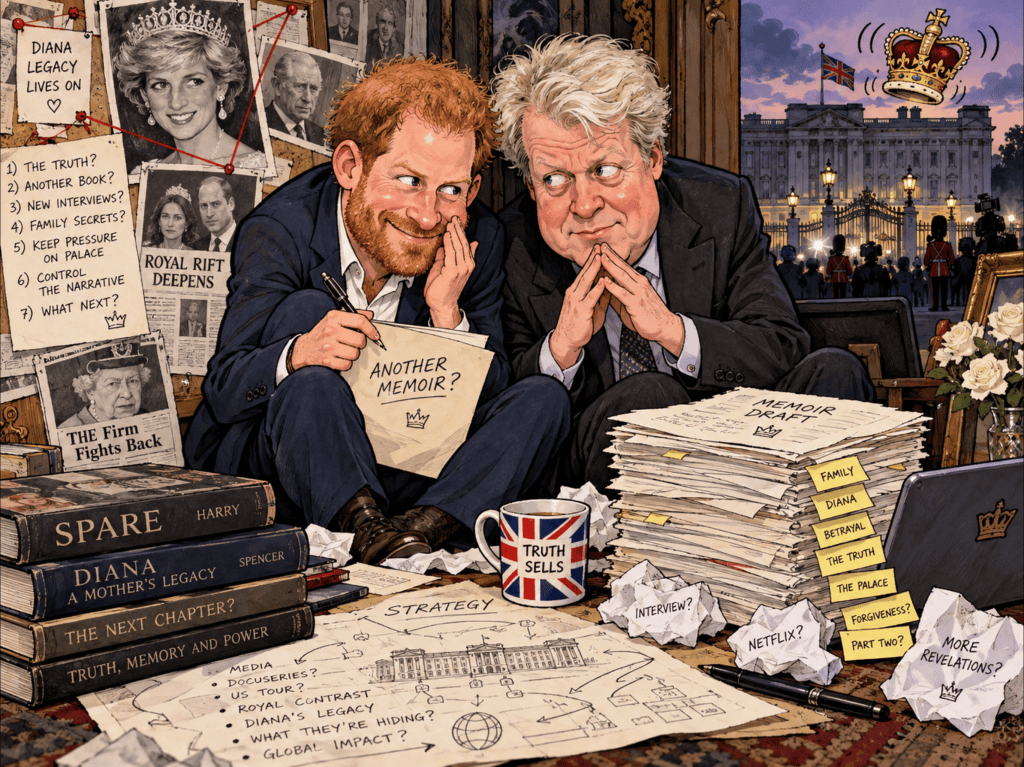
Expect months of explosive memoirs, endless TV panels, and harrowing family drama, ending in a solemn pledge that “lessons will be learned” about royal publishing schedules.
The constitutional fabric of Great Britain is once again reportedly hanging by a thread, threatened this time not by Oliver Cromwell or foreign invaders, but by the apocalyptic combination of a Duke with a book contract and an Earl with a podcast. Commentators across the nation have taken a deep breath and asked the terrifying, existential question: Will Prince Harry, in dark alliance with his uncle, Earl Spencer, finally bring down the British monarchy?
The allegation at the heart of this national crisis is as familiar as it is devastating: a group of extraordinarily wealthy aristocrats are mildly annoyed with each other. Earl Spencer has released yet another memoir detailing decades-old grievances, while Prince Harry continues his tireless, noble quest to privacy by giving prime-time broadcast interviews about his estranged family. Between them, they possess enough grievances, archival photos, and publisher advances to fill every morning talk show until the sun expands and consumes the earth.
Naturally, our national institutions have sprung into high gear to manage the fallout. The palace will deploy its standard nuclear option: issuing a frostily worded statement from a “royal insider” expressing deep disappointment, while carefully briefing chosen correspondents that the King is focusing on his vegetable patch. Parliament will hold urgent, grandstanding debates where MPs passionately demand the removal of aristocratic titles that nobody under the age of sixty-five actually understands. Fleet Street will print millions of pages of breathless analysis, complete with body-language experts analyzing three seconds of video footage of a nephew nodding at his uncle in a car park.
And then what? What actually changes?
The short answer is absolutely nothing. After months of apocalyptic headlines, panel debates featuring furious men in heavy suits, and a three-part Netflix docuseries that reuses the same six historical photographs, the thousand-year-old British state will not crumble into dust. King Charles will continue to appear on 50p coins, Prince William will go on cutting ribbons at regional leisure centres, and the crown jewels will remain safely behind bulletproof glass in the Tower of London.
The tragic reality of British institutional drama is that the volume of noise is almost always inversely proportional to the scale of the consequence. We are presented with a titanic clash of royal titans, but the likely aftermath will look remarkably bureaucratic. There will be no constitutional collapse, no republican revolution, and no televised dismantling of Buckingham Palace. At most, we can expect a slightly modified royal communications policy, a firm reminder about non-disclosure agreements for palace staff, and the immortal, solemn assurance that “lessons have been learned.”
If the public genuinely wanted an alternative to this endless, expensive cycle of high-born soap opera, the solution is embarrassingly simple: stop buying the books. A monarchy cannot be brought down by a disgruntled uncle with a feather quill, but it could certainly be rendered completely irrelevant if the British public decided, just once, to turn the channel and read a proper book instead.
Until that day comes, the monarchy remains entirely safe—not because it is invincible, but because we seem utterly incapable of looking away from the drama.
🔥 Challenges: If years of explosive interviews, tell-all books, and family feuds haven’t changed a single line of the British constitution, is royal drama actually a threat to the monarchy, or is it secretly the only thing keeping us interested?
What do you think? Drop your thoughts in the comments below, hit the like button if you enjoyed this piece, and share it with your fellow royal-watchers!


Leave a comment