Five men have been arrested near RAF Fairford on suspicion of preparing a terrorist act and explosives offences. Three suspicious vans were reportedly heading towards the Gloucestershire airbase, bomb-disposal teams were called in, dozens of homes were evacuated and counter-terrorism police took over the investigation.
And what apparently helped bring this formidable operation crashing to a halt?
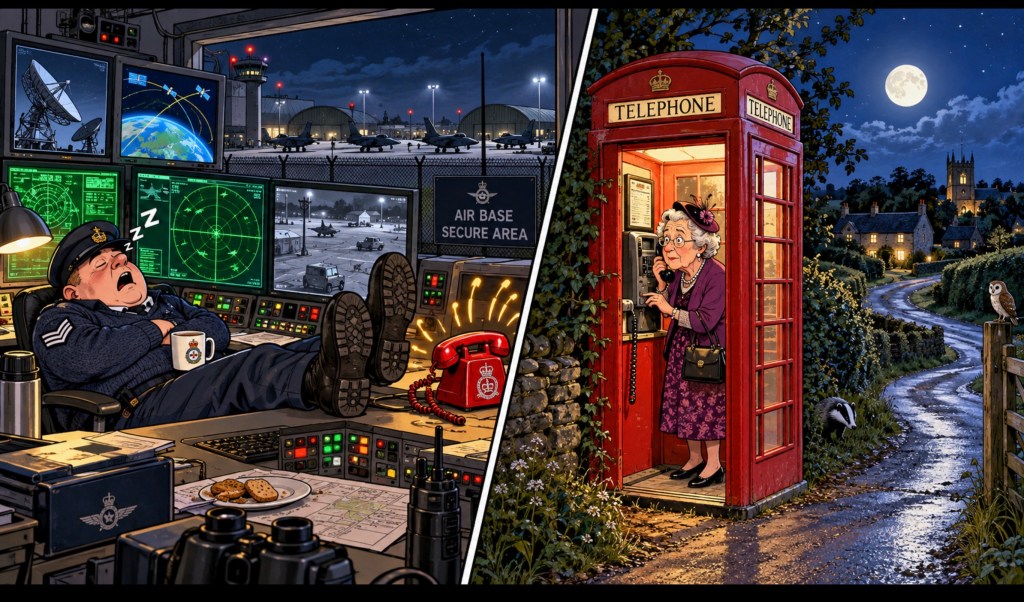
Not a satellite, not a drone, not an RAF surveillance aircraft bristling with technology. A little old woman driving home from a party at one o’clock in the morning.
Britain spends billions on defence. Margaret had headlights.
The unnamed local resident reportedly came across three vans blocking a country road near RAF Fairford and saw a group of hooded or balaclava-clad men. She became suspicious, tried the Ministry of Defence police, said she received no answer, probably sleeping, and then dialled 999. Armed officers arrived shortly afterwards.
She later summed up the situation rather beautifully herself: a “plucky amateur” should not be the person spotting suspicious activity beside an airbase reportedly on high alert.
Quite.
Because RAF Fairford is not a village cricket pavilion containing three folding chairs and a lawnmower.
It is a strategically significant airbase used by the United States Air Force. In recent months it has been connected with US military operations involving Iran, making security around the site rather more consequential than checking whether somebody has forgotten to lock the clubhouse.
Yet according to the accounts now emerging, the crucial early-warning system appears to have consisted of a civilian noticing that three vans and several masked men hanging around a military installation in the middle of the night looked, on balance, slightly unusual.
This is less Eye in the Sky and more Mrs Marple Goes to Fairford.
To be clear, the five men have been arrested on suspicion of offences. An investigation is under way, explosives experts have been examining the vehicles, and motives and any wider connections remain matters for investigators to establish. Arrest is not conviction, and allegations about who was behind any suspected plot have not yet been proved.
But that does not make the security question disappear.
Quite the opposite.
If investigators eventually establish that a serious attack was being prepared, the uncomfortable question becomes even larger: how did suspicious vehicles and masked men apparently get close enough to one of Britain’s strategically important military sites for a woman returning from a party to become part of the detection system?
Britain has radar systems capable of tracking aircraft hundreds of miles away. Intelligence services monitor terrorism. Military bases have fences, cameras, guards, patrols, access controls and security procedures.
Apparently what we were missing was somebody coming round the corner with full beams on.
🔥 Challenges: If an ordinary resident could apparently spot suspicious activity near a high-alert military airbase before the security system did, should the bigger investigation be not only what the suspects were allegedly doing — but why nobody guarding the base appears to have noticed first? Tell us what you think on the Chameleon News blog.
Comment, like and share if you think Britain’s security systems should detect the threat before somebody driving home from a party does.


Leave a comment