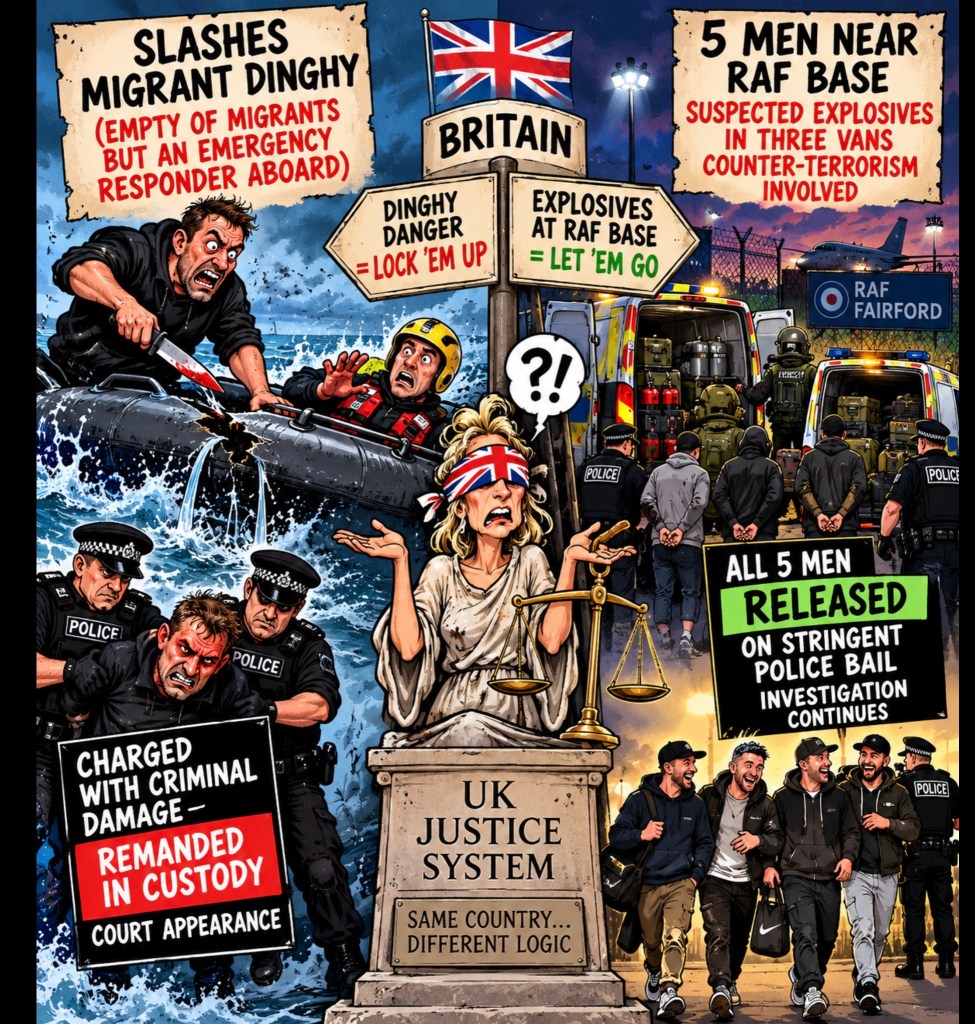
Apparently, Britain has developed a new national-security measuring system, and somewhere along the way somebody replaced the calculator with a roulette wheel.
Daniel Thomas allegedly slashes a migrant dinghy in the Channel—empty of migrants, although an emergency responder was aboard—and ends up charged, remanded in custody and hauled before a court.
Meanwhile, five men are arrested near RAF Fairford after police respond to three suspicious vans, suspected explosive material is examined by bomb-disposal experts, homes are evacuated, and counter-terrorism officers arrest the men on suspicion of preparing a terrorist act.
Then, on Monday, all five are released on stringent police bail while the investigation continues.
No, that does not mean they are guilty. It does not mean Thomas is guilty either. That is what courts and investigations are for.
But from the outside?
Christ alive, the optics have been assembled by Monty Python. 🎪
💣 Three Vans, Suspected Explosives… and Britain Produces the Bail Forms
Imagine explaining this sequence without sounding like you’ve suffered a head injury.
“Right, what happened here?”
“Well, five blokes were stopped near an RAF base.”
“Anything suspicious?”
“Three vans.”
“Anything in the vans?”
“Police are investigating suspected explosive devices.”
“Counter-terrorism involved?”
“Yes.”
“Residents evacuated?”
“Eighty-five households.”
“Bomb squad?”
“Obviously.”
“So this is exceptionally serious?”
“Absolutely.”
“And the suspects?”
“Released on stringent bail while inquiries continue.”
Right then. Carry on. Nothing about that sequence will generate public questions whatsoever. 🫠
And that is the real issue: not that bail automatically means leniency, and not that remand automatically means somebody is more dangerous.
Courts and police make detention decisions according to different legal tests, available evidence, investigative needs, risks of absconding or interference, and the circumstances of each individual case.
But governments and institutions cannot spend years telling the public that national security is existentially important and then act surprised when apparently contrasting criminal-justice decisions leave people scratching holes through their scalps.
Thomas’s alleged act involved a knife, criminal damage and an emergency responder aboard the dinghy. That is serious.
A suspected explosives investigation involving three vans travelling towards an RAF base is also, rather obviously, serious.
The public is entitled to ask how the system arrives at dramatically different custody outcomes without immediately being told that merely noticing the difference makes them some sort of dangerous extremist.
Sometimes a question is just a bloody question. 🇬🇧
🔥 Challenges 🔥
So here’s the one worth debating:
Do you understand why these two cases produced such different custody decisions—or does Britain’s justice system need to do a far better job explaining itself?
Keep guilt and innocence out of it: both cases still involve allegations and active legal processes.
But the contrast in how they look to the public is impossible to miss.
👇 Drop your take in the BLOG comments. Like it, share it, argue with it—just bring something better than a slogan.
The sharpest comments will be included in the next issue of the magazine. 🎯📝


Leave a comment