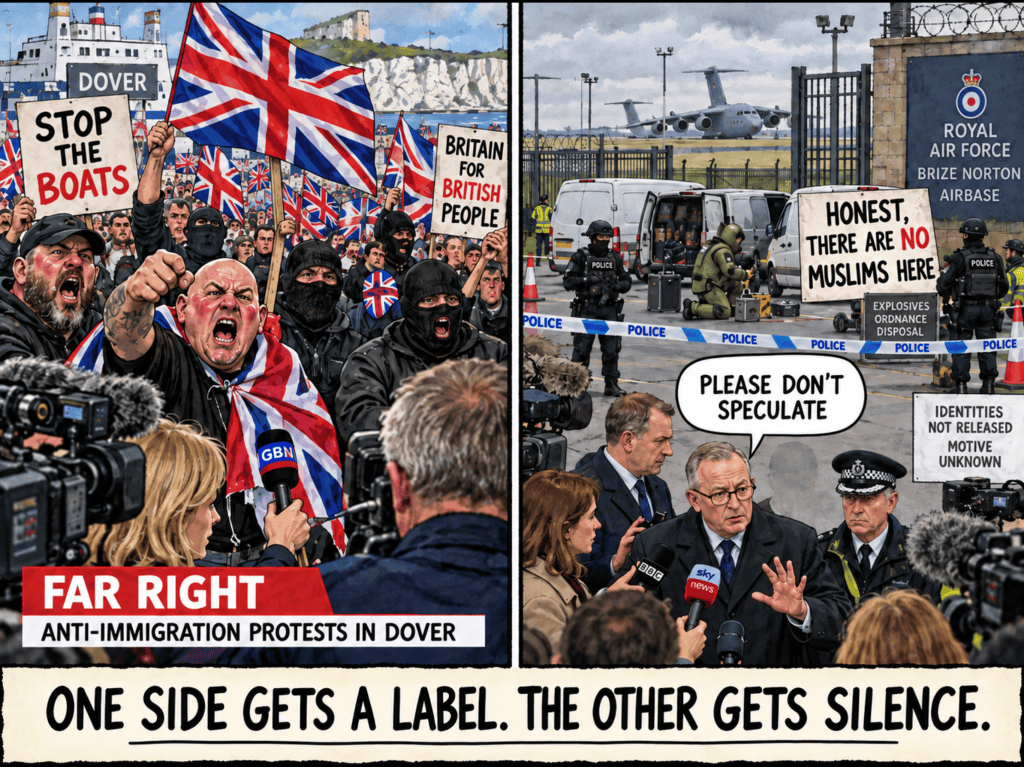
Five men are in custody after three suspicious vans were reportedly heading towards RAF Fairford, a strategically important airbase used by the United States. Police initially arrested them over suspected explosives offences and then on suspicion of preparing a terrorist act. Bomb-disposal teams were deployed, homes were evacuated and investigators are examining what reports describe as suspected improvised explosive devices.
Yet one thing remains conspicuously absent: we still do not know who these men are, their nationalities, or what ideology allegedly motivated them. Police have not released those details, and investigators are reportedly considering several possibilities, including an Iranian connection, a jihadist motive or something else entirely.
Fair enough while evidence is being gathered. But it creates a rather extraordinary contrast with Britain’s treatment of political protesters, where colourful labels appear to be available before the kettle has finished boiling.
Balaclava at Dover? Full Biography. Explosives Near an RAF Base? Please Don’t Speculate. 🎭
Earlier this month, hundreds of masked anti-immigration protesters blocked roads around Dover. The demonstration was organised by Daniel Thomas, better known as Danny Tommo. The Home Secretary subsequently publicly described Thomas as “far-right and outright racist” and warned that he and his organisation would face the full force of the law if they committed crimes.
That is remarkably decisive language.
Interestingly, the Dover blockade itself reportedly resulted in no arrests.
Now compare the atmosphere.
Masked protesters block roads: organisers named, political affiliations dissected, motives analysed, condemnation supplied.
Five men are arrested near an airbase on suspicion of preparing a terrorist act, with three vans being examined by bomb-disposal specialists: early stages, investigation continuing, please avoid speculation.
Legally, there are perfectly understandable reasons not to identify suspects prematurely. Nobody should be convicted by newspaper headline, and terrorism investigations can involve intelligence and evidence that cannot immediately be made public.
But the difference in public language is still striking.
Apparently Britain possesses two entirely different dictionaries.
For protesters, we have the deluxe edition containing words like far-right, extremist, racist, dangerous and threat.
For suspected terrorism investigations, somebody appears to have misplaced the adjectives.
There is another uncomfortable detail.
The Fairford incident was reportedly uncovered after a member of the public noticed suspicious activity and called 999. The Guardian reports that the suspected plot appears to have been discovered by chance rather than through an intelligence-led operation.
Think about that.
🔥
Challenges: Why Does Britain Sometimes Learn More About Protesters Than Terror Suspects?
Should police and government release more information about the Fairford suspects once it can safely be disclosed — including nationality, alleged motive and whether investigators believe a wider network was involved? Or is withholding those details essential while the investigation continues? Tell us what you think in the comments on the Chameleon News blog.
👇 Comment, like and share — because when three vans allegedly carrying suspected explosives reach the doorstep of an RAF base, “please don’t speculate” cannot be the final answer.


Leave a comment