Britain’s security system appears to work beautifully — provided somebody notices the suspected terrorists when they are already driving towards an RAF base.
Five men have been arrested near RAF Fairford on suspicion of explosives offences and preparing a terrorist act after police were alerted to three suspicious vehicles travelling towards the base. Armed officers moved in, bomb-disposal teams examined the vehicles and residents were evacuated. The men are suspects and the investigation is continuing.
The awkward part is that the alarm was reportedly raised by a member of the public who spotted suspicious activity and called 999. The Guardian reports that the operation was not intelligence-led.
Apparently the First Line of Defence Is Someone Looking Out of the Window
This is the part politicians should be explaining.
Britain spends billions on border security, intelligence, counter-terrorism policing and protecting military installations. Yet three suspicious vans allegedly carrying materials being examined as possible improvised explosive devices reportedly got within minutes of a strategically important RAF base before an ordinary member of the public raised the alarm.
That is not exactly a glowing advert for prevention.
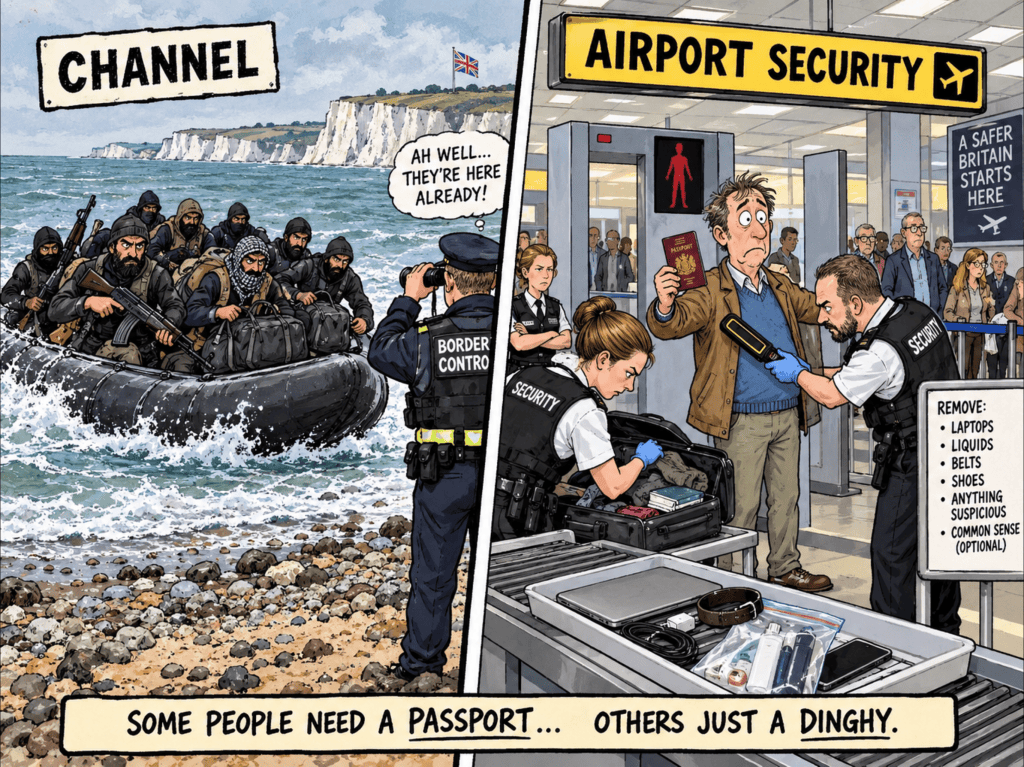
We are constantly told about systems, databases, commands, taskforces and sophisticated security operations. Meanwhile thousands of people continue entering Britain illegally across the Channel, often creating exactly the sort of identity and background questions that proper border control is supposed to resolve before entry.
Yet British citizens travelling legally can arrive carrying government-issued biometric passports and still quite rightly face security checks.
Good.
Check them.
But if somebody enters illegally and authorities have less reliable information about who they are, common sense says the scrutiny should become tougher, not more relaxed.
That is not accusing everybody arriving by boat of terrorism. It is applying the most basic rule of security imaginable:
The less you know, the more careful you should be.
Nobody guarding RAF Fairford would wave an unidentified van through the gate because nobody had yet proved there was a bomb inside.
So why should border security operate on the assumption that uncertainty is harmless until somebody proves otherwise?
And Fairford raises another uncomfortable question.
If investigators establish that viable explosive devices were being prepared, where were they made? Who obtained the materials? Was anyone else involved? Was there a wider support network?
Those questions remain unanswered. They should remain questions until investigators establish the facts.
But they are rather important questions.
Because explosives do not normally assemble themselves in the back of a Transit van while everyone is asleep.
The authorities responded impressively once the alarm was raised. Armed police arrived. Roads were closed. Homes were evacuated. Bomb-disposal robots appeared. Counter-terrorism officers took control.
Britain is apparently superb at Act Two.
The problem is Act One.
How did a suspected operation involving five men and three suspicious vehicles get that close to a military base before somebody driving past thought, “Hang on a minute”?
That is where the satire writes itself.
Perhaps we no longer need another billion-pound security strategy.
Perhaps we simply issue every pensioner in Gloucestershire with binoculars and a hotline.
Neighbourhood Watch: Strategic Nuclear Edition.
And after all the investigations, briefings and solemn promises, what actually changes?
Another review?
More barriers around RAF bases?
Another announcement about intelligence sharing?
Another minister insisting procedures are being strengthened?
Or will we eventually arrive at Westminster’s favourite destination:
“Lessons will be learned.”
The practical answer is much simpler.
Control the border properly. Establish identities before uncertainty becomes somebody else’s problem. Treat unknown backgrounds as something requiring investigation, not reassurance. Protect strategic sites before suspicious vehicles are almost on the doorstep.
Security is supposed to stop dangerous situations developing.
If your system only springs magnificently into action once the bomb squad is unpacking the robot, that is not prevention.
That is an excellent emergency service.
🔥
Challenges: If Suspected Explosives Can Get This Close to an RAF Base, What Exactly Are We Preventing?
Britain has enormous security organisations, sophisticated technology and layers of border control — yet this suspected plot was reportedly noticed by a member of the public. Are we spending too much time telling people the systems are working and not enough time asking why threats can apparently get so far before anybody spots them? Tell us what you think on the Chameleon News blog.
👇 Comment, like and share — because “thank goodness someone noticed” is not much of a defence strategy.


Leave a comment