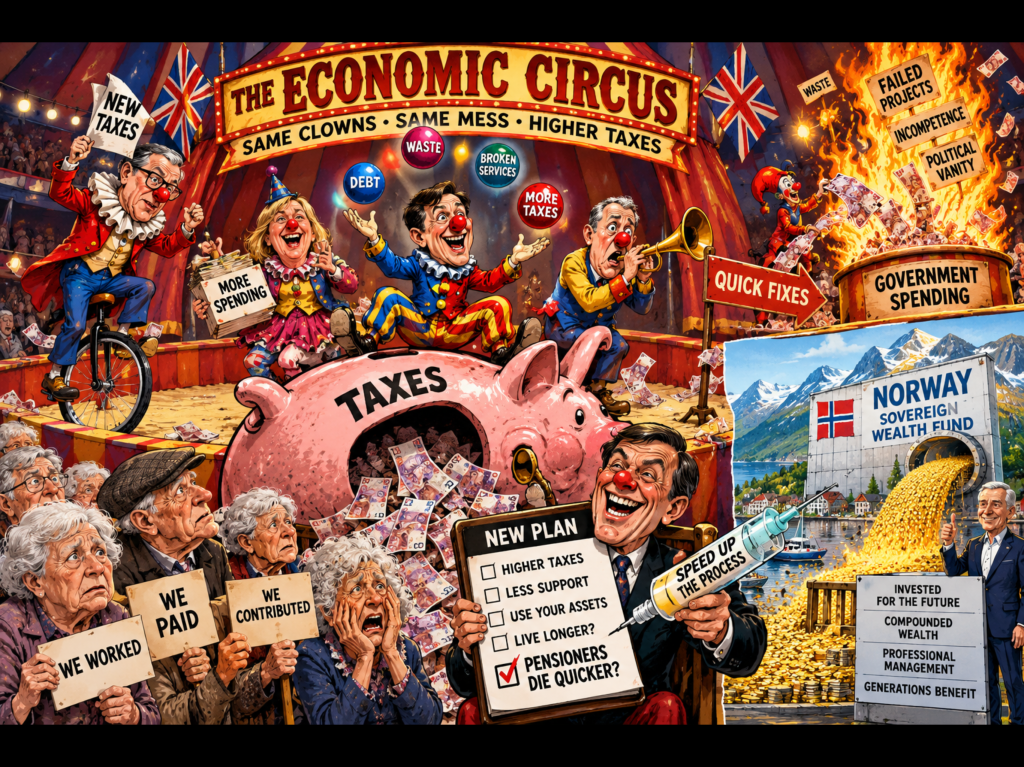
There comes a point when polite political commentary becomes pointless, because the evidence is sitting in front of us. Britain is not suffering from a shortage of taxation. It is suffering from decades of poor political management of the money already taken from us.
Taxes rise, services deteriorate, debt grows, and every few years another Chancellor appears to explain that the country faces a difficult financial situation requiring “tough choices”. Those tough choices almost never seem to involve admitting that successive governments have managed long-term national finances badly. Instead, they involve finding another group of people to squeeze.
Pensioners are now becoming one of the easiest targets. The argument is familiar: people are living longer, the State Pension costs more, social care costs more and healthcare costs more. Therefore, something must give. But why is the conclusion so often that pensioners must give?
They did not design the pension system. They did not decide how National Insurance would be used. They did not decide whether pension contributions should be invested. They did not decide how North Sea oil revenues should be managed. They did not spend decades refusing to solve social care. Politicians did.
For most people, National Insurance feels like a contribution towards their future. You work, you pay in, and eventually you receive a pension. But Britain never built the kind of enormous national investment fund that decades of compulsory contributions might lead you to imagine.
The system largely works on a pay-as-you-go basis. Money comes in from current workers and helps pay current pensioners. That may have looked perfectly manageable when the population was younger and the ratio between workers and retirees was more comfortable, but an ageing population was hardly an unforeseeable event. Governments had decades of demographic data showing exactly what was coming.
Yet instead of building a vast pool of invested national retirement wealth, Britain continued largely on the same path. Now the bill is arriving and pensioners are being discussed as though they somehow created the problem simply by surviving long enough to collect what they were promised.
That is what makes the argument so absurd. If the system was badly designed, that is a political failure. If governments failed to prepare for an ageing population, that is a political failure. If social care remains unresolved after decades of reviews, commissions and promises, that is a political failure.
Yet the proposed solutions so often involve reducing support, increasing taxation, changing pension rules or forcing older people to use more of their own assets to finance care. In other words, the people who had no control over the design are expected to absorb the consequences of the design.
And then you look at Norway. That is where the comparison becomes embarrassing.
Britain and Norway both benefited enormously from North Sea oil and gas. Both countries received huge revenues from natural resources that could only be extracted once. But Norway understood something that British governments consistently failed to grasp: temporary wealth should be turned into permanent wealth.
Rather than allowing the entire benefit of oil revenues to disappear into normal government spending, Norway created a sovereign wealth fund and invested for the long term. The money was not simply collected and consumed. It was converted into assets. Those assets produced returns. Those returns were reinvested. Over decades the fund became enormous.
Today Norway’s Government Pension Fund Global is worth trillions and owns significant stakes across world markets. More importantly, a very large part of its value now comes not from the original oil money, but from investment returns generated over time. That is what compounding does when politicians are prevented from spending everything immediately.
Britain had access to extraordinary natural wealth too, but instead of building a national investment machine of comparable scale, the money was absorbed into the general finances of government. Some of it funded tax reductions, some of it supported public spending, and some of it simply disappeared into the normal churn of government budgets.
Now, decades later, Britain looks at pension costs and social care and says there is not enough money. That is not bad luck. That is bad management.
The difference between Britain and Norway is not that Norway discovered a secret form of economics. They simply had the discipline to accept that not every penny available to government should be spent by the politicians of the day. That is the lesson Britain still refuses to learn.
Politicians operate on short electoral cycles. Their incentive is to spend money where the benefit can be seen before the next election. Investment works on a completely different timescale. A national fund built over forty or fifty years may deliver its greatest benefit long after the politicians who created it have retired or died.
That is precisely why politicians should not have unrestricted control over long-term national wealth. We would never allow a government minister to personally manage a multi-trillion-pound investment portfolio simply because they won an election. Yet collectively, that is effectively what we allow politics to do with national wealth.
Every government can change priorities. Every Chancellor can alter taxes. Every administration can decide to spend more today and leave the consequences for tomorrow. And tomorrow eventually arrives.
That is exactly what has happened with pensions. Britain should have been building large-scale retirement assets decades ago. Imagine if part of compulsory pension contributions had genuinely been invested. Imagine if those contributions had been allowed to compound over forty years. Imagine if employer contributions, employee contributions and investment returns had accumulated across generations.
Britain would not simply have pension liabilities. It would have pension assets.
Instead of asking every year how much today’s workers must be taxed to support today’s pensioners, government could also ask how much the national retirement fund had earned. That would not eliminate every problem. A transition would be difficult. Existing pensioners still need to be paid while a new system is built. Markets go down as well as up. Proper safeguards would be essential.
But at least it would be a serious attempt to create wealth rather than endlessly moving money from one taxpayer to another.
The same principle should apply far beyond pensions. Some national revenues should be protected from short-term politics. Strategic assets, resource revenues and long-term retirement contributions should be placed into independently managed funds with strict legal rules.
Politicians should decide the broad objectives, but professionals should manage the money. The capital should be protected, withdrawals should be governed by clear limits, accounts should be completely transparent, and no Chancellor should be able to raid the fund simply because the Budget has gone wrong.
That is not removing democracy. It is recognising competence.
We do not ask MPs to perform surgery, design aircraft or run nuclear power stations simply because they won a constituency election. So why do we pretend that winning an election automatically makes somebody capable of managing national wealth over a fifty-year horizon?
It does not.
And that is the real scandal.
The public has been trained to accept that whenever government finances deteriorate, somebody must pay more. But perhaps we should ask a different question: why was so much money already collected not managed better?
Why were temporary resources not converted into lasting national wealth? Why were pension contributions not used more aggressively to build long-term assets? Why did successive governments know the population was ageing but still fail to create a system robust enough to handle it?
Those are not questions for pensioners. They are questions for Westminster.
The pensioners did their part. They worked, they paid, they contributed, and they planned their lives around promises made by governments. If the system is now cracking, that is not proof that pensioners became too expensive. It is proof that the people running the system failed to prepare properly for something they knew was coming.
And if this Government really believes the biggest problem is that pensioners are living too long, perhaps they should stop pretending this is sophisticated economics.
At the rate their ideas are going, they might as well start looking for ways to help pensioners die quicker, because that appears to be where the political brain cells run out.
That is how absurd the argument has become.


Leave a comment