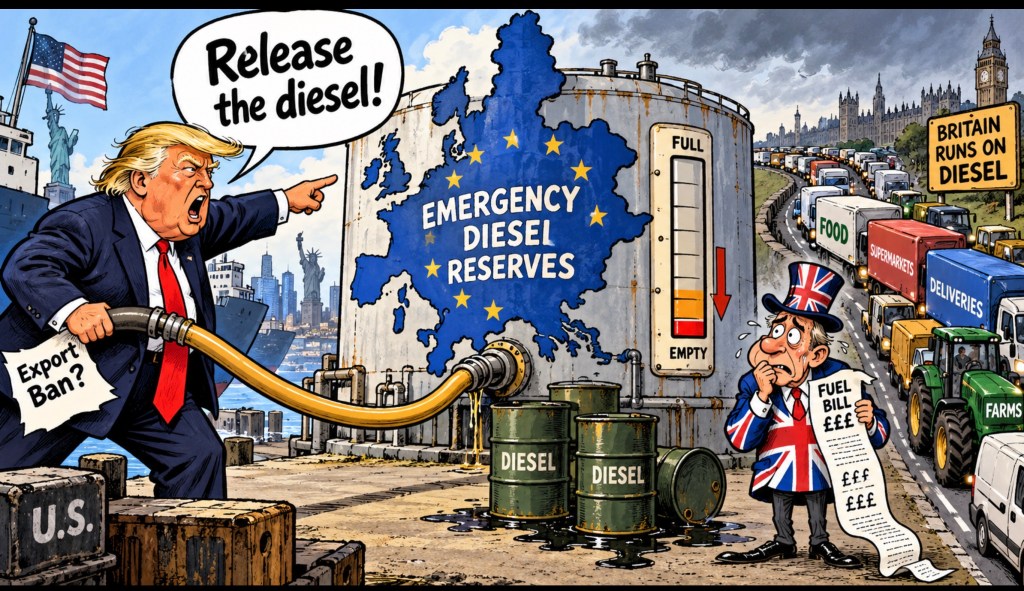
⛽🌍Britain and Europe spent years discovering the joys of energy dependence, and now the bill appears to be arriving with a nozzle attached.
The Trump administration has reportedly pressed European governments to release 120 million barrels of emergency diesel over six months to help push down global fuel prices, with France and Germany warned that failure to cooperate could bring restrictions on US diesel exports. The request would amount to roughly 40% of Europe’s emergency diesel holdings. No such export ban has yet been announced, and no European release on that scale has been agreed. (Reuters)
For Britain, this is hardly an academic argument. The UK does not currently refine enough diesel to satisfy domestic demand, and roughly one-third of UK diesel imports last year came from America. (The Guardian)
🚨 Welcome to the Great Transatlantic Diesel Siphon
Nothing says “energy security” quite like discovering that your emergency fuel supply may depend on somebody else’s emergency, somebody else’s refinery and somebody else’s political calendar.
Europe keeps emergency stocks for precisely the sort of moment when normal supplies become unreliable. Now those reserves are being discussed as a way of easing a wider international squeeze — while the country threatening to restrict exports is simultaneously one of the suppliers Europe relies upon.
It’s geopolitical pass-the-jerry-can. 🛢️
America says: release your reserves.
Europe says: but they’re emergency reserves.
America says: yes, this feels like an emergency.
Meanwhile Britain is standing beside the conversation holding an increasingly expensive diesel receipt and wondering when exactly “energy independence” became a historical reenactment.
The uncomfortable part isn’t simply Donald Trump applying pressure. It’s that the pressure has somewhere to land.
Britain closed refining capacity, Europe became more dependent on imported refined fuels, Russian supplies were disrupted, and the global diesel market has become increasingly vulnerable to events thousands of miles away. The result is a system where a diplomatic argument in Washington can potentially become a haulage bill in Wolverhampton. 🚛💷
And diesel isn’t some luxury product consumed exclusively by people polishing vintage Land Rovers.
It moves lorries, tractors, construction machinery, delivery fleets and large parts of the industrial economy. When diesel becomes scarce or expensive, the pain doesn’t politely remain on the petrol-station sign. It travels through transport costs and supply chains until it eventually arrives at the supermarket checkout wearing a completely different name.
There is also an important reality check amid the panic: in early September, the European Commission said there was no immediate EU oil-supply security problem, although it warned that Middle East instability and autumn and winter demand could tighten markets in the months ahead. (Energy)
So this isn’t “Europe runs out of diesel tomorrow.”
It’s arguably more revealing than that.
It’s a demonstration of just how quickly strategic dependence becomes political leverage.
Emergency reserves are supposed to be the fire extinguisher behind the glass.
The problem begins when several people discover they need the same extinguisher — and one of them owns the hose. 🔥⛽
🔥 Challenges
Here’s the question Britain should be debating:
How did an advanced economy end up depending so heavily on imported diesel that decisions made in Washington, Moscow, Beijing or the Middle East can ripple straight through British transport and food prices?
Is keeping emergency stocks enough?
Should Britain maintain more domestic refining capacity?
Or is importing fuel perfectly sensible until geopolitics suddenly reminds us what the word “strategic” actually means?
💬 Drop your view in the blog comments — especially if you work in haulage, farming, logistics, construction or another diesel-dependent industry. We want to hear what higher fuel costs are actually doing on the ground.
👇 Comment, like and share the post — and send it to somebody who still thinks energy security begins and ends at the petrol pump.
The best comments will be included in the next issue of the magazine. 🎯📝


Leave a comment