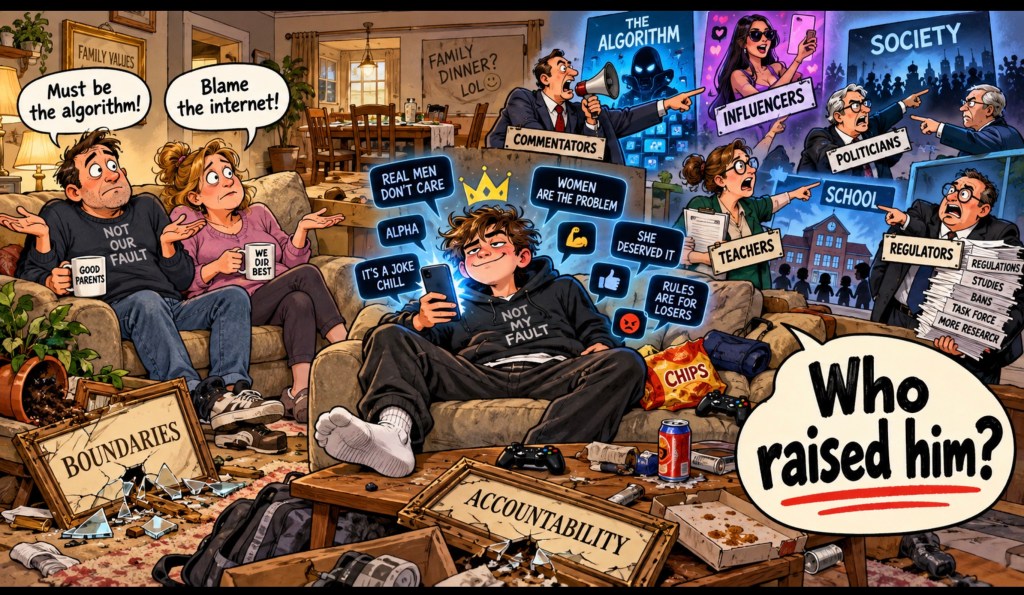
🤱📱🔥Every time public anxiety over young men erupts, Britain seems to assemble the same emergency committee of usual suspects: social media, schools, influencers, smartphones, video games, “toxic culture,” and whichever app adults have just discovered exists.
Missing from the interrogation room rather often? The home.
That does not mean parents are solely responsible for everything their children become. Young people are shaped by families, friends, schools, communities, economic pressures, media and their own choices. But it does raise an awkward question: if parents are routinely described as the most important influence in a child’s early life, why do they sometimes vanish from the conversation the moment that child behaves appallingly?
📱 Apparently the Algorithm Raised Him
Modern public debate can sometimes sound as though perfectly well-adjusted boys wander innocently through childhood until, at fourteen, an algorithm kicks down the bedroom door and turns them into misogynists before dinner.
One podcast. Three clips. A few poisonous memes. Suddenly seventeen years of parenting are treated like deleted browser history.
Convenient, isn’t it?
Blaming technology alone offers almost everyone a comfortable escape hatch. Governments can announce initiatives. Platforms can rewrite policies. Schools can organise another assembly. Commentators can demand tougher regulation.
And parents?
Apparently they were just renting a room in the same building. 🏠
Of course, online environments can amplify ugly ideas, normalise hostility and connect vulnerable teenagers with people eager to exploit insecurity. Schools matter. Peer groups matter. Wider culture matters.
But so do the thousand boring moments that never make a parliamentary hearing: being told “no,” learning that women are people rather than props, watching how adults speak to one another, being corrected when you behave cruelly, discovering that actions have consequences, and realising that the universe does not reorganise itself around your tantrum.
Character is not manufactured in one viral video.
Neither is it manufactured entirely at the dinner table.
That is precisely why treating any single culprit as the universal explanation is so seductive — and so inadequate. 🎭
Public institutions can regulate platforms and educate children. Technology companies can moderate content. Schools can teach respect. Communities can reinforce standards.
But none of those institutions can completely substitute for adults who are present, attentive and willing to set boundaries at home.
Perhaps the uncomfortable question is not, “Who corrupted these boys?”
Perhaps it is:
Who taught them what was acceptable before the internet got involved — and who corrected them afterwards?
Because blaming an algorithm for everything is wonderfully efficient.
Algorithms cannot argue back at the dinner table. 🤖🍽️
🔥 Challenges
So where does responsibility actually sit?
With parents who shape a child’s earliest behaviour? With technology companies that can amplify destructive content? With schools and communities? With young people themselves?
Or is the real mistake our obsession with finding one villain whenever the answer is an inconvenient web of shared responsibility?
💬 Take the argument to the Chameleon News blog comments. Challenge the premise, defend it, dismantle it or bring evidence the debate is missing.
👇 Comment. Like. Share. And send the argument to someone who will disagree with you.
The best comments will be featured in the magazine. 🎯📝


Leave a comment