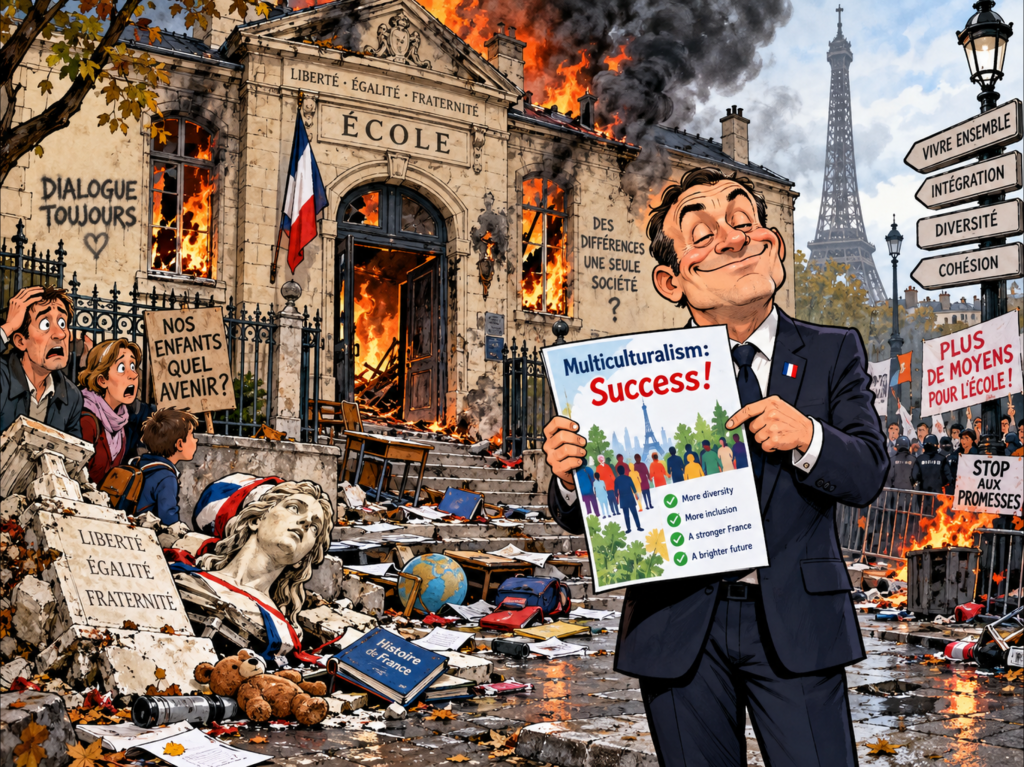
For years, Europe has been sold a beautifully polished brochure. Diversity is our strength. Multiculturalism enriches us. Different communities living together will naturally produce harmony, understanding and a better society. Wonderful. Absolutely wonderful.
Meanwhile, in France, schools are burning, teachers have been attacked, thousands have been arrested amid violent unrest and police are battling demonstrators outside institutions supposedly built to give the next generation a future.
So yes — multiculturalism. Don’t you just love it? 🔥📚
Not because every burning school can simply be blamed on immigration. The evidence does not support that shortcut. But because France now provides a rather uncomfortable backdrop to the much bigger question Europe has spent decades trying desperately not to ask: what happens when celebrating difference becomes easier than building cohesion?
🇫🇷 Liberté, Égalité… and Somebody Pass the Fire Extinguisher
France possesses one of Europe’s oldest and proudest cultural identities. Its towns, schools, churches, universities and civic institutions weren’t assembled last Tuesday by a diversity consultant armed with a PowerPoint presentation. They were built over generations. They survived wars, revolutions and occupation, and now some French schools apparently need to survive the pupils.
During the latest unrest, fires have been reported at schools in several French cities, alongside attacks on staff and clashes with police. Demonstrations originally centred on overcrowding, deteriorating facilities and staff shortages before parts of the movement descended into violence.
There is an irony here large enough to be seen from the Eiffel Tower. “Our schools are falling apart!” And the solution? Set fire to them. Brilliant. 🔥👏 It’s roughly the educational equivalent of complaining that your kitchen tap leaks and solving the problem with a flamethrower.
But beneath the absurdity lies something far more important. France has spent decades wrestling with difficult questions about integration, national identity, assimilation, secularism, immigration and whether people sharing the same territory necessarily means they share the same society.
Those questions cannot be answered by pretending every immigrant is responsible for unrest. They also cannot be answered by screaming “racist!” whenever somebody asks whether multicultural policy has actually produced the cohesion its advocates promised. That is the conversation worth having.
Because multiculturalism isn’t merely about having Moroccan food on Monday, Vietnamese food on Wednesday and congratulating ourselves on Friday because everybody owns a different flag. A functioning multicultural society requires something considerably less glamorous: shared rules, shared obligations, shared civic expectations and enough common identity that people actually feel invested in maintaining the country they live in.
Without that, “multiculturalism” risks becoming little more than multiple cultures occupying the same postcode while increasingly having less to say to one another. And France has been warning about those tensions for years.
Yet Europe’s political class often seems terrified even to examine the results. The approved script remains wonderfully simple: diversity is good, integration problems are complicated, social fragmentation is best left unmentioned, burning cars are blamed on socioeconomic factors and burning schools on structural inequality. But question multiculturalism itself and suddenly the room catches fire faster than the classroom.
Apparently everything may be questioned except the philosophy underpinning the experiment. 🤡 And that’s ridiculous.
A mature country should be capable of saying two things simultaneously: immigrants are individuals and should not collectively be blamed for criminal behaviour, and immigration and multiculturalism are legitimate public policies whose consequences, successes and failures must be open to scrutiny. Those propositions aren’t enemies. They’re basic common sense.
If multiculturalism works, demonstrate where it works. If integration is failing, say where it is failing. If poverty is driving unrest, confront poverty. If criminality is driving it, confront criminality. If political agitators are exploiting young people, expose them.
But stop treating the word “multiculturalism” like some sacred religious object that must be carried around Europe on a velvet cushion while everybody pretends not to notice the cracks appearing underneath it.
France does not need slogans. It needs cohesion. And cohesion requires more than simply placing millions of people with different backgrounds inside the same national borders and assuming history will politely sort out the details.
🔥 Challenges: Is Europe Allowed to Question the Experiment Yet? 🔥
Here’s the uncomfortable question: at what point does questioning multiculturalism stop being taboo and start becoming basic democratic scrutiny?
Has France successfully integrated a changing population into a shared national culture? Has multiculturalism strengthened French society? Has it weakened social cohesion? Or is the truth considerably more complicated than either side wants to admit?
That’s the debate worth having — with evidence, not tribal slogans. 💬 Tell us what you think in the blog comments. Has multiculturalism delivered what Europe was promised, or have governments spent decades refusing to confront its failures?
👇 Comment. Like. Share. Challenge the argument.
The best comments will be included in the magazine. 🎯📝


Leave a comment