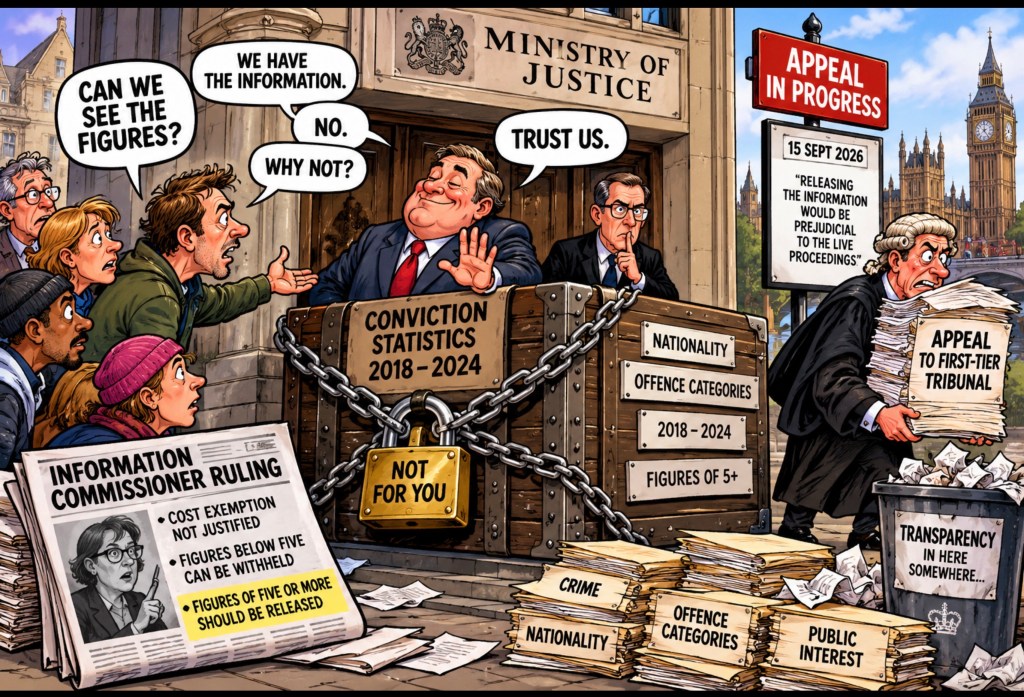
Britain appears to have discovered an exciting new model of government transparency. It goes something like this: “We have the figures.” Excellent. Can we see them? “No.” Why? “Because we’d rather you didn’t.”
The dispute concerns Ministry of Justice conviction data covering 2018 to 2024, including breakdowns by nationality and broad offence groups. In June, the Information Commissioner ruled that the Ministry had not demonstrated that the cost exemption applied and that its personal-information exemption could justify withholding figures below five, but not figures of five or more.
You might imagine that would result in a spreadsheet appearing somewhere on GOV.UK. Adorable. 📁
Instead, the Ministry of Justice is appealing the ruling to the First-tier Tribunal. On 15 September 2026, the Government confirmed that the appeal was still in progress, saying it would be prejudicial to the live proceedings to release the requested information.
🪟 Welcome to the Ministry of Frosted Glass
Here is the peculiar thing about withholding statistics: the statistics themselves might eventually turn out to be thoroughly boring. They might confirm existing assumptions. They might challenge them. They might produce awkward headlines, or they might produce no headlines whatsoever.
We don’t know.
And that is precisely the problem. Because once a government starts fighting over whether the public may inspect ordinary statistical information, attention naturally shifts from the numbers themselves to a much more interesting question: why the fight? 🤔
That does not prove there is anything scandalous hiding in the figures. It does, however, demonstrate one of Westminster’s recurring public-relations talents: taking something potentially mundane and wrapping it in enough official secrecy to make everybody stare at it.
It is the governmental equivalent of walking into a room carrying a locked suitcase and announcing, “Absolutely nothing interesting in here,” then hiring lawyers when somebody asks to open it. 🧳⚖️
If the figures are unremarkable, publication may help demonstrate that. If they complicate public arguments about crime, nationality or immigration, that is relevant information too. Either way, statistics cannot meaningfully inform public debate while sitting behind an administrative curtain.
And secrecy has an unfortunate habit: it breeds speculation. One withheld dataset becomes three rumours, twelve screenshots, four conspiracy threads and somebody’s uncle on Facebook announcing that he has “seen the real numbers.” 📱🔥
That is why transparency is not merely about satisfying curiosity. It is one of the ways institutions prevent information vacuums from being filled with nonsense.
Governments frequently ask citizens to rely upon official evidence. Fair enough. But confidence in official evidence becomes harder to sustain when the response to requests for some of that evidence is effectively: “The figures exist. Please stop asking about them.”
Perhaps the eventual tribunal decision will vindicate the Ministry’s position. Perhaps it will not. That question is now for the legal process.
But the broader democratic absurdity remains wonderfully intact. The state possesses information about matters generating enormous public argument. The public asks to examine it. A regulator says substantial parts should be disclosed. And the resulting answer is not a spreadsheet.
It is an appeal.
Nothing says “trust the evidence” quite like making the evidence itself the subject of litigation. 📊🔒
🔥 Challenges: What Does Transparency Actually Mean?
Here is the question worth arguing about: when official statistics concern controversial subjects, should the instinct be greater openness or greater caution?
Does appealing this ruling protect legitimate privacy and legal interests, or does fighting disclosure risk creating more suspicion than publication ever would? And perhaps most importantly, how much confidence can any government expect from the public if citizens cannot inspect the evidence behind some of the arguments they are being asked to accept?
💬 Drop your view in the blog comments — especially if you think there is a principled case for withholding the figures.
👇 Comment, like and share the post. Get the argument out of the echo chambers and into the open.
The best comments will be included in the next issue of the magazine. 🎯📝


Leave a comment