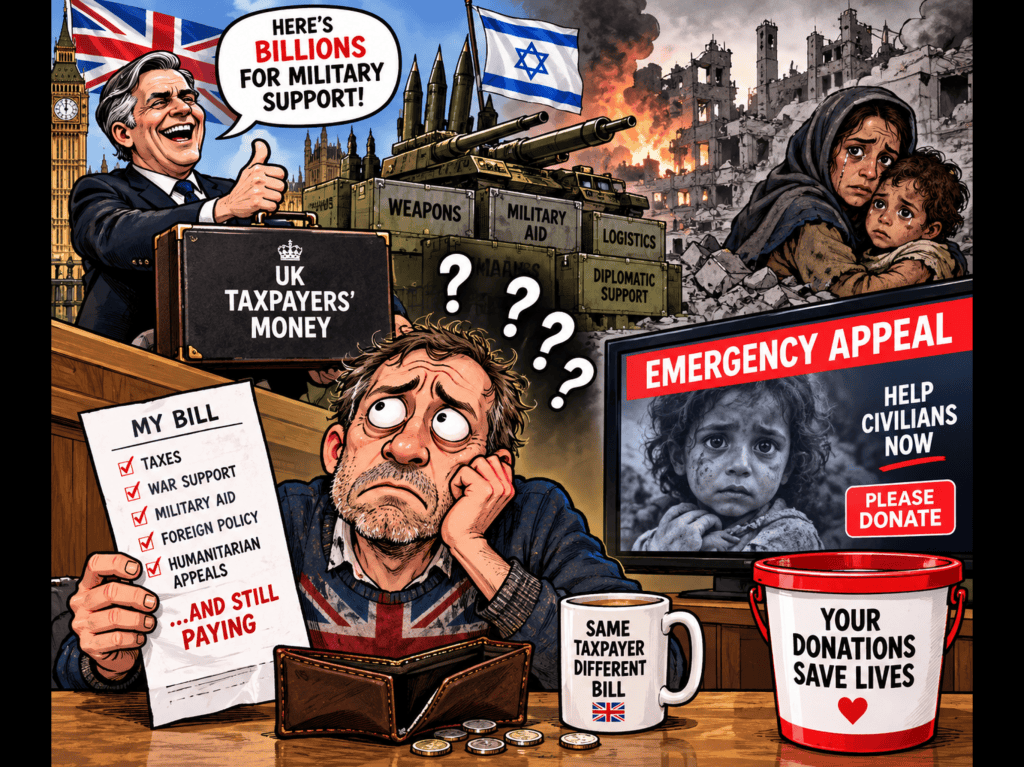
💣🩹There’s a grim little loop here that feels less like foreign policy and more like a national subscription trap: taxpayers help bankroll Britain’s support for Israel, then get asked through tear-stained television appeals to donate again for the civilians crushed beneath the consequences of war. The charities are doing what charities do—trying to keep human beings alive. But the politicians? They owe the public more than silence, slogans, and the usual fog machine of “complexity.”
The Government Sets the Fire, Then Hands You the Collection Bucket
🔥🪣It takes a special kind of political theatre to help sustain the machinery of war while asking ordinary people to fund the clean-up operation during the ad break.
There you are, sitting on the sofa, watching images of exhausted children, shattered hospitals, and families with nowhere left to run. Then comes the appeal: Please give what you can. And decent people do, because compassion hasn’t been fully privatised yet. But somewhere between the donation number and the government press statement, a question starts clawing at the wallpaper:
Why are citizens being asked to pay for humanitarian relief while their own government’s choices may be helping fuel the disaster?
That is the contradiction nobody in power seems eager to put on a leaflet. The public purse supports policy. The private conscience funds the aftermath. Politicians talk about alliances, security, and strategic interests, while charities are left asking pensioners, nurses, teachers, and parents to chip in for food, medicine, and tents.
It is not the charities that deserve the anger. They are responding to suffering in real time, not posing for microphones in front of flags. The moral invoice belongs elsewhere.
If the government believes its policy is justified, then explain the whole equation. Explain how military support, diplomatic cover, humanitarian concern, and public donation appeals are supposed to fit together without making taxpayers feel like they are paying twice: once for the politics, and again for the pain.
Because right now, it looks like the public is being handed both ends of the bill—one marked “national interest,” the other marked “human compassion.” And somehow, the people who signed off the first one are nowhere near the till when the second arrives. 💣➡️🩹
🔥Challenges🔥
Here’s the question worth dragging into daylight: how many times should ordinary people be expected to pay for political decisions they never truly got to approve?
Drop your take in the blog comments. Is this hypocrisy, moral confusion, or just the standard operating system of modern government? 💬
👇 Comment, like, and share—because if politicians won’t explain the contradiction, the public can certainly expose it.
The best comments will be included in the magazine. 📝


Leave a Reply