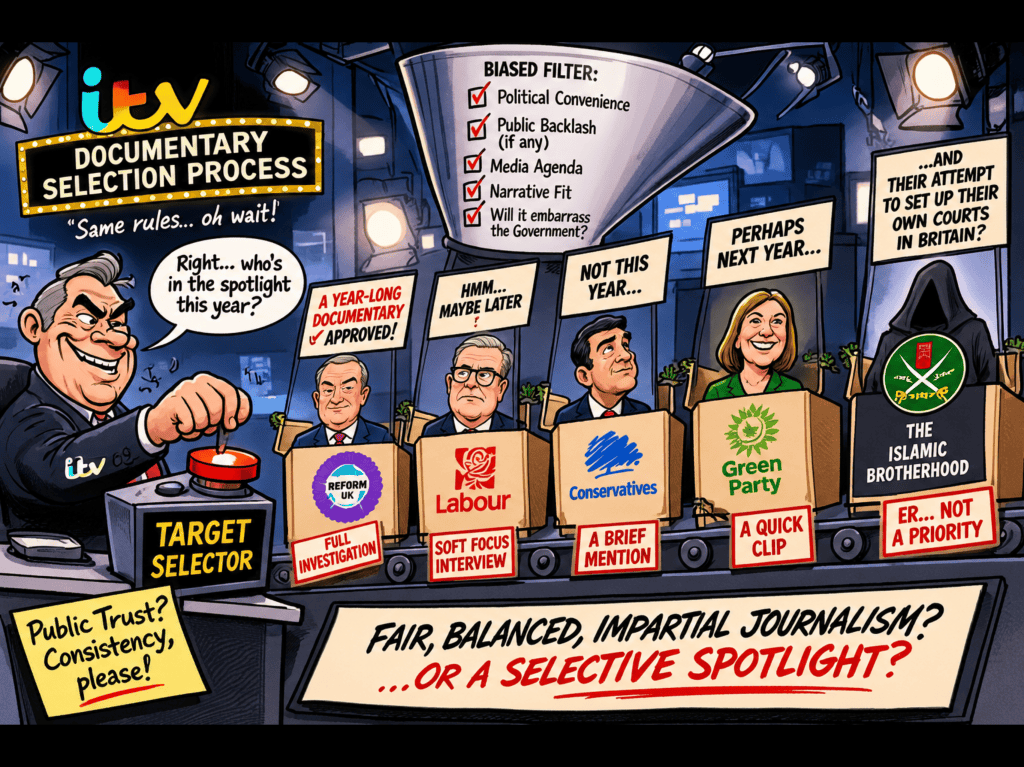
📺🎭A year-long documentary aimed squarely at Reform supporters has landed with all the subtlety of a marching band in a library. Offensive remarks? Absolutely, expose them. Challenge them. Drag them under the studio lights. But here’s the awkward little question wobbling in the corner like an uninvited guest: where is the same forensic, year-long microscope for Labour, the Conservatives, the Greens, and every other movement trying to influence British public life?
🎬 Investigative Journalism or Campaign Ad With Better Lighting?
Nobody serious is saying vile remarks should be ignored. If someone says something offensive, hateful, or dangerous, they should be challenged—hard. That is journalism doing its job.
But journalism stops looking like journalism when the spotlight only seems to know one postcode.
Where are the hidden cameras inside every major party? Where is the year-long trawl through Labour activist groups, Conservative associations, Green Party meetings, and all the delightful little WhatsApp swamps where political hypocrisy goes to breed?
And while we are apparently in the golden age of fearless broadcasting, where is the ITV documentary on groups accused of trying to create parallel systems of authority in Britain? Where is the serious investigation into religious or ideological organisations that some critics claim are pushing for community-based courts, unofficial justice networks, or pressure structures outside the normal British legal system?
Because that seems like a fairly important public-interest question, does it not? ⚖️
If a broadcaster has the time, money, and appetite to spend a year digging into Reform supporters, then surely it also has the courage to investigate any organisation—religious, political, activist, or otherwise—accused of undermining equal justice under British law.
Not a hit piece on ordinary Muslims. Not a lazy smear against communities. Not the bargain-bin bigotry of blaming millions for the actions of a few. But a proper investigation into power, influence, intimidation, ideology, and whether anyone is trying to build unofficial systems that leave vulnerable people—especially women, dissenters, or minorities within minorities—without the protection of the law. 🔦
That is exactly the kind of story serious journalism should be chasing.
Because if the standard is “expose extremists, bigots, cranks, and people with ideas that should have been left in a dusty filing cabinet in 1973,” then fantastic. Apply it everywhere. Put every party, pressure group, faction, movement, and self-appointed moral council through the same blender.
No favourites. No sacred cows. No convenient blind spots. 🐄🚫
But when one party gets the full documentary treatment and others get soft lighting, sympathetic framing, or complete silence, people are entitled to ask whether they are watching journalism—or a campaign strategy with subtitles.
Public trust is not built by pointing the camera in one direction and pretending the rest of the room is empty. It is built by being consistent, ruthless, and fair. If broadcasters want to police democracy, they cannot also start dressing like contestants in it.
So the question remains: when did ITV become a political party?
And more importantly—when does every other party, pressure group, and power network get its turn under the same unforgiving lights? 🔦
🔥Challenges🔥
Is this accountability—or selective outrage wrapped in a documentary budget? Should every party and pressure group face the same year-long scrutiny, or is the media now choosing its targets before the public chooses its leaders?
If broadcasters want public trust, they need one rule for everyone: expose wrongdoing wherever it sits, whether it wears a rosette, a robe, a slogan, or a halo. 🎭
Drop your verdict in the blog comments. Don’t whisper it into the Facebook void—bring it to the blog where the debate belongs. 💬⚡
👇 Comment, like, and share if you think journalism should investigate everyone, not just the politically convenient.
The best comments will be included in the magazine. 📝🎯


Leave a Reply