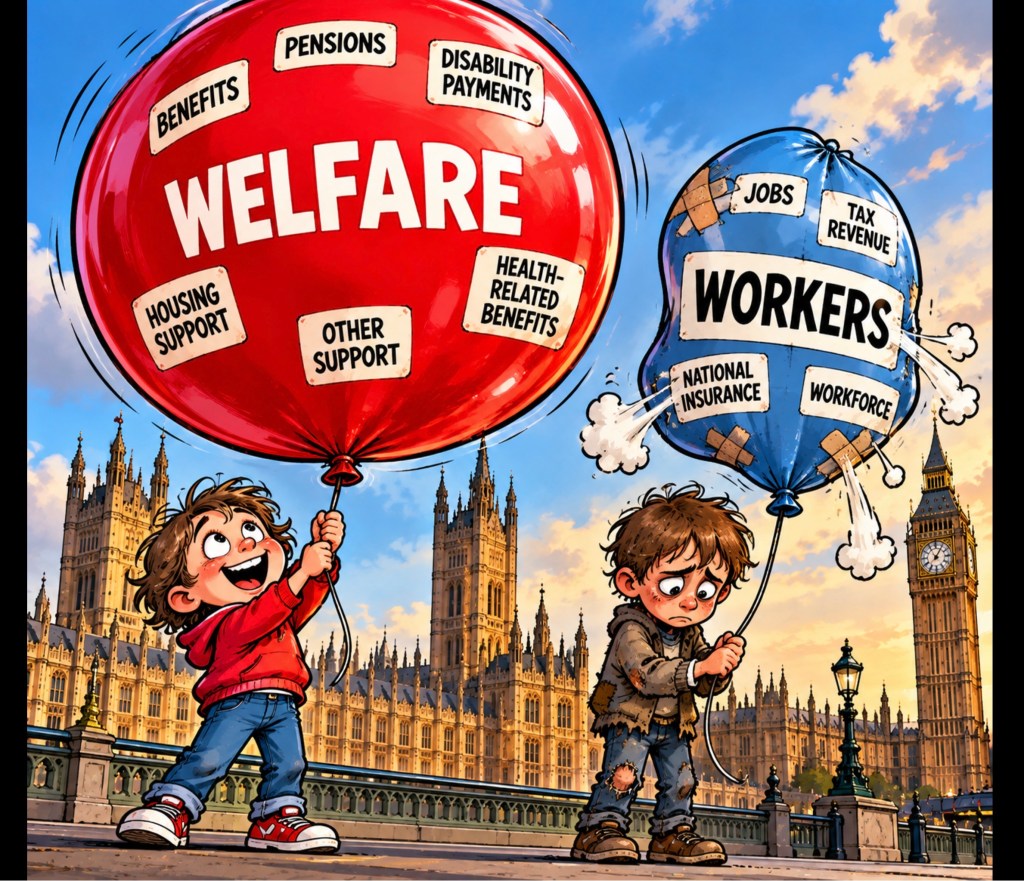
🤖💸Britain’s welfare bill is set to keep rising all the way to the next election, despite Andy Burnham’s promised benefits reforms. And now, with AI marching into offices, call centres, warehouses, design studios, admin departments, and every other job once considered safely “human,” the country may soon face a brutal new equation: fewer workers paying in, more people needing support, and a Treasury trying to balance the lot with a calculator held together by panic and blu tack.
The Robots Are Coming, and They Don’t Pay National Insurance
🐷🤖This is the bit Westminster would rather dress up in a glossy strategy paper with a photo of someone pointing at a laptop.
AI is not just a shiny productivity toy. It is a workforce disruptor with a charger cable. It does not take sick days, it does not join unions, it does not ask for maternity leave, and — rather inconveniently for the Treasury — it does not pay income tax, National Insurance, rent, VAT, council tax, or spend its lunch break buying a depressed sandwich from Pret.
So when politicians talk about “getting Britain back to work,” someone might want to whisper the awkward part: what happens when the work itself is quietly being deleted?
Yes, AI may create new jobs. Every technological revolution comes with that comforting little bedtime story. But the transition is never neat. It is not a polite handover with tea and biscuits. It is usually a stampede, followed by a skills gap, followed by a government minister announcing a “taskforce” while thousands of people discover that their career has been replaced by a subscription plan.
Meanwhile, the welfare bill keeps swelling. Some of that is pensions. Some of it is health. Some of it is disability. Some of it is housing. Some of it is a labour market that increasingly looks like a game of musical chairs where the chairs are being automated, outsourced, or turned into apps.
And here lies the grim little joke: Britain wants Scandinavian welfare, American tax levels, Singaporean efficiency, and British delivery times. In other words, a golden unicorn wearing a hard hat.
If the workforce shrinks, the taxpayer base shrinks. If the welfare bill rises, the pressure rises. If AI accelerates job displacement faster than Britain can retrain people, then we are not looking at a temporary headache. We are looking at a structural migraine with a Treasury logo on it. 🧠📉
Burnham’s reforms may help at the edges. But “back to work” only works if there is suitable work to go back to. You cannot sanction your way into a functioning economy if the jobs are being eaten by algorithms and the remaining workers are being asked to fund the whole circus with overtime, frozen thresholds, and spiritual exhaustion.
Britain needs an honest debate now: who pays when machines do more of the work, humans do less of it, and the welfare state keeps expanding like a balloon in a box room?
Because pretending this is just a benefits problem is like blaming the lifeboat for the ship sinking. 🚢💥
🔥Challenges🔥
Are we ready for a future where fewer workers support a growing welfare bill — or are politicians still pretending AI is just a fancy spellcheck with good manners?
Drop your take in the blog comments. Should AI-driven companies pay more into the system? Should Britain rethink welfare entirely? Or are we sleepwalking into a tax-and-benefits crisis wearing noise-cancelling headphones? 💬⚡
👇 Comment, like, and share if you think Britain needs a real plan before the robots clock in and the taxpayers clock out.
The best comments will be included in the magazine. 🎯📝


Leave a Reply