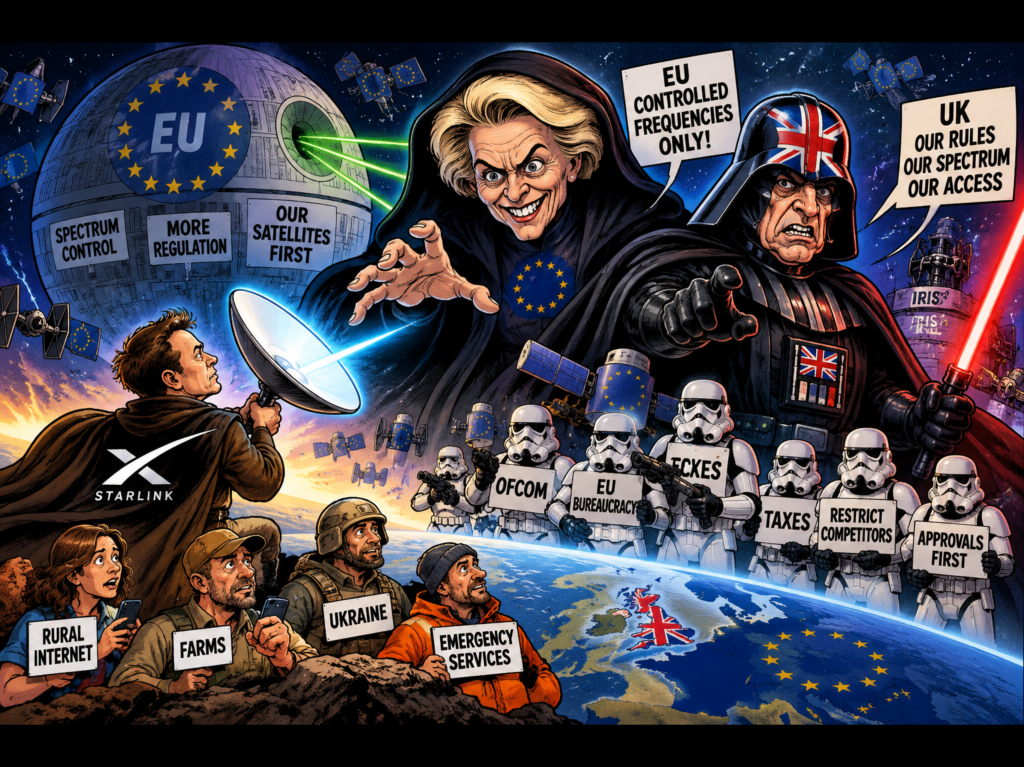
🛰️⚔️Europe is now trying to loosen its grip from Starlink’s celestial broadband empire, not because everyone’s garden dish is about to explode into regulatory confetti, but because the bigger question has finally landed like a rogue satellite: who controls the signals when things get serious? This is not a Europe-wide shutdown of household Starlink broadband. It is a power struggle over future satellite frequencies, mobile-phone-to-satellite services, secure communications, and whether Europe wants its emergency lifelines dangling from someone else’s off switch. 🚨📡
The Empire Strikes Broadband Back
🌍🛸So here we are: Europe has looked up at the night sky and realised the stars are not twinkling — they’re privately owned infrastructure with terms and conditions. Lovely.
The EU wants a slice of the 2 GHz mobile-satellite band kept under European control, which sounds boring until you remember that “boring frequency allocation” is often where the future gets quietly carved up while the rest of us are distracted by subscription prices and router lights. This is about satellites talking directly to phones, secure government services, commercial operators, and international competitors all elbowing each other in the orbital queue like it’s Black Friday at a space Costco. 🛒🚀
Meanwhile, Deutsche Telekom, Orange, Telefónica and Vodafone are circling the launchpad, exploring a joint bid for satellite spectrum. Translation: Europe’s telecom giants have noticed the space race and are now trying to find the keys to the rocket. They do not yet have a full replacement network. They still need a satellite partner. But they have produced the traditional corporate mating call: “exploring strategic options.” Majestic. 🦚📶
Then comes IRIS², the EU’s own secure satellite network project, designed to protect European digital independence and keep governments, emergency services and critical users connected during crises. In plain English: Europe wants a backup plan that does not require nervously refreshing an app owned by someone who might be having a very dramatic week online.
And after Ukraine’s recent Starlink and Starshield disruption, the “who can pull the plug?” question no longer feels theoretical. It feels like the sort of thing you ask before your battlefield comms, emergency networks or national infrastructure start buffering at the worst possible moment. Nothing says “strategic autonomy” like realising your crisis communications might depend on a billionaire’s mood, a regulatory dispute, or a satellite tantrum in low Earth orbit. 😬🛰️
Still, let’s not pretend the solution is easy. Building alternatives is sensible. Essential communications need dependable backup, public accountability and resilient control. But restricting competitors before the alternatives actually work? That risks leaving people with fewer choices, higher costs and a shiny European replacement network that exists mostly in PowerPoint, press releases and committee snacks. 🍪📊
And Britain? Different orbit entirely. EU decisions do not automatically decide UK access. The UK is handling its own satellite-frequency future through domestic rules and Ofcom, because apparently even the satellites must now respect post-Brexit paperwork. 🇬🇧📝
So yes, the Star Wars saga has begun — not with lightsabres, but with spectrum bands, telecom alliances, regulatory chess and the dawning realisation that whoever owns the signal may one day own the silence. 🌌⚡
🔥Challenges🔥
Who should control Europe’s emergency communications: governments, private giants, telecom alliances, or whoever can launch the most metal into the sky first? Is this smart independence, protectionist panic, or the beginning of a bureaucratic Death Star with roaming charges? Drop your take in the blog comments — especially if you can explain satellite spectrum without making everyone immediately age 40 years. 💬🛰️
👇 Comment, like, and share if you think Europe needs backup before the Wi-Fi wars go fully intergalactic.
The best comments will be included in the magazine. 🎯📝


Leave a Reply