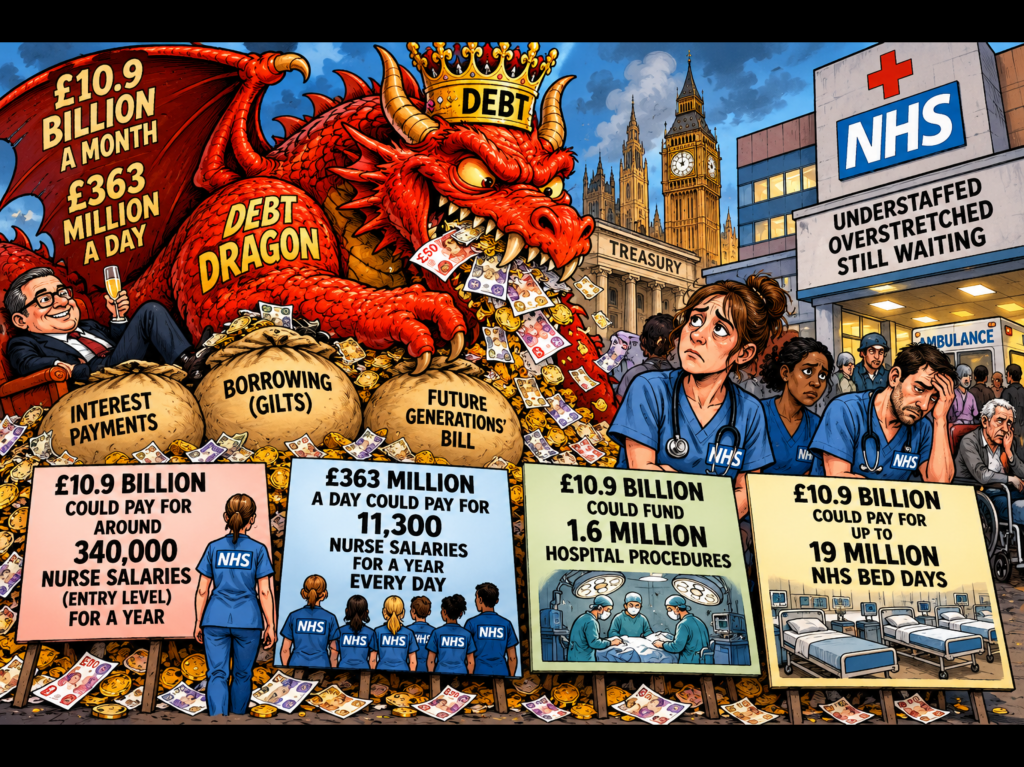
🐉🏥💷Britain’s latest reported debt-interest bill was £10.9 billion for September 2026—about £363 million a day. Not new hospitals. Not more nurses. Not faster cancer scans. Not an emergency department that doesn’t look like a coach station during a power cut. Just the cost of feeding the national debt beast while it lounges over the Treasury like Smaug with a spreadsheet. 🧾🔥
To put that in NHS terms: a newly qualified NHS nurse on the 2026/27 Agenda for Change Band 5 entry rate earns £32,073 a year, while the top Band 5 rate is £39,043. That means £10.9 billion is roughly equivalent to around 340,000 entry-level nurse salaries for a year, or about 279,000 top Band 5 nurse salaries. NHS Employers lists the official 2026/27 pay scales, and nursing pay guides show Band 5 nurses starting at £32,073 and rising to £39,043.
Imagine the Ward Round From Another Universe
🩺🚑For the same recorded monthly interest bill, you could theoretically fund nurse salaries on a scale so vast it would make every understaffed ward weep into its lukewarm tea.
That £363 million per day could cover about 11,300 newly qualified nurse annual salaries—every single day. One day of debt interest could fund a small city’s worth of nurses for a year. But instead, the money disappears into the financial furnace marked “servicing previous borrowing,” while real nurses sprint down corridors trying to be three people, a therapist, a technician, a cleaner, and a miracle with a pulse. 🏃♀️💉
And hospitals? The King’s Fund says the average cost of an elective inpatient procedure was estimated at £6,620 for 2024/25. At that rate, £10.9 billion is roughly equivalent to 1.6 million elective inpatient procedures. One month of recorded debt interest. Over a million operations. That is the sort of comparison that makes a waiting list cough nervously and hide behind a clipboard.
Even using a parliamentary answer estimating an NHS standard bed day at £345 from 2020/21 cost data, £10.9 billion would represent tens of millions of standard bed days. A later parliamentary estimate uplifted bed-day cost to £562, which would still make the September interest bill equivalent to roughly 19 million bed days. That is not a budget footnote. That is a parallel NHS made of money, beds, staff, and slightly fewer patients stuck in corridors wondering whether the vending machine counts as catering.
Of course, before someone in a grey suit waddles in shouting “Well actually,” no, you cannot simply cancel debt interest and hand the exact same cash to nurses tomorrow morning. Some of that September bill was inflation-linked accounting, not immediate cash out the door. Governments also have legal debt obligations, and bond markets do not accept payment in good intentions or ministerial jazz hands. 🎩📉
But that is exactly the point. Debt interest is not imaginary. It is a claim on the future. It is money that narrows choices. It is the invisible queue-jumper walking into the Treasury before hospitals, schools, councils, and nurses even get to the desk.
So when people ask why wards are stretched, why nurses burn out, why waiting lists grow teeth, and why every public service seems to be held together with tape, unpaid overtime, and one heroic receptionist named Linda, remember the Debt Dragon is eating first. 🐉🍽️
🔥Challenges🔥
Here’s the question that should make every taxpayer’s eyebrow leave their forehead: if one month’s debt-interest bill could theoretically match hundreds of thousands of nurse salaries or over a million hospital procedures, what does that say about the price of political delay, economic mismanagement, and pretending borrowing has no hangover?
Drop your take in the blog comments. Should Britain prioritise debt reduction, NHS funding, tax reform, or finally stop treating nurses like disposable angels with ID badges? 💬🩺
👇 Comment, like, and share—because if the Debt Dragon gets £363 million a day, the nurses deserve more than applause and a stale biscuit. 🍪🔥
The best comments will be included in the magazine. 🎯📝


Leave a Reply