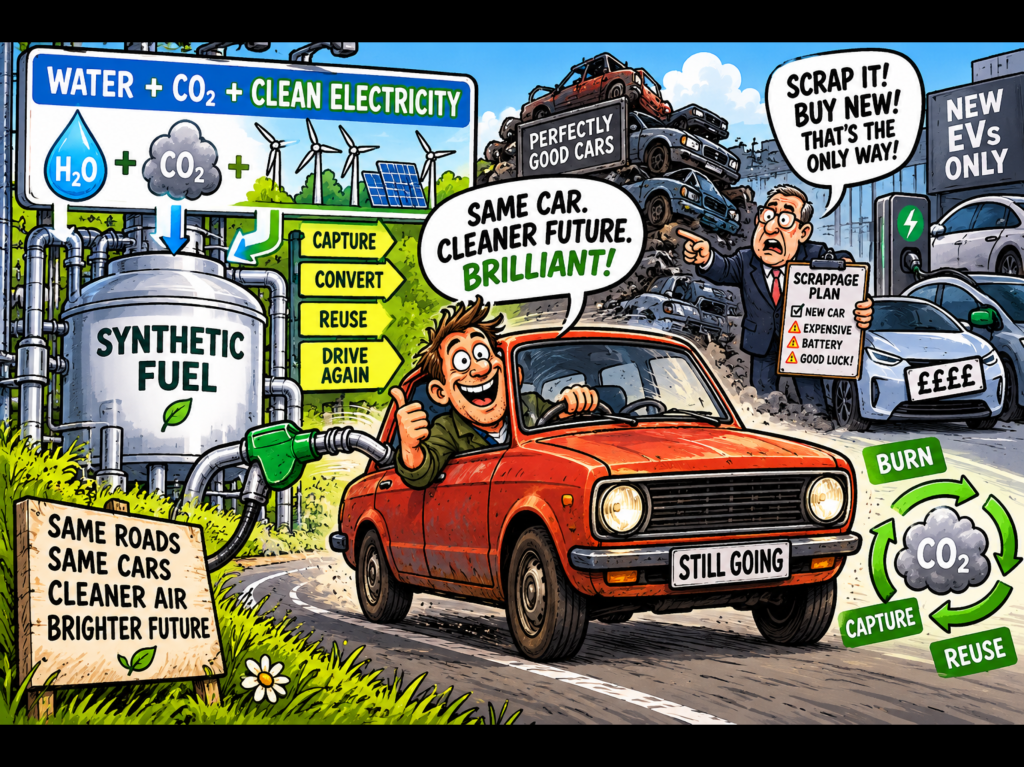
⛽🔄🚗What if the cleaner future didn’t begin with scrapping every car on the road and pretending everyone has a spare £40,000 hiding behind the sofa cushions? Synthetic fuel offers a fascinating middle lane: fuel made from water, captured carbon dioxide, and low-carbon electricity that could, in suitable engines, help the cars we already own keep moving with a smaller fossil footprint.
The Great “Keep Your Car” Rebellion Against Scrap-It-and-Start-Again Thinking
🛠️🌍For years, motorists have been told the road to environmental virtue is paved with brand-new vehicles, giant batteries, charging apps, and the quiet panic of wondering whether the nearest plug is broken, busy, or located behind a bin in a supermarket car park. 🔌😬
Synthetic fuel walks in like the awkward but useful cousin at the climate dinner table and says, “Actually, what about the cars already built?”
And that is not a small point. Millions of vehicles are already sitting on driveways, in car parks, and outside houses where people are trying to pay bills, not audition for a luxury technology advert. If a serviceable car can keep doing its job using cleaner, carefully produced fuel, that deserves more than a patronising pat on the bonnet.
The idea is beautifully circular in theory: take captured CO₂, combine it with hydrogen made from water using clean electricity, and produce fuel. Burn it, release CO₂, capture it again, and round we go — less fossil digging, more carbon recycling. Is it magic? No. Is it perfect? Also no. Is it potentially useful? Absolutely. ⚙️♻️
Of course, there are catches, because apparently the laws of physics refuse to be softened by a good press release. Synthetic fuel takes a lot of electricity. It costs more than conventional fuel. It still produces exhaust emissions. And if the electricity used to make it comes from dirty sources, the whole thing starts looking less like climate progress and more like greenwashing wearing a lab coat. 🧪🙄
But here is the part that often gets buried under the “electric or nothing” shouting match: not every transport problem has the same solution. Cars, vans, aircraft, ships, older vehicles, rural drivers, classic cars, emergency fleets, and people without easy charging access all live in the real world — a place policy sometimes visits briefly before returning to its heated conference room.
Synthetic fuel could help reduce reliance on freshly extracted oil while making use of existing engines, fuel stations, tanks, and supply networks. That is not a loophole. That is called using the infrastructure we already paid for. Revolutionary stuff, apparently. 🏗️⛽
The sensible answer is not to crown synthetic fuel king of the road or throw it into the bin because it fails someone’s purity test. The sensible answer is to investigate it properly, scale it honestly, regulate it carefully, and use it where it actually makes sense.
Because a cleaner future should not mean turning every working car into a guilt sculpture. Sometimes progress is not about replacing everything overnight. Sometimes it is about making what we already have work smarter. 🚗✨
🔥Challenges🔥
Here is the question that should make policymakers sweat into their recycled lanyards: why are we acting as though motorists only deserve one path to cleaner driving? Synthetic fuel might not be the silver bullet, but it could be one very useful tool in the box — especially for people who cannot simply swap their car, driveway, budget, or lifestyle on command.
Drop your take in the blog comments: is synthetic fuel a serious climate solution, a costly distraction, or the missing middle ground nobody wants to admit we need? 💬⚡
👇 Comment, like, and share — because the future of motoring should not be decided only by people who think “affordable transition” is a branding exercise.
The best comments will be included in the magazine. 🎯📝


Leave a Reply